Home › Resources › Defense in Depth
Defense in Depth
Layering overlapping controls so that no single failure exposes everything.
Lea esta ficha de referencia en español
Executive Summary
Defense in depth is the strategy of using multiple, overlapping security controls so that if one fails, others still protect the asset. It assumes that no single control is perfect and builds redundancy into the design. The goal is to make a successful attack require defeating many independent barriers rather than one.
What It Is
Defense in depth is a design principle borrowed from military strategy and applied to information security. Instead of relying on one strong wall, it stacks many layers of protection around what matters, spanning people, process, and technology. A phishing email might slip past an email filter, but a trained user, multi-factor authentication, endpoint detection, network segmentation, and least-privilege access each offer another chance to stop or limit the attack. Each layer is independent, so a weakness in one does not automatically mean total compromise.
Why It Matters
Every control eventually fails or gets bypassed. Patches lag, users click, tools misconfigure, and attackers adapt. Defense in depth accepts this reality and plans for it. For a business, it turns a single mistake from a catastrophe into a contained event. For professionals, it is one of the most common interview topics and a lens auditors and architects use constantly. It also underpins modern ideas like assuming breach, where teams design as if an attacker is already inside and rely on inner layers to limit the damage.
How It Works
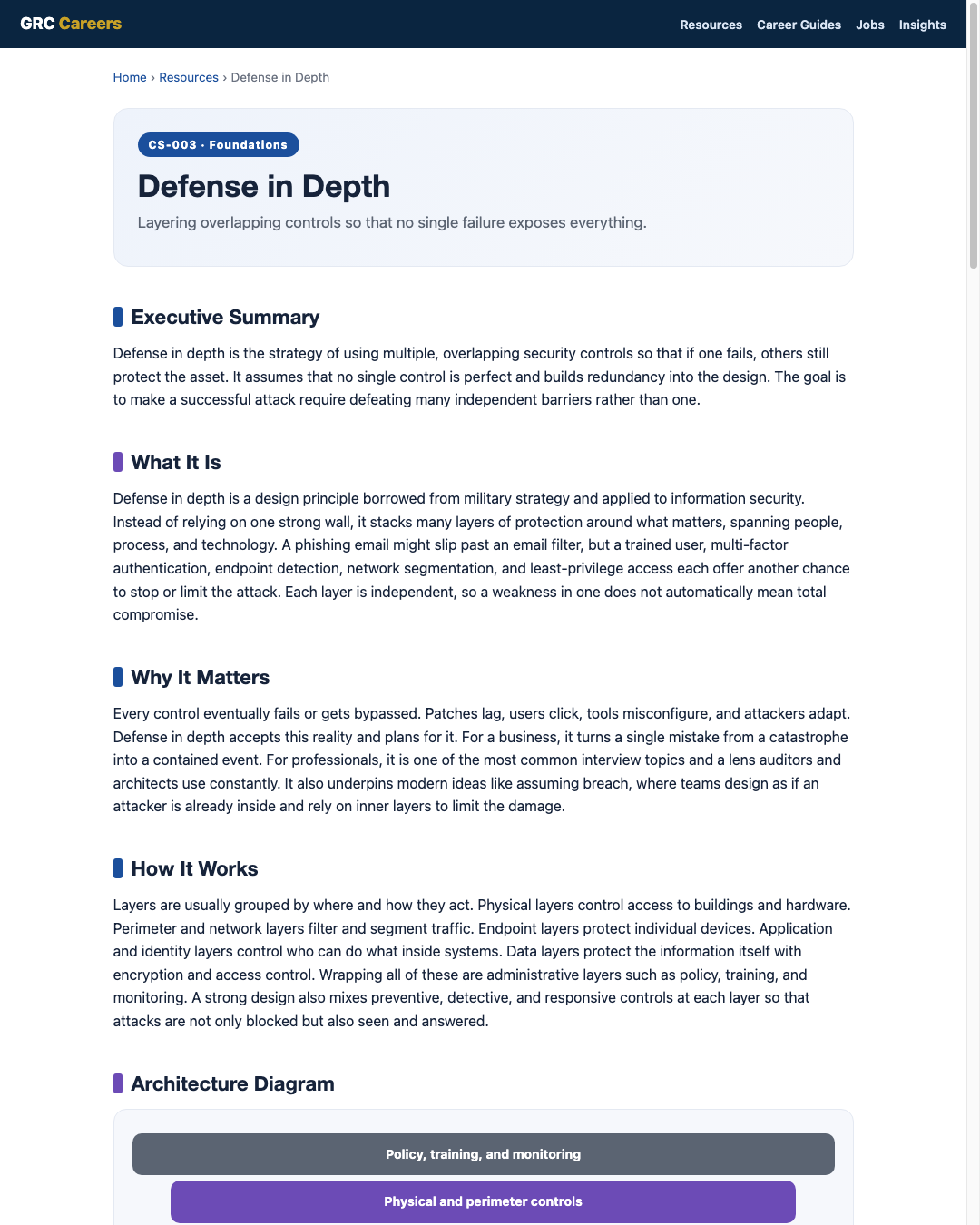
Layers are usually grouped by where and how they act. Physical layers control access to buildings and hardware. Perimeter and network layers filter and segment traffic. Endpoint layers protect individual devices. Application and identity layers control who can do what inside systems. Data layers protect the information itself with encryption and access control. Wrapping all of these are administrative layers such as policy, training, and monitoring. A strong design also mixes preventive, detective, and responsive controls at each layer so that attacks are not only blocked but also seen and answered.
Architecture Diagram
Visual Workflow
Common Attacks
- Phishing that bypasses one filter but is caught by MFA or user reporting
- Malware that evades antivirus but is caught by endpoint detection
- Lateral movement that is slowed by network segmentation
- Stolen credentials that are limited by least-privilege access
- Perimeter breaches that are contained before reaching sensitive data
Common Mistakes
- Investing heavily in the perimeter and leaving the interior flat and open
- Stacking controls that all fail the same way, giving false depth
- Adding only preventive layers with no detection or response
- Assuming more products equals more depth without checking coverage
- Neglecting the human and process layers while over-buying technology
Best Practices
- Combine preventive, detective, and responsive controls at each layer
- Segment networks so a breach in one area does not spread everywhere
- Enforce least privilege so a single account cannot reach everything
- Use diverse controls so they do not share the same weakness
- Include people and process as first-class layers, not afterthoughts
- Regularly test that inner layers hold when an outer one is bypassed
Quick Checklist
- Network segmentation separating critical systems from general access
- MFA and least privilege enforced on important accounts
- Endpoint detection in addition to basic antivirus
- Logging and monitoring at multiple layers, not just the perimeter
- Data encrypted so a network breach does not automatically expose it
- A tabletop or technical test that assumes one layer has failed
Recommended Tools
Filter and divide traffic to contain movement
Catches threats that slip past preventive controls on devices
Enforces least privilege as an inner defensive layer
Provides detection across multiple layers at once
Industry Standards
Control families support layered, overlapping safeguards
Prioritized controls that build defensive layers step by step
Encourages protection, detection, and response across layers
Career Relevance
Defense in depth is central to the work of security engineers, architects, SOC analysts, and penetration testers, and it is a frequent interview question at every level. GRC analysts and auditors use it to judge whether a control set has real depth or just a hard shell. It is also a core idea behind zero trust, which many governance and security roles now must understand.
Interview Questions
- What is defense in depth, and why is one control never enough?
- Give an example of layered controls stopping a phishing attack.
- How does network segmentation contribute to defense in depth?
- What is the difference between depth and simply buying more tools?
- How does defense in depth relate to the idea of assuming breach?
Related Certifications
Further Reading
- CISA: Layering Network Security (guidance)
- NIST SP 800-53 Control Catalog
- CIS Critical Security Controls
Key Takeaways
- Defense in depth layers many overlapping controls so no single failure is fatal.
- It assumes every control can fail and plans for that reality.
- Effective depth mixes preventive, detective, and responsive controls.
- People and process are layers too, not just technology.
- It underpins modern strategies like assume breach and zero trust.
FAQ
Is defense in depth the same as zero trust?
They are related but distinct. Defense in depth is the broad idea of layering controls. Zero trust is a specific modern approach that removes implicit trust and verifies every request. Zero trust uses layering, but adds strict identity and continuous verification.
Does defense in depth mean buying more security products?
No. Real depth comes from diverse, independent controls that fail in different ways, including people and process. Buying many similar tools that share the same weakness gives only the appearance of depth.
How many layers are enough?
There is no fixed number. The goal is that no single failure exposes a critical asset, and that attacks are both blocked and detected. Depth is judged by coverage and independence, not by a count of layers.
Related Careers
Related certifications
CompTIA Security+ISC2 CISSPISC2 Certified in Cybersecurity (CC)Current openings
Suggested learning path
- Ground the basics with CS-001 Cybersecurity
- Study this sheet: Defense in Depth
- Go deeper: Cybersecurity
- Go deeper: The CIA Triad
- Validate it: work toward CompTIA Security+
- Find the role: browse current openings