Home › Resources › The Cyber Kill Chain
The Cyber Kill Chain
The stages of an intrusion, and how breaking any one stage can stop the whole attack.
Lea esta ficha de referencia en español
Executive Summary
The cyber kill chain is a model that breaks a targeted intrusion into ordered stages, from early reconnaissance to the attacker's final objective. Its defensive value is that disrupting any single stage can stop the entire attack. It gives teams a structured way to think about detection and prevention across the whole intrusion, not just the moment of breach.
What It Is
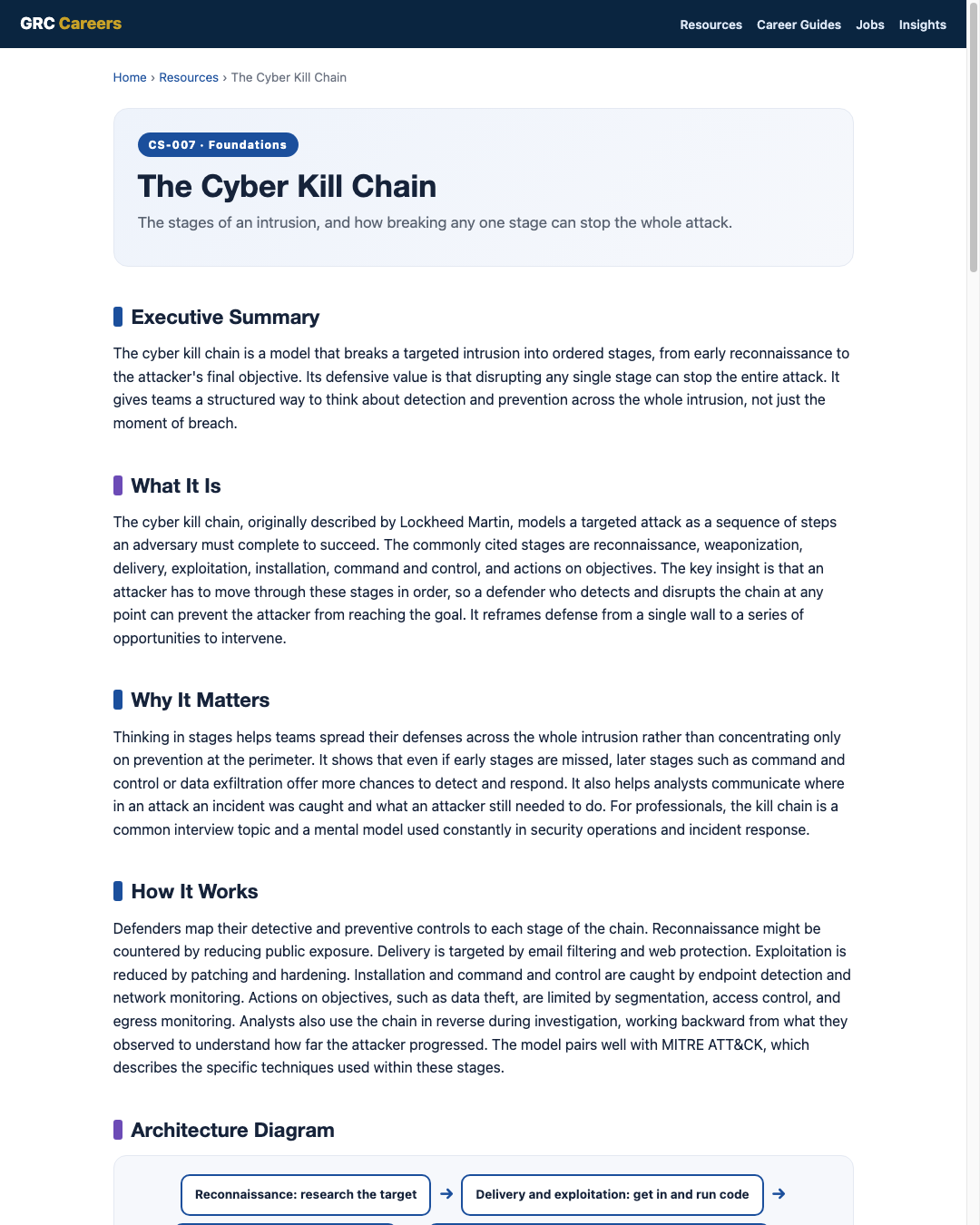
The cyber kill chain, originally described by Lockheed Martin, models a targeted attack as a sequence of steps an adversary must complete to succeed. The commonly cited stages are reconnaissance, weaponization, delivery, exploitation, installation, command and control, and actions on objectives. The key insight is that an attacker has to move through these stages in order, so a defender who detects and disrupts the chain at any point can prevent the attacker from reaching the goal. It reframes defense from a single wall to a series of opportunities to intervene.
Why It Matters
Thinking in stages helps teams spread their defenses across the whole intrusion rather than concentrating only on prevention at the perimeter. It shows that even if early stages are missed, later stages such as command and control or data exfiltration offer more chances to detect and respond. It also helps analysts communicate where in an attack an incident was caught and what an attacker still needed to do. For professionals, the kill chain is a common interview topic and a mental model used constantly in security operations and incident response.
How It Works
Defenders map their detective and preventive controls to each stage of the chain. Reconnaissance might be countered by reducing public exposure. Delivery is targeted by email filtering and web protection. Exploitation is reduced by patching and hardening. Installation and command and control are caught by endpoint detection and network monitoring. Actions on objectives, such as data theft, are limited by segmentation, access control, and egress monitoring. Analysts also use the chain in reverse during investigation, working backward from what they observed to understand how far the attacker progressed. The model pairs well with MITRE ATT&CK, which describes the specific techniques used within these stages.
Architecture Diagram
Visual Workflow
Common Attacks
- Phishing used for the delivery stage of an intrusion
- Exploitation of unpatched software to gain code execution
- Malware installation to establish a persistent foothold
- Command and control traffic used to direct compromised systems
- Data exfiltration or ransomware at the actions on objectives stage
Common Mistakes
- Focusing all defense on prevention at the earliest stages only
- Assuming a missed early stage means the attack cannot be stopped
- Having no detection for command and control or exfiltration
- Treating the model as rigid when real attacks can skip or reorder steps
- Using the chain to describe attacks but never mapping controls to it
Best Practices
- Distribute detection and prevention across every stage of the chain
- Invest in later-stage detection so early misses are not fatal
- Monitor for command and control and unusual outbound traffic
- Use segmentation and egress controls to limit actions on objectives
- Combine the kill chain with MITRE ATT&CK for technique-level detail
- Use the chain in investigations to measure how far an attacker got
Quick Checklist
- Controls mapped to each kill chain stage with gaps identified
- Email and web defenses covering the delivery stage
- Patching and hardening reducing exploitation
- Endpoint detection covering installation and foothold
- Network monitoring for command and control traffic
- Egress and data controls limiting exfiltration
Recommended Tools
Disrupt the delivery stage of intrusions
Catches installation and post-exploitation activity
Surfaces command and control and exfiltration
Correlates activity across stages into a coherent picture
Industry Standards
Technique-level detail that complements the kill chain stages
Incident handling guidance that uses staged thinking
Detect and Respond functions align with breaking the chain
Career Relevance
The cyber kill chain is core knowledge for SOC analysts, incident responders, threat hunters, and red teamers, who use it to structure detection and investigation. GRC analysts and risk professionals use it to reason about where controls sit in an attack. It is a frequent interview question and a shared vocabulary across defensive and offensive roles.
Interview Questions
- What are the stages of the cyber kill chain?
- Why does breaking a single stage stop the whole attack?
- Which stages are often missed, and how would you add coverage?
- How do the kill chain and MITRE ATT&CK relate to each other?
- How would you use the kill chain during an active investigation?
Related Certifications
Further Reading
Key Takeaways
- The kill chain models an intrusion as ordered stages an attacker must complete.
- Disrupting any single stage can stop the entire attack.
- Later-stage detection matters because early stages are often missed.
- It reframes defense as many chances to intervene, not one wall.
- It pairs well with MITRE ATT&CK for technique-level detail.
FAQ
Is the kill chain the same as MITRE ATT&CK?
No. The kill chain describes the high-level stages of an intrusion in order. MITRE ATT&CK is a detailed knowledge base of the specific techniques attackers use, many of which occur within those stages. They complement each other.
Do real attacks always follow the kill chain in order?
Not exactly. The model is a useful simplification. Real intrusions can skip, repeat, or reorder steps, and some stages blur together. It is still valuable as a framework for organizing defense and investigation.
Why focus on later stages if I can stop attacks early?
Because early prevention will sometimes fail. If the only defenses are at delivery and exploitation, a single miss lets the attacker run unopposed. Later-stage detection provides additional chances to catch and contain the intrusion.
Related Careers
Related certifications
CompTIA Security+GIAC Certified Incident Handler (GCIH)CompTIA CySA+Current openings
Suggested learning path
- Ground the basics with CS-001 Cybersecurity
- Study this sheet: The Cyber Kill Chain
- Go deeper: Cybersecurity
- Go deeper: Threat Actors
- Validate it: work toward CompTIA Security+
- Find the role: browse current openings