Home › Resources › Attack Surface
Attack Surface
Every point where an attacker could try to get in, and why shrinking it is a core defense.
Lea esta ficha de referencia en español
Executive Summary
The attack surface is the total set of points where an unauthorized user could try to enter or extract data from a system. It includes software, services, accounts, devices, and people. A smaller, well-understood attack surface is easier to defend, which makes reducing it one of the most effective and cost-efficient security strategies.
What It Is
The attack surface is the sum of all the ways an attacker could interact with a system to try to compromise it. It is usually described in a few categories. The digital attack surface includes exposed applications, open ports, APIs, cloud services, and unpatched software. The physical attack surface includes devices, ports, and hardware an attacker could reach in person. The human attack surface includes the people who can be phished, tricked, or coerced. Every account, every internet-facing service, and every third-party connection adds to it. Attack surface management is the ongoing practice of discovering, monitoring, and shrinking these exposures.
Why It Matters
Attackers do not need to break every defense, only to find one weak, exposed point. As organizations adopt cloud services, remote work, and countless integrations, their attack surface expands quickly and often invisibly. Forgotten servers, test environments, and abandoned accounts are common entry points precisely because no one is watching them. Reducing the attack surface lowers the number of things that can go wrong and the amount that must be defended and monitored. For professionals, understanding and mapping the attack surface is foundational work in security operations, engineering, and risk.
How It Works
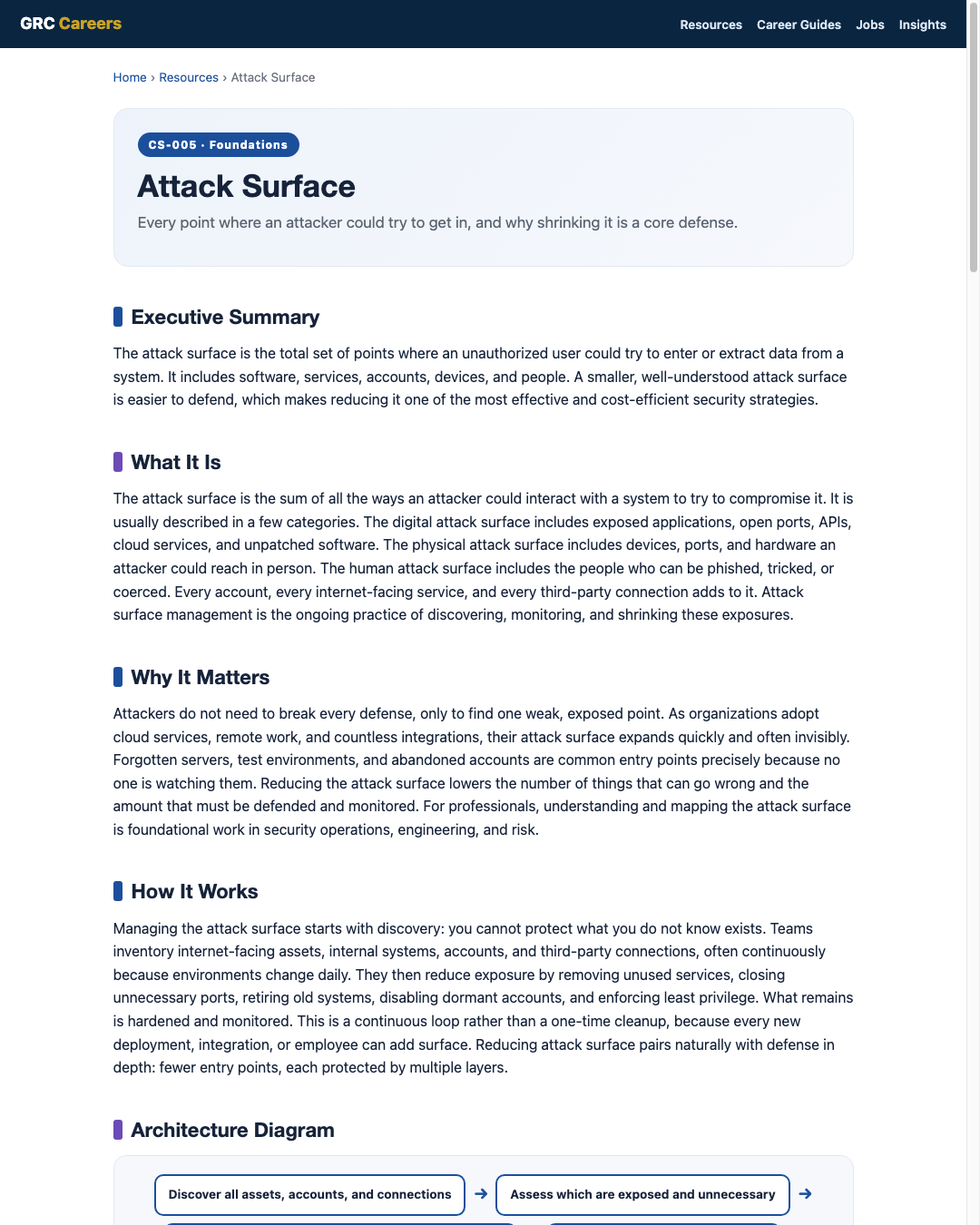
Managing the attack surface starts with discovery: you cannot protect what you do not know exists. Teams inventory internet-facing assets, internal systems, accounts, and third-party connections, often continuously because environments change daily. They then reduce exposure by removing unused services, closing unnecessary ports, retiring old systems, disabling dormant accounts, and enforcing least privilege. What remains is hardened and monitored. This is a continuous loop rather than a one-time cleanup, because every new deployment, integration, or employee can add surface. Reducing attack surface pairs naturally with defense in depth: fewer entry points, each protected by multiple layers.
Architecture Diagram
Visual Workflow
Common Attacks
- Exploitation of a forgotten or shadow internet-facing server
- Abuse of open ports or unnecessary exposed services
- Compromise of dormant or over-permissioned accounts
- Attacks through vulnerable third-party integrations and APIs
- Phishing that targets the human part of the attack surface
Common Mistakes
- Not knowing the full inventory, so shadow assets go undefended
- Leaving unused services, ports, and test systems exposed
- Keeping dormant accounts and default credentials active
- Treating attack surface as a one-time audit instead of continuous
- Ignoring third-party and supply chain connections in the surface
Best Practices
- Maintain a current, owned inventory of assets and accounts
- Continuously discover internet-facing exposure, including shadow IT
- Remove unnecessary services, ports, and legacy systems
- Disable dormant accounts and enforce least privilege
- Include third-party and API connections in surface assessments
- Reduce the human attack surface with training and phishing-resistant MFA
Quick Checklist
- Current inventory of internet-facing assets and services
- Unnecessary ports and services closed or removed
- Dormant and default accounts disabled
- Third-party integrations reviewed and minimized
- Continuous external scanning or attack surface monitoring in place
- Regular review that identifies and retires shadow or legacy assets
Recommended Tools
Continuously discover and track external exposure
Find weaknesses across discovered assets
Maintain a record of what exists and who owns it
Surfaces misconfigured or exposed cloud resources
Industry Standards
Inventory and configuration controls that reduce exposure
Configuration and least-privilege controls that shrink surface
Identify function covers asset inventory and exposure
Career Relevance
Attack surface work is central to SOC analysts, security engineers, penetration testers, and vulnerability managers, who discover, prioritize, and reduce exposure daily. GRC analysts and auditors assess whether inventory and reduction practices exist and work. Understanding attack surface is expected across nearly every security role and is a common interview topic.
Interview Questions
- What is an attack surface, and what does it include beyond software?
- Why does the attack surface tend to grow over time?
- How would you discover internet-facing assets you did not know about?
- What are practical ways to reduce an organization's attack surface?
- How do third parties and APIs factor into the attack surface?
Related Certifications
Further Reading
Key Takeaways
- The attack surface is every point an attacker could use to get in.
- It spans digital, physical, and human exposure.
- It grows quietly through cloud, integrations, and forgotten assets.
- Reducing it is one of the most cost-effective defenses available.
- Managing it is a continuous loop of discover, reduce, harden, and monitor.
FAQ
How is attack surface different from vulnerability?
The attack surface is all the points where an attacker could try to interact with a system. A vulnerability is a specific weakness in one of those points. Reducing the attack surface lowers how many places a vulnerability could even exist.
Can the attack surface ever be zero?
No useful system has a zero attack surface, because any service that people can use can also be probed. The goal is to keep the surface as small and well-monitored as the function of the system allows.
What is shadow IT and why does it matter here?
Shadow IT is technology adopted without the security team's knowledge, such as an unsanctioned cloud service. It matters because it adds attack surface that no one is watching or hardening, making it a frequent entry point.
Related Careers
Related certifications
CompTIA Security+ISC2 Certified in Cybersecurity (CC)CompTIA PenTest+ (for offensive tracks)Current openings
Suggested learning path
- Ground the basics with CS-001 Cybersecurity
- Study this sheet: Attack Surface
- Go deeper: Cybersecurity
- Go deeper: Defense in Depth
- Validate it: work toward CompTIA Security+
- Find the role: browse current openings