Home › Resources › Cyber Hygiene
Cyber Hygiene
The routine, everyday practices that prevent the majority of common attacks.
Lea esta ficha de referencia en español
Executive Summary
Cyber hygiene is the set of routine, consistent practices that keep systems and accounts healthy and resistant to attack, much like personal hygiene prevents illness. It covers basics such as strong authentication, patching, backups, least privilege, and awareness. Done reliably, these ordinary habits prevent the large majority of common incidents.
What It Is
Cyber hygiene refers to the everyday maintenance practices that keep an organization's security posture strong over time. It is deliberately unglamorous: keeping software updated, using multi-factor authentication, managing passwords well, maintaining an accurate inventory, limiting access to what is needed, backing up important data, and training people to recognize threats. The idea is that consistency matters more than sophistication. Most successful attacks exploit basic gaps, such as an unpatched system, a reused password, or a missing second authentication factor, rather than exotic techniques.
Why It Matters
A large share of real-world breaches trace back to lapses in basics rather than advanced attacks. Attackers prefer the easy path, and poor hygiene provides it. Good hygiene also multiplies the value of every other security investment, because advanced tools cannot compensate for unpatched systems or shared credentials. For smaller organizations with limited budgets, hygiene is the highest-return security work available. For professionals, the ability to design and sustain hygiene programs is a practical, valued skill, and interviewers often probe whether a candidate understands that fundamentals prevent more harm than any single product.
How It Works
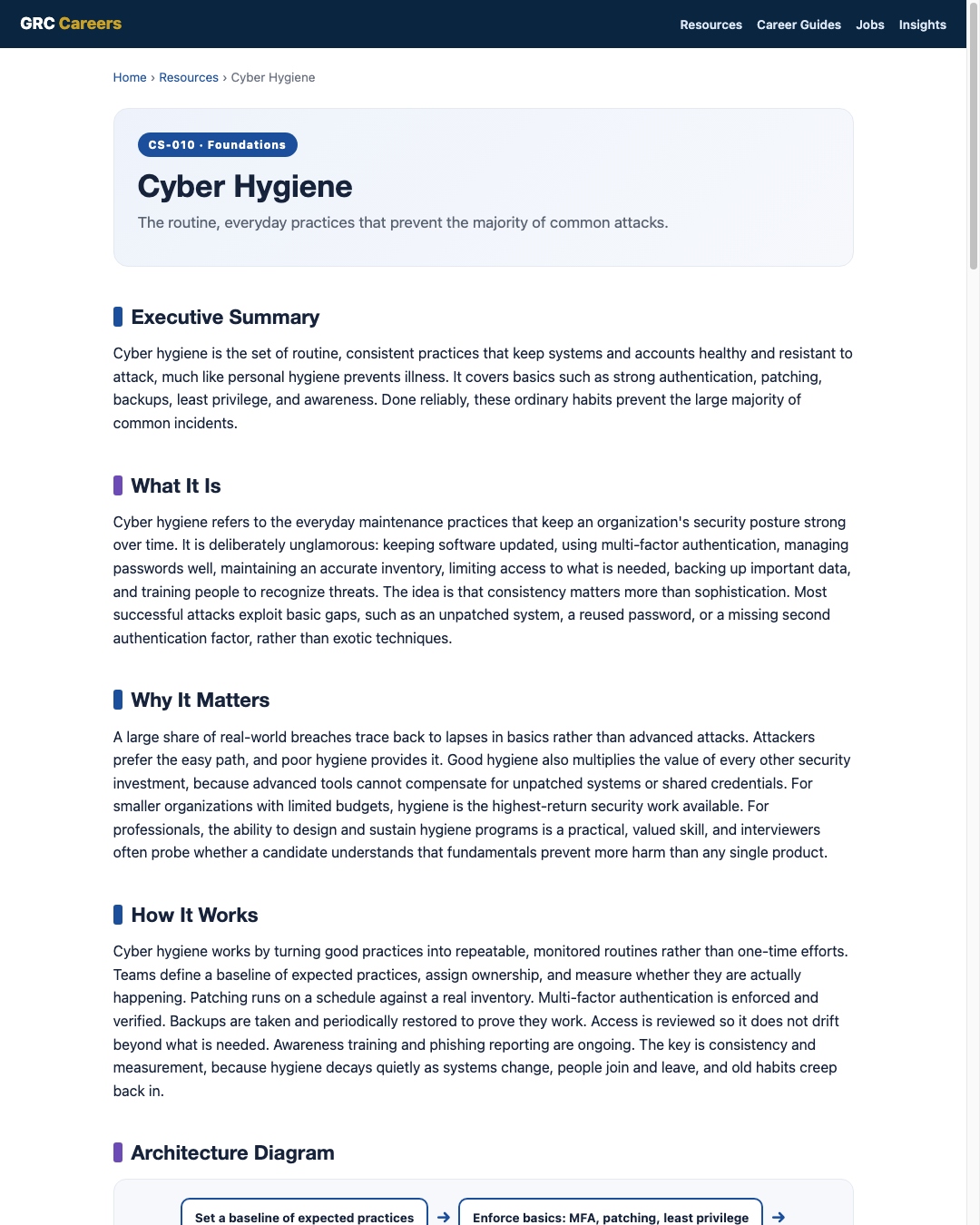
Cyber hygiene works by turning good practices into repeatable, monitored routines rather than one-time efforts. Teams define a baseline of expected practices, assign ownership, and measure whether they are actually happening. Patching runs on a schedule against a real inventory. Multi-factor authentication is enforced and verified. Backups are taken and periodically restored to prove they work. Access is reviewed so it does not drift beyond what is needed. Awareness training and phishing reporting are ongoing. The key is consistency and measurement, because hygiene decays quietly as systems change, people join and leave, and old habits creep back in.
Architecture Diagram
Visual Workflow
Common Attacks
- Account takeover using reused or weak passwords without MFA
- Exploitation of systems that were never patched
- Ransomware made worse by untested or missing backups
- Phishing that succeeds against untrained users
- Abuse of excess access that was granted and never reviewed
Common Mistakes
- Treating hygiene as a one-time cleanup rather than an ongoing routine
- Enabling MFA in some places but not on the most-attacked accounts
- Patching inconsistently or against an incomplete inventory
- Assuming backups work without ever testing a restore
- Letting access accumulate as people change roles
Best Practices
- Enforce multi-factor authentication on all important accounts
- Patch promptly on a defined schedule against a real inventory
- Use a password manager and eliminate reused or weak passwords
- Apply least privilege and review access regularly
- Maintain and regularly test backups of important data
- Run ongoing awareness training and make reporting suspicious activity easy
Quick Checklist
- MFA enabled on email, admin, and remote access accounts
- Patching schedule in place with an accurate asset inventory
- Password manager in use and reused passwords eliminated
- Access reviewed and trimmed to least privilege
- Backups taken and a real restore tested recently
- Ongoing security awareness training and an easy way to report phishing
Recommended Tools
Strengthens the most-attacked control, credentials
Keep systems current on a reliable schedule
Protect data and enable recovery, when restores are tested
Build and measure user readiness
Industry Standards
Practical, prioritized basics that define good hygiene
Baseline outcomes across Protect and Recover
Accessible starting guidance for foundational practices
Career Relevance
Cyber hygiene is the daily reality of IT and security operations, SOC analysts, and system administrators, and it is the practical core of what GRC analysts and auditors assess. It matters in every role, since even non-security staff practice hygiene through passwords, updates, and awareness. Demonstrating that you value and can sustain fundamentals is a strong signal in interviews across security, IT, and governance.
Interview Questions
- What is cyber hygiene, and why does it prevent most attacks?
- Which hygiene practices give the highest return for the effort?
- How would you keep patching consistent across a changing environment?
- Why is testing backups as important as taking them?
- How do you keep access from drifting beyond least privilege over time?
Related Certifications
Further Reading
Key Takeaways
- Cyber hygiene is routine maintenance that keeps security strong over time.
- Most attacks exploit basic gaps, not advanced techniques.
- Consistency and measurement matter more than sophistication.
- Backups only count when restores are actually tested.
- Hygiene is the highest-return security work, especially on a limited budget.
FAQ
Is cyber hygiene enough on its own?
For many small organizations it prevents most common incidents and is the best place to start. Larger or higher-risk organizations need it plus more advanced detection and response, but even they cannot succeed without strong hygiene underneath.
What is the single most impactful hygiene practice?
There is no single answer for every case, but enforcing multi-factor authentication and patching known vulnerabilities consistently stop a very large share of common attacks. Reliable, tested backups are close behind for limiting damage.
Why does hygiene decay over time?
Environments change constantly. New systems appear, people join and leave, and access accumulates. Without ownership, measurement, and routine review, practices that were once solid quietly slip, which is why hygiene must be ongoing.
Related Careers
Related certifications
CompTIA Security+ISC2 Certified in Cybersecurity (CC)CompTIA A+ (for IT foundations)Current openings
Suggested learning path
- Ground the basics with CS-001 Cybersecurity
- Study this sheet: Cyber Hygiene
- Go deeper: Cybersecurity
- Go deeper: The CIA Triad
- Validate it: work toward CompTIA Security+
- Find the role: browse current openings