
Home › Career Guides › AI Security Architect Career Guide
AI Security Architect Career Guide
A GRC Careers roadmap
Artificial intelligence is rapidly becoming part of the enterprise technology stack. Organizations are deploying generative AI assistants, autonomous agents, machine learning models, and intelligent applications at an unprecedented pace. Unfortunately, attackers are evolving just as quickly.
Traditional cybersecurity programs were designed to protect networks, servers, endpoints, and applications. AI introduces an entirely new attack surface: prompt injection, model theft, adversarial attacks, data poisoning, insecure APIs, and AI agents operating with excessive privileges. That is why one of the fastest-growing cybersecurity careers today is the AI Security Architect, a role that combines enterprise security architecture with AI engineering, cloud security, governance, and risk management to ensure AI systems are secure by design rather than secured after deployment.
What Does an AI Security Architect Do?
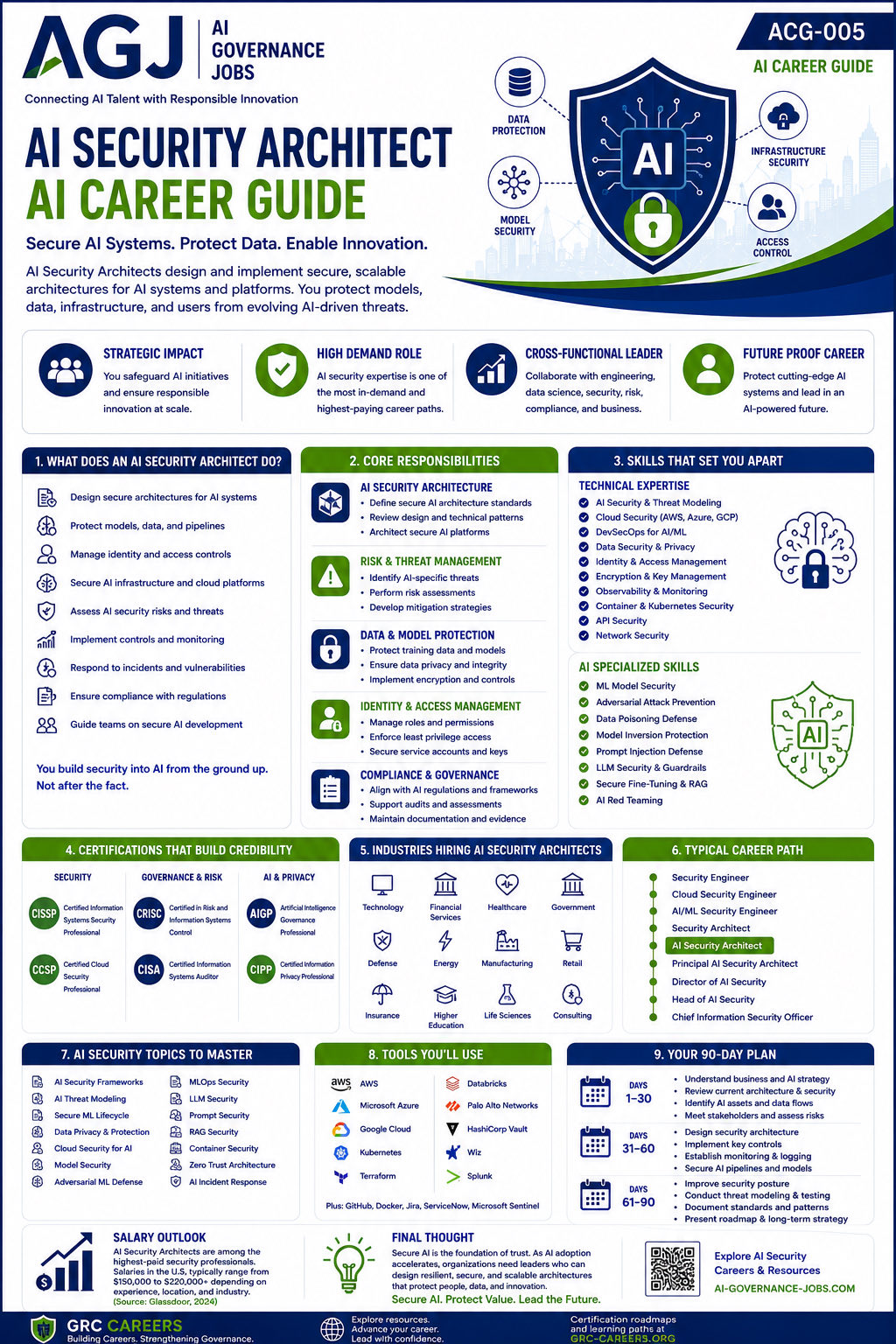
An AI Security Architect designs the security strategy for artificial intelligence systems throughout their lifecycle. Rather than focusing on traditional infrastructure alone, this role secures the entire AI ecosystem, including models, data pipelines, cloud environments, APIs, autonomous agents, and the people who interact with them. Typical responsibilities include:
- Designing secure AI architectures
- Performing AI threat modeling
- Protecting training data and foundation models
- Securing AI development pipelines
- Implementing identity and access controls
- Defending against prompt injection and adversarial attacks
- Supporting AI governance initiatives
- Developing AI security standards
- Collaborating with engineering, legal, compliance, and internal audit
Think of this position as the chief architect responsible for building secure foundations before AI systems ever reach production.
Why Organizations Are Hiring AI Security Architects
Many companies rushed into AI adoption before fully understanding the associated risks. Today, executive leadership is asking difficult questions: Can our AI systems be manipulated? Could proprietary data leak into public models? What happens if an AI agent receives administrator privileges? How do we secure hundreds of employees using generative AI every day? These questions require expertise that bridges cybersecurity and artificial intelligence, and the AI Security Architect provides the answers.
The New AI Threat Landscape
Unlike traditional applications, AI systems introduce risks that most security teams have never encountered before.
Prompt Injection
Attackers manipulate prompts to bypass safety controls or force AI systems to reveal confidential information.
Data Poisoning
Malicious data is introduced into training datasets to influence future AI behavior.
Model Theft
Organizations invest millions in proprietary models that become valuable intellectual property targets.
Adversarial Machine Learning
Small, carefully crafted changes to inputs can cause AI systems to produce incorrect or dangerous outputs.
AI Supply Chain Risk
Organizations increasingly depend on third-party models, APIs, plugins, and open-source components that may introduce vulnerabilities.
Autonomous Agent Risk
AI agents capable of taking actions across enterprise systems require strong identity management and least-privilege access controls.
Core Responsibilities
Most AI Security Architects divide their work across five major areas:
- Secure Architecture: Design secure AI platforms, cloud environments, APIs, and deployment pipelines that follow security-by-design principles.
- AI Risk Management: Identify emerging threats, perform risk assessments, conduct threat modeling, and prioritize remediation.
- Identity and Access Management: Ensure AI systems operate with appropriate permissions while protecting credentials, APIs, and privileged accounts.
- Data and Model Protection: Secure training data, prevent unauthorized model access, implement encryption, and protect intellectual property.
- Governance and Compliance: Align security controls with governance frameworks, regulatory requirements, and internal policies.
Skills That Separate Great AI Security Architects
Cybersecurity: Zero Trust architecture, identity and access management, cloud security, DevSecOps, network security, API security, security architecture, threat modeling.
Artificial Intelligence: Large Language Models, machine learning fundamentals, prompt security, AI agents, Retrieval Augmented Generation (RAG), MLOps, AI guardrails, model lifecycle management.
Leadership: Enterprise architecture, executive communication, cross-functional collaboration, risk management, strategic planning, vendor management, governance.
The strongest candidates are comfortable speaking with software engineers one hour and executive leadership the next.
Certifications That Strengthen Your Resume
No single certification qualifies someone for AI Security Architecture, but several demonstrate expertise across complementary disciplines:
- AI Governance: Artificial Intelligence Governance Professional (AIGP)
- Cybersecurity: CISSP, CCSP, GIAC Cloud Security Automation
- Governance and Risk: CISA, CRISC
- Cloud Platforms: AWS Certified Security Specialty, Microsoft Cybersecurity Architect Expert, Google Professional Cloud Security Engineer
Technologies You Will Use
AI Security Architects work across multiple platforms, including Microsoft Azure, AWS, Google Cloud, Kubernetes, Docker, Terraform, HashiCorp Vault, GitHub Enterprise, Microsoft Defender, Microsoft Sentinel, CrowdStrike, Palo Alto Cortex, Wiz, and Splunk. Generative AI platforms such as Claude, ChatGPT, and Microsoft Copilot are increasingly part of daily workflows as well.
Industries Hiring AI Security Architects
Demand spans nearly every industry adopting AI at scale: financial services, healthcare, technology, government, defense contractors, insurance, manufacturing, energy, telecommunications, life sciences, consulting, and critical infrastructure. Organizations in highly regulated environments are among the earliest adopters, because AI security has become closely tied to compliance, operational resilience, and enterprise risk management.
Career Progression
Many professionals enter AI Security Architecture from cybersecurity or cloud engineering roles. A common progression: Security Analyst, then Security Engineer, then Cloud Security Engineer, then Security Architect, then AI Security Architect, then Principal AI Security Architect, then Director of AI Security, and ultimately Chief Information Security Officer (CISO). Professionals with backgrounds in DevSecOps, cloud security, enterprise architecture, AI engineering, or security consulting often transition into this role successfully.
The Future of AI Security
Artificial intelligence is changing cybersecurity just as dramatically as cloud computing did a decade ago. Organizations are beginning to recognize that AI cannot simply be governed; it must also be secured from design through deployment and continuous operation. As AI regulations mature and attackers grow more sophisticated, AI Security Architects will become central to enterprise resilience, shaping how organizations protect sensitive data, secure intelligent systems, maintain regulatory compliance, and preserve stakeholder trust. For cybersecurity professionals looking to future-proof their careers, few opportunities offer this combination of technical challenge, strategic impact, and long-term demand.
Related Resources
Continue building your expertise: NIST AI RMF vs. ISO/IEC 42001, ISO/IEC 42001 and the EU AI Act, the Responsible AI Framework Map, and the full AI Career Guide Library.
Frequently Asked Questions
What does an AI Security Architect do?
An AI Security Architect designs and implements secure, scalable architectures for AI systems and platforms, protecting models, data, infrastructure, and users from evolving AI-driven threats. They build security into AI from the ground up rather than adding it after deployment.
What certifications does an AI Security Architect need?
Core security credentials include CISSP and CCSP, complemented by CRISC and CISA for governance and risk, and AIGP and CIPP for AI governance and privacy.
What is the career path to AI Security Architect?
A common path runs Security Engineer, Cloud Security Engineer, AI/ML Security Engineer, Security Architect, and then AI Security Architect, advancing to Principal AI Security Architect, Director or Head of AI Security, and Chief Information Security Officer.
What specialized skills do AI Security Architects need?
Beyond cloud and network security, AI Security Architects need AI-specific skills like ML model security, adversarial attack prevention, data poisoning defense, model inversion protection, prompt injection defense, LLM security and guardrails, secure fine-tuning and RAG, and AI red teaming.