
| Title | Chief Information Officer (CIO) |
|---|---|
| Department | Information Technology / Executive Leadership |
| Reports to | [Chief Executive Officer / Chief Operating Officer / Board] |
| Location | [Remote / Hybrid / On-site] |
| Employment type | Full-time |
| Salary | [Salary range. Postings with a range perform significantly better, and several states require one.] |
Position overview
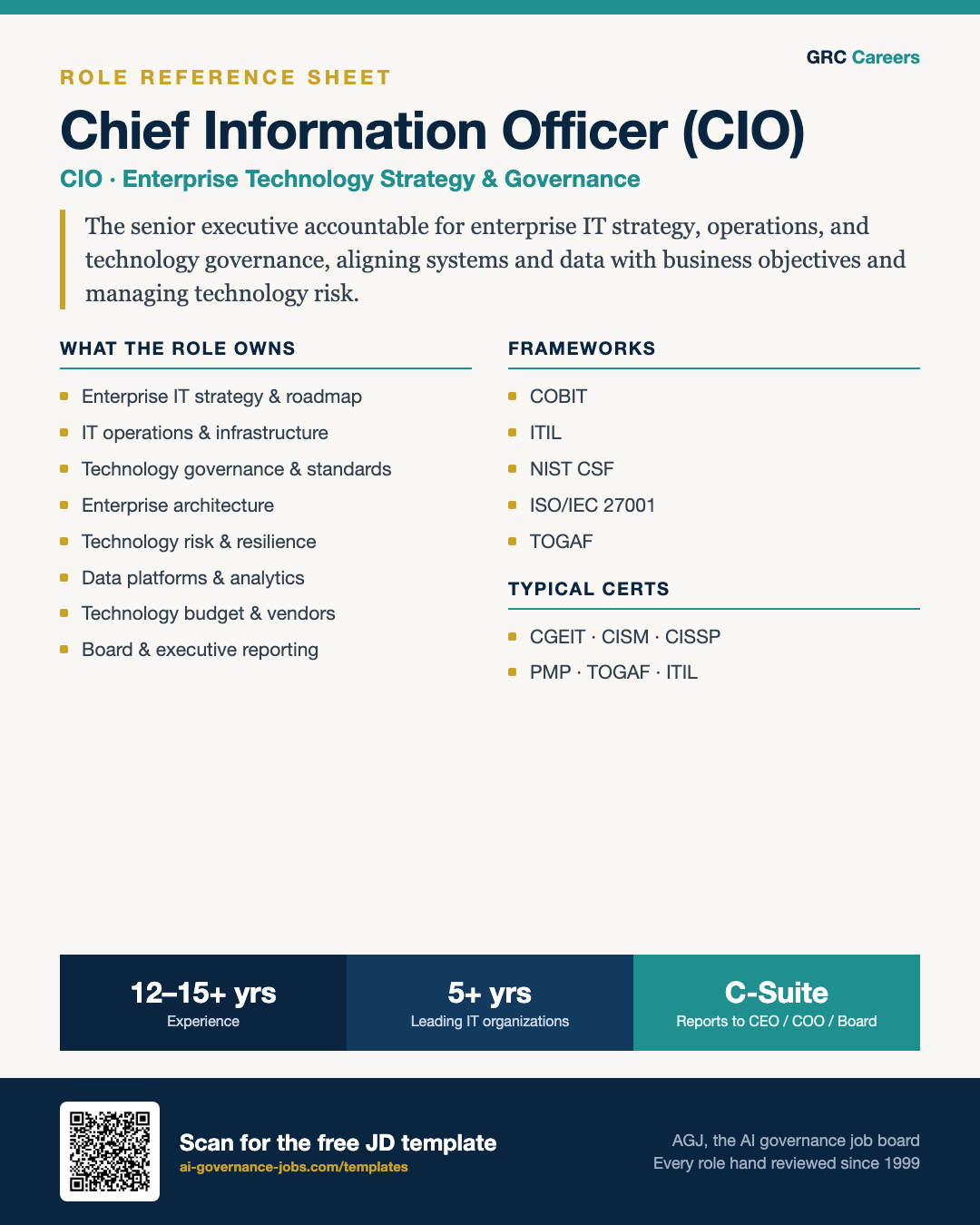
The Chief Information Officer (CIO) provides executive leadership for [Company]'s information technology strategy, operations, and governance. This role sets the direction for enterprise systems, infrastructure, applications, and data platforms in support of business objectives.
The CIO partners closely with executive leadership, business unit heads, security, risk, compliance, and finance to align technology investment with strategy, manage operational and cyber risk, and deliver measurable value from the technology portfolio.
As technology becomes central to competitive advantage, the CIO serves as the organization's senior authority on IT strategy, digital transformation, and the controls that govern how systems and data are managed.
Key responsibilities
Technology strategy
- Develop and execute the enterprise IT strategy and multi-year roadmap.
- Align technology investment with business objectives and priorities.
- Lead digital transformation and modernization initiatives.
- Set enterprise architecture standards and technology governance policies.
- Present technology strategy and performance to executive leadership and the Board.
IT operations
Direct the reliable, secure operation of enterprise systems and services, including:
- Infrastructure, networks, cloud platforms, and data centers
- Enterprise applications, ERP, and business systems
- Service management, availability, and operational resilience
- Capacity planning, performance, and end-user support
Technology governance
- Establish IT governance policies, standards, and controls.
- Oversee the technology investment and project portfolio.
- Ensure alignment with COBIT and ITIL practices.
- Maintain executive dashboards and technology reporting.
Cybersecurity and risk oversight
Partner with security and risk leaders to oversee enterprise technology risk, including cybersecurity posture, access management, data protection, business continuity, disaster recovery, and third-party technology risk.
Data and information management
- Set enterprise data management and governance standards.
- Oversee data platforms, analytics, and reporting capabilities.
- Ensure information is accurate, available, and appropriately protected.
- Support data-driven decision making across the business.
Vendor and financial management
Manage the technology budget, vendor relationships, and sourcing strategy, including contract negotiation, service level oversight, cost optimization, and concentration risk across major technology providers.
Team leadership
Build and lead the technology organization, including talent development, organizational design, workforce planning, and a culture of service, security, and continuous improvement.
Required qualifications
- Bachelor's degree in Computer Science, Information Systems, Engineering, Business, or a related discipline. Master's degree or MBA preferred.
- 12 to 15+ years of progressive experience in information technology, including senior leadership roles.
- 5+ years leading enterprise technology functions or large IT organizations.
- Experience briefing executive leadership and Boards of Directors.
- Strong understanding of enterprise architecture, cloud, cybersecurity, and data platforms.
- Track record of delivering technology strategy and transformation in complex organizations.
Preferred certifications
One or more of: CGEIT, CISM, CISSP, CDPSE, PMP, TOGAF, ITIL, or COBIT certification.
Technical knowledge
Enterprise architecture, cloud computing, IT infrastructure, enterprise applications and ERP, cybersecurity, data management and analytics, IT service management, technology governance, IT risk management, vendor management, budgeting and financial management, and digital transformation.
Essential competencies
Strategic leadership, executive communication, Board presentation skills, business alignment, change leadership, program management, negotiation and influence, and sound technology decision making.
Success measures: first 12 months
- Establish or refresh the enterprise IT strategy and roadmap.
- Assess technology risk, security posture, and operational resilience.
- Strengthen IT governance, standards, and portfolio oversight.
- Deliver priority modernization or transformation initiatives.
- Improve system availability, performance, and service quality.
- Optimize technology spend and vendor relationships.
- Build executive and Board technology reporting.
- Develop the technology team and organizational capabilities.
About [Company]
[Two or three sentences about your organization, the maturity of your program, and what the first year looks like. Candidates in this field respond to honesty about whether they are joining a build or an established function.]
Post this role on GRC Careers
Reach professionals who specialize in enterprise IT strategy and technology governance rather than hoping they find you in a general feed. Hand reviewed, live within one business day.
See how others are hiring
Review live GRC leadership jobs postings to benchmark scope, level, and posted salary before you publish yours.
Stay close to the market
Job alerts
Get new GRC leadership jobs roles sent to you as they post.
Newsletter
Hiring trends, salary signals, and new templates from GRC Careers.
Frequently asked questions
What does a Chief Information Officer (CIO) do?
The Chief Information Officer sets and executes the enterprise technology strategy. They lead IT operations, infrastructure, applications, and data platforms, and establish the governance and controls that keep information systems secure, reliable, and aligned with business goals.
What qualifications and certifications does a CIO need?
Most CIOs bring 12 to 15 or more years in information technology, including at least 5 years leading enterprise IT functions. Common certifications include CGEIT, CISM, CISSP, PMP, TOGAF, and ITIL, and many hold an MBA or a graduate degree in a technical discipline.
Who does a Chief Information Officer report to?
The CIO typically reports to the Chief Executive Officer, the Chief Operating Officer, or the Board, and partners closely with the CISO, CTO, and business unit leaders.
What frameworks does a CIO use?
Common reference frameworks include COBIT and ITIL for IT governance and service management, the NIST Cybersecurity Framework and ISO/IEC 27001 for security, and TOGAF for enterprise architecture.
Want to edit it, not just read it?
Copying from the page works, and this template stays free. But if you want the real thing to make your own, the editable Word file is in the toolkit, along with all 44 job descriptions, 38 career guides, 21 reference sheets, and 16 executive briefs. Yours to adapt, rename, and reuse, commercially, forever.