
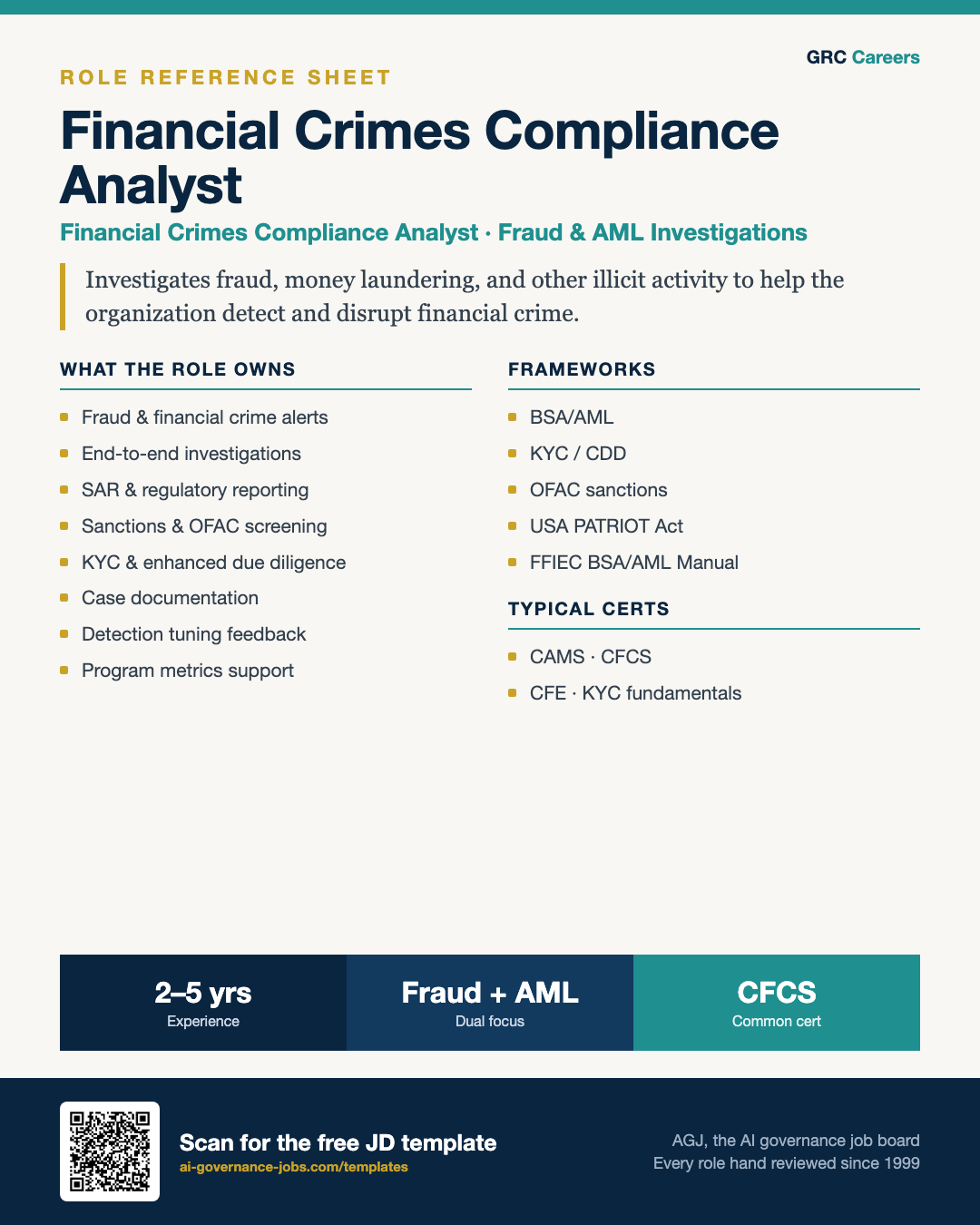
| Title | Financial Crimes Compliance Analyst |
|---|---|
| Department | Financial Crimes / Fraud / Compliance |
| Reports to | [Financial Crimes Manager / BSA Officer / Chief Compliance Officer] |
| Location | [Remote / Hybrid / On-site] |
| Employment type | Full-time |
| Salary | [Salary range. Postings with a range perform significantly better, and several states require one.] |
Position overview
The Financial Crimes Compliance Analyst supports [Company]'s financial crimes program, helping detect, investigate, and disrupt fraud, money laundering, and other illicit activity across products and customers. This role spans transaction monitoring, fraud analysis, sanctions screening, and customer due diligence.
Working within the financial crimes function, the analyst investigates alerts and cases, documents findings, supports reporting obligations, and helps tune detection to reduce noise and catch real activity. The role protects both the organization and its customers from harm.
This is a hands-on investigative role for an analytical professional who is comfortable connecting data points and writing clear, defensible case narratives.
Key responsibilities
Alert and case review
- Review and disposition financial crime and fraud alerts.
- Analyze transactions and customer behavior for illicit patterns.
- Document analysis and decisions consistently.
- Escalate confirmed or high-risk activity per procedure.
Investigations
Investigate fraud, money laundering, and financial crime cases end to end, gathering evidence and reaching supported conclusions.
- Research customers, counterparties, and transaction flows.
- Assess activity against typologies and fraud indicators.
- Prepare thorough, well-documented case files.
Regulatory reporting
Support Suspicious Activity Report preparation and other regulatory reporting where warranted, ensuring narratives are clear, complete, and timely.
Sanctions and KYC
- Review sanctions and OFAC screening alerts.
- Support KYC and enhanced due diligence reviews.
- Help keep customer risk ratings current.
Detection tuning and quality
Provide feedback on rule and model performance, support tuning to reduce false positives, and participate in quality assurance of investigations.
Reporting and collaboration
Contribute to program metrics and reporting, and partner with fraud, AML, product, and operations teams on emerging threats.
Required qualifications
- Bachelor's degree in Finance, Accounting, Criminal Justice, Business, or a related discipline, or equivalent experience.
- 2 to 5 years of experience in financial crimes, fraud, AML, or a related compliance role.
- Working knowledge of BSA/AML, fraud typologies, sanctions, and KYC.
- Experience investigating alerts or cases and writing clear narratives.
- Strong analytical and research skills.
- Attention to detail and sound judgment.
Preferred certifications
One or more of: CAMS, CFCS, CFE, or equivalent financial crimes certification.
Technical knowledge
Financial crime and fraud investigation, transaction and behavior analysis, SAR and regulatory reporting, sanctions and OFAC screening, KYC and enhanced due diligence, typology analysis, detection tuning, and case management systems.
About [Company]
[Two or three sentences about your organization, the maturity of your program, and what the first year looks like. Candidates in this field respond to honesty about whether they are joining a build or an established function.]
Post this role on GRC Careers
Reach professionals who specialize in financial crimes and fraud compliance rather than hoping they find you in a general feed. Hand reviewed, live within one business day.
See how others are hiring
Review live GRC jobs postings to benchmark scope, level, and posted salary before you publish yours.
Stay close to the market
Job alerts
Get new GRC jobs roles sent to you as they post.
Newsletter
Hiring trends, salary signals, and new templates from GRC Careers.
Frequently asked questions
What does a Financial Crimes Compliance Analyst do?
A Financial Crimes Compliance Analyst investigates fraud, money laundering, and other illicit activity. They review alerts and cases, analyze transactions and customer behavior, support regulatory reporting, and help tune detection to catch real threats while reducing noise.
What qualifications and certifications does a Financial Crimes Compliance Analyst need?
Most bring 2 to 5 years in financial crimes, fraud, or AML, plus a bachelor's degree or equivalent experience. Common certifications include CAMS and CFCS, and many also hold or pursue the CFE.
How is this role different from an AML Compliance Analyst?
An AML Compliance Analyst focuses on money laundering detection and reporting, while a Financial Crimes Compliance Analyst usually covers a broader remit that also includes fraud and other illicit activity. Scope varies by organization and the two roles often overlap.
What frameworks govern financial crimes work?
The work is shaped by the Bank Secrecy Act and its AML rules, KYC and customer due diligence expectations, sanctions programs administered by OFAC, and the USA PATRIOT Act, with FFIEC guidance for examination.
Want to edit it, not just read it?
Copying from the page works, and this template stays free. But if you want the real thing to make your own, the editable Word file is in the toolkit, along with all 44 job descriptions, 38 career guides, 21 reference sheets, and 16 executive briefs. Yours to adapt, rename, and reuse, commercially, forever.