
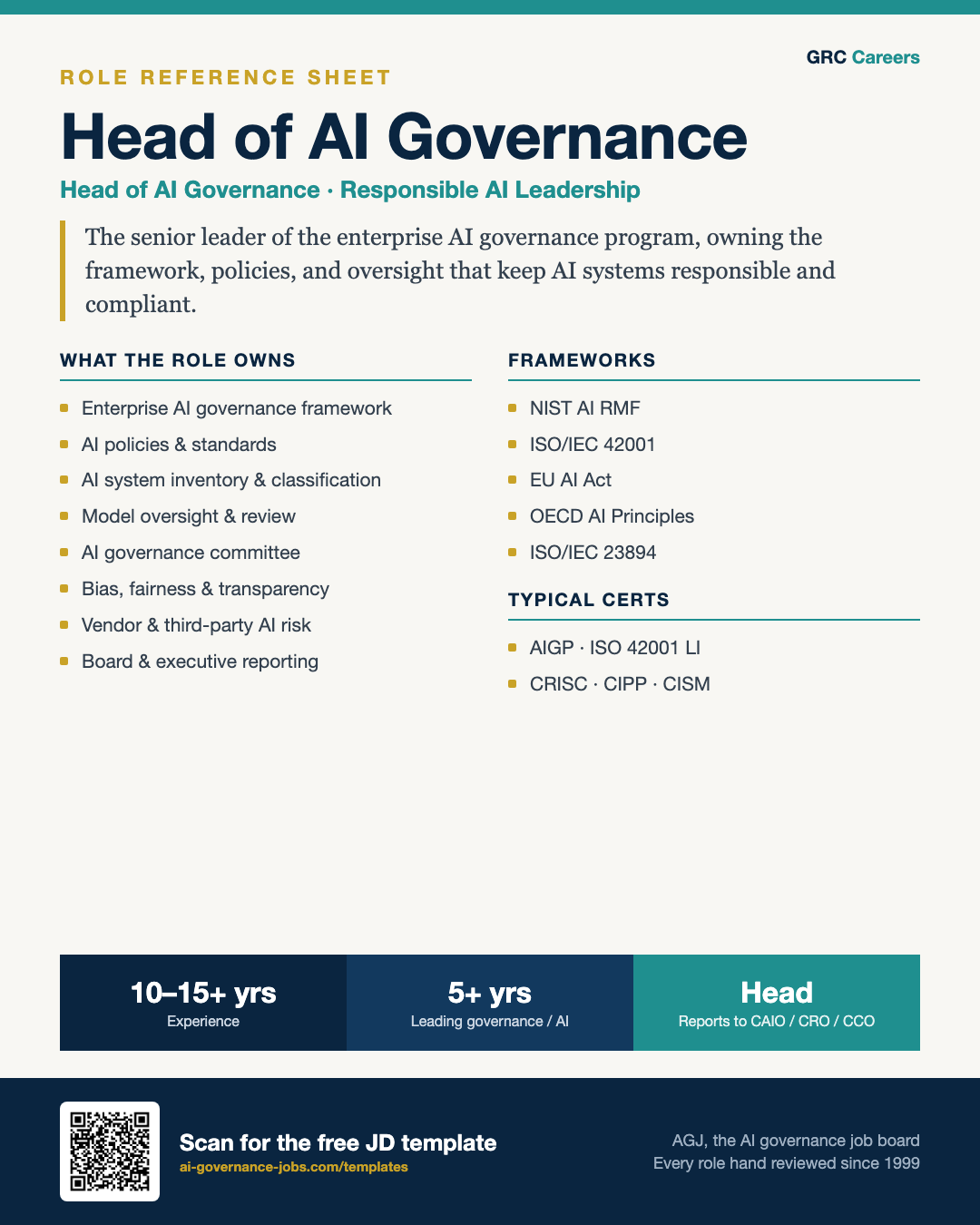
| Title | Head of AI Governance |
|---|---|
| Department | AI Governance / Risk / Compliance |
| Reports to | [Chief AI Officer / Chief Risk Officer / Chief Compliance Officer] |
| Location | [Remote / Hybrid / On-site] |
| Employment type | Full-time |
| Salary | [Salary range. Postings with a range perform significantly better, and several states require one.] |
Position overview
The Head of AI Governance leads [Company]'s enterprise AI governance program, providing the framework, policies, and oversight that keep AI systems responsible, compliant, and aligned with organizational values.
This role partners closely with data science, engineering, legal, privacy, security, risk, and compliance to set AI governance standards, run model oversight and review, and prepare the organization for evolving AI regulation.
As AI adoption accelerates, the Head of AI Governance serves as the senior authority on responsible AI and the controls that govern how AI systems are built, deployed, and monitored.
Key responsibilities
AI governance framework
- Develop and own the enterprise AI governance framework.
- Align the program with NIST AI RMF, ISO/IEC 42001, and the EU AI Act.
- Establish AI principles, policies, and standards.
- Build a roadmap for AI governance maturity.
- Present AI governance updates to leadership and the Board.
Model oversight and review
Establish oversight across the AI and model lifecycle, including:
- AI system inventory and risk classification
- Model documentation, validation, and approval
- Bias, fairness, transparency, and explainability review
- Human oversight and monitoring in production
AI policy and standards
- Set enterprise AI use policies and acceptable use standards.
- Define governance for generative AI and AI agents.
- Establish review gates before AI deployment.
- Maintain AI governance documentation and controls.
Regulatory readiness
Monitor and prepare for AI regulation, including the EU AI Act risk tiers and obligations, and translate emerging requirements into enterprise controls and processes.
AI governance committee
Chair or coordinate the AI governance committee, facilitate cross-functional review of AI use cases, and drive consistent decisions on high-risk AI systems.
Third-party and vendor AI
- Assess AI vendors and third-party models.
- Review contractual AI provisions and disclosures.
- Monitor foundation model and vendor risk.
- Establish AI due diligence procedures.
Culture and enablement
Build AI literacy and responsible AI practices across the organization through training, guidance, and enablement so teams can innovate within clear guardrails.
Required qualifications
- Bachelor's degree in Computer Science, Data Science, Law, Information Systems, or a related discipline. Master's degree preferred.
- 10 to 15+ years of experience in governance, risk, compliance, data, or AI-related roles.
- 5+ years leading governance, risk, or AI programs.
- Strong understanding of AI and machine learning concepts.
- Experience implementing governance frameworks in complex organizations.
- Experience briefing executive leadership and the Board.
Preferred certifications
One or more of: AIGP, ISO/IEC 42001 Lead Implementer or Lead Auditor, CRISC, CIPP, or CISM.
Technical knowledge
AI governance, responsible AI, model lifecycle oversight, AI risk assessment, bias and fairness evaluation, transparency and explainability, generative AI and AI-agent governance, AI policy development, regulatory analysis, vendor AI risk, and GRC and model governance platforms.
Essential competencies
Strategic leadership, executive communication, Board presentation skills, ethical judgment, cross-functional facilitation, program management, regulatory interpretation, and change leadership.
Success measures: first 12 months
- Establish the enterprise AI governance framework.
- Stand up the AI system inventory and risk classification.
- Publish enterprise AI use policies and standards.
- Launch the AI governance committee and review gates.
- Complete baseline reviews of high-risk AI systems.
- Advance EU AI Act and regulatory readiness.
- Build executive and Board AI governance reporting.
- Improve organizational AI governance maturity.
About [Company]
[Two or three sentences about your organization, the maturity of your program, and what the first year looks like. Candidates in this field respond to honesty about whether they are joining a build or an established function.]
Post this role on GRC Careers
Reach professionals who specialize in AI governance and responsible AI rather than hoping they find you in a general feed. Hand reviewed, live within one business day.
See how others are hiring
Review live GRC leadership jobs postings to benchmark scope, level, and posted salary before you publish yours.
Stay close to the market
Job alerts
Get new GRC leadership jobs roles sent to you as they post.
Newsletter
Hiring trends, salary signals, and new templates from GRC Careers.
Frequently asked questions
What does a Head of AI Governance do?
The Head of AI Governance leads the enterprise AI governance program. They own the AI governance framework, policies, and model oversight, chair the AI governance committee, and prepare the organization for AI regulation such as the EU AI Act.
What qualifications and certifications does a Head of AI Governance need?
Most bring 10 to 15 or more years across governance, risk, compliance, data, or AI, including at least 5 years leading programs. Common certifications include AIGP, ISO/IEC 42001 Lead Implementer or Lead Auditor, CRISC, and CIPP.
Who does a Head of AI Governance report to?
The role typically reports to the Chief AI Officer, the Chief Risk Officer, or the Chief Compliance Officer, and partners across data science, legal, privacy, security, and business units.
What frameworks does a Head of AI Governance use?
Core reference frameworks include the NIST AI Risk Management Framework, ISO/IEC 42001, the EU AI Act, the OECD AI Principles, and ISO/IEC 23894 for AI risk management.
Want to edit it, not just read it?
Copying from the page works, and this template stays free. But if you want the real thing to make your own, the editable Word file is in the toolkit, along with all 44 job descriptions, 38 career guides, 21 reference sheets, and 16 executive briefs. Yours to adapt, rename, and reuse, commercially, forever.