
| Title | Regulatory Compliance Manager |
|---|---|
| Department | Compliance / Legal / Risk |
| Reports to | [Chief Compliance Officer / VP Compliance / General Counsel] |
| Location | [Remote / Hybrid / On-site] |
| Employment type | Full-time |
| Salary | [Salary range. Postings with a range perform significantly better, and several states require one.] |
Position overview
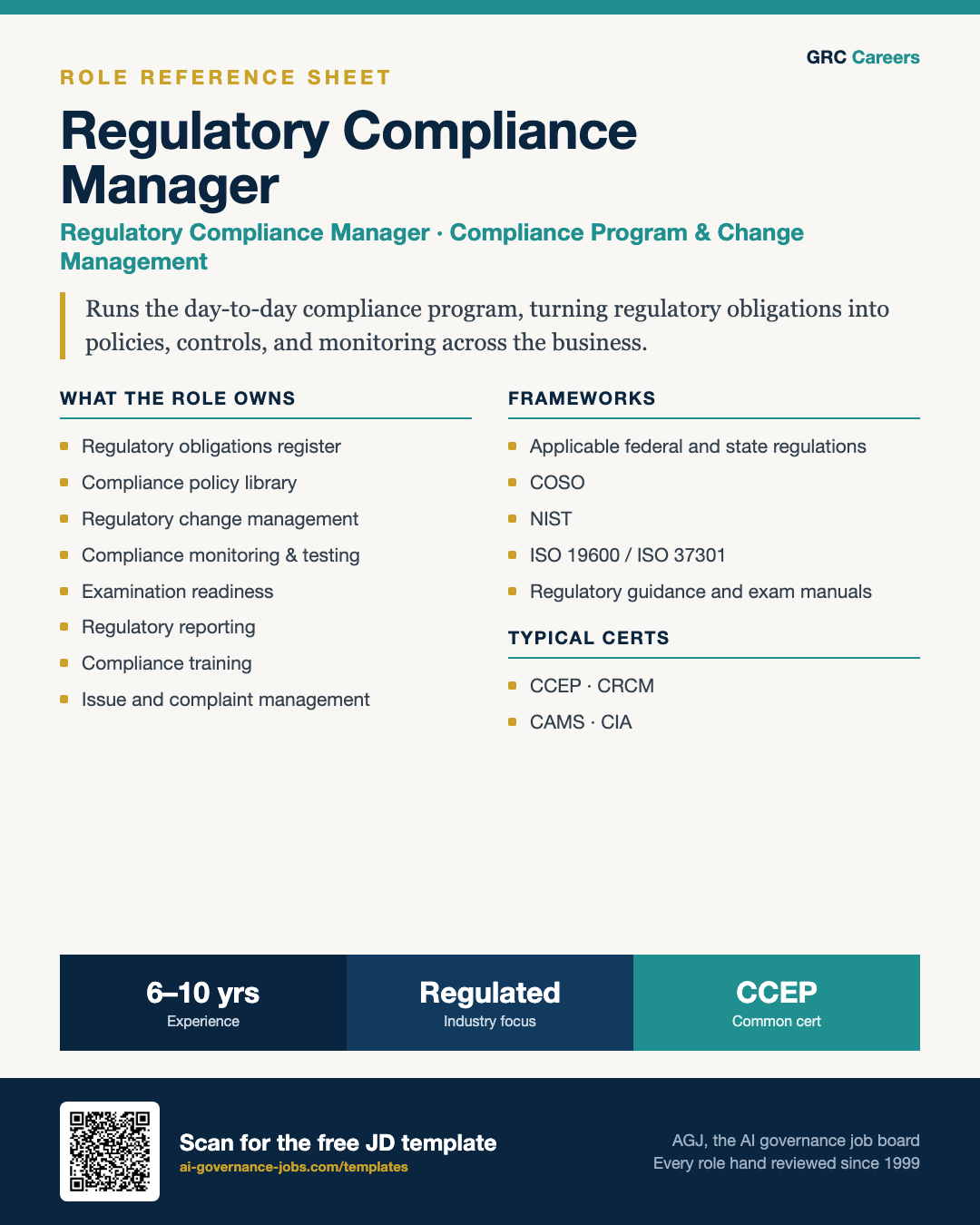
The Regulatory Compliance Manager leads [Company]'s compliance program, ensuring the organization meets its legal and regulatory obligations across all applicable jurisdictions. This role owns regulatory change management, policy development, compliance monitoring, and the relationship with regulators and examiners.
Working across legal, risk, operations, and business lines, the Regulatory Compliance Manager builds practical controls, delivers training, investigates issues, and reports on compliance health to senior leadership. The role balances regulatory rigor with commercial understanding so the business can grow within the rules.
This is a hands-on leadership role that suits a compliance professional who can interpret regulation, operationalize it, and keep the program current as rules evolve.
Key responsibilities
Regulatory change management
- Monitor legislative and regulatory developments across applicable jurisdictions.
- Assess the impact of new and amended rules on the business.
- Translate regulatory requirements into policies, procedures, and controls.
- Maintain a regulatory inventory and obligations register.
- Communicate changes to affected stakeholders and track implementation.
Compliance program management
- Develop, maintain, and enforce compliance policies and standards.
- Operate the compliance risk assessment and testing calendar.
- Maintain the policy library and attestation processes.
- Coordinate compliance activities across business units.
Monitoring and testing
Design and run compliance monitoring and testing to confirm controls are operating as intended. Track exceptions, root causes, and remediation.
- Build monitoring plans tied to key regulatory obligations.
- Perform periodic control testing and thematic reviews.
- Document findings and drive corrective action to closure.
Regulatory examinations and reporting
Serve as a primary point of contact for regulators and examiners. Prepare examination materials, coordinate responses, and manage regulatory filings and reporting deadlines.
Training and advisory
- Deliver compliance training to employees and business leaders.
- Advise business teams on regulatory questions and new initiatives.
- Promote a strong compliance culture across the organization.
Investigations and issue management
Investigate compliance concerns, potential violations, and complaints. Document findings, recommend remediation, and escalate significant matters to leadership.
Required qualifications
- Bachelor's degree in Business, Finance, Law, Accounting, or a related discipline. Advanced degree a plus.
- 6 to 10 years of progressive compliance experience in a regulated industry.
- Strong knowledge of the regulatory environment applicable to the organization.
- Experience building and running compliance monitoring or testing programs.
- Demonstrated ability to interpret regulation and translate it into operational controls.
- Experience managing regulatory examinations or audits.
Preferred certifications
One or more of: CCEP, CRCM, CAMS, CIA, or equivalent compliance certification.
Technical knowledge
Regulatory change management, compliance risk assessment, policy and procedure development, compliance monitoring and testing, examination management, regulatory reporting, complaint and issue management, controls design, and GRC platforms.
Essential competencies
Sound judgment, clear written and verbal communication, stakeholder influence, attention to detail, program management, and the ability to explain regulation to non-specialist audiences.
Success measures: first 12 months
- Establish a current regulatory obligations inventory.
- Refresh core compliance policies and procedures.
- Stand up a compliance monitoring and testing calendar.
- Complete a compliance risk assessment across business lines.
- Close open regulatory findings and remediation items.
- Deliver a baseline compliance training program.
- Prepare the organization for its next regulatory examination.
- Improve compliance reporting to senior leadership.
About [Company]
[Two or three sentences about your organization, the maturity of your program, and what the first year looks like. Candidates in this field respond to honesty about whether they are joining a build or an established function.]
Post this role on GRC Careers
Reach professionals who specialize in regulatory compliance and change management rather than hoping they find you in a general feed. Hand reviewed, live within one business day.
See how others are hiring
Review live GRC jobs postings to benchmark scope, level, and posted salary before you publish yours.
Stay close to the market
Job alerts
Get new GRC jobs roles sent to you as they post.
Newsletter
Hiring trends, salary signals, and new templates from GRC Careers.
Frequently asked questions
What does a Regulatory Compliance Manager do?
A Regulatory Compliance Manager runs an organization's day-to-day compliance program. They monitor regulatory change, build policies and controls, run compliance monitoring and testing, manage examinations, and advise the business on regulatory requirements.
What qualifications and certifications does a Regulatory Compliance Manager need?
Most bring 6 to 10 years of compliance experience in a regulated industry plus a bachelor's degree in business, finance, or law. Common certifications include CCEP and CRCM, and in some sectors CAMS or CIA.
Who does a Regulatory Compliance Manager report to?
The role typically reports to the Chief Compliance Officer, a VP of Compliance, or the General Counsel, depending on how the organization structures its compliance function.
What is regulatory change management?
Regulatory change management is the process of tracking new and amended rules, assessing their impact on the business, and updating policies, procedures, and controls so the organization stays current with its obligations.
Want to edit it, not just read it?
Copying from the page works, and this template stays free. But if you want the real thing to make your own, the editable Word file is in the toolkit, along with all 44 job descriptions, 38 career guides, 21 reference sheets, and 16 executive briefs. Yours to adapt, rename, and reuse, commercially, forever.