
Home › AI Governance Insights › How to Become an AI Governance Analyst: A Career Guide for AI Governance, Risk, and Responsible AI
How to Become an AI Governance Analyst: A Career Guide for AI Governance, Risk, and Responsible AI
By F. Jay Hall and Stephan Pochet, Founder, GRC Careers LLC · June 28, 2026 · 6 min read
Artificial intelligence is transforming organizations across every industry. As companies adopt AI at an unprecedented pace, they face an equally important challenge: making sure those systems are governed responsibly. That challenge has created one of the fastest-growing career opportunities in technology today, and it has a name: the AI Governance Analyst.
Here is the part most people miss. Unlike many AI careers, you do not need to become a machine learning engineer to succeed. Organizations are actively looking for professionals who can bridge business strategy, governance, compliance, technology, and risk. If you enjoy solving complex problems, working across departments, interpreting regulations, or helping organizations manage risk, this may be one of the most exciting paths open to you right now.
Key Takeaways
- You do not need to be a machine learning engineer. AI governance rewards business judgment, communication, and risk skills.
- An AI Governance Analyst builds the policies, system inventories, risk assessments, and oversight that let an organization use AI responsibly.
- Employers want governance frameworks, risk management, regulatory compliance, responsible-AI principles, and cross-functional communication.
- Backgrounds in governance, compliance, audit, cybersecurity, or enterprise risk transfer directly, and often command higher pay.
- Start now: learn the NIST AI RMF and ISO/IEC 42001, earn one respected certification, and read real job descriptions.
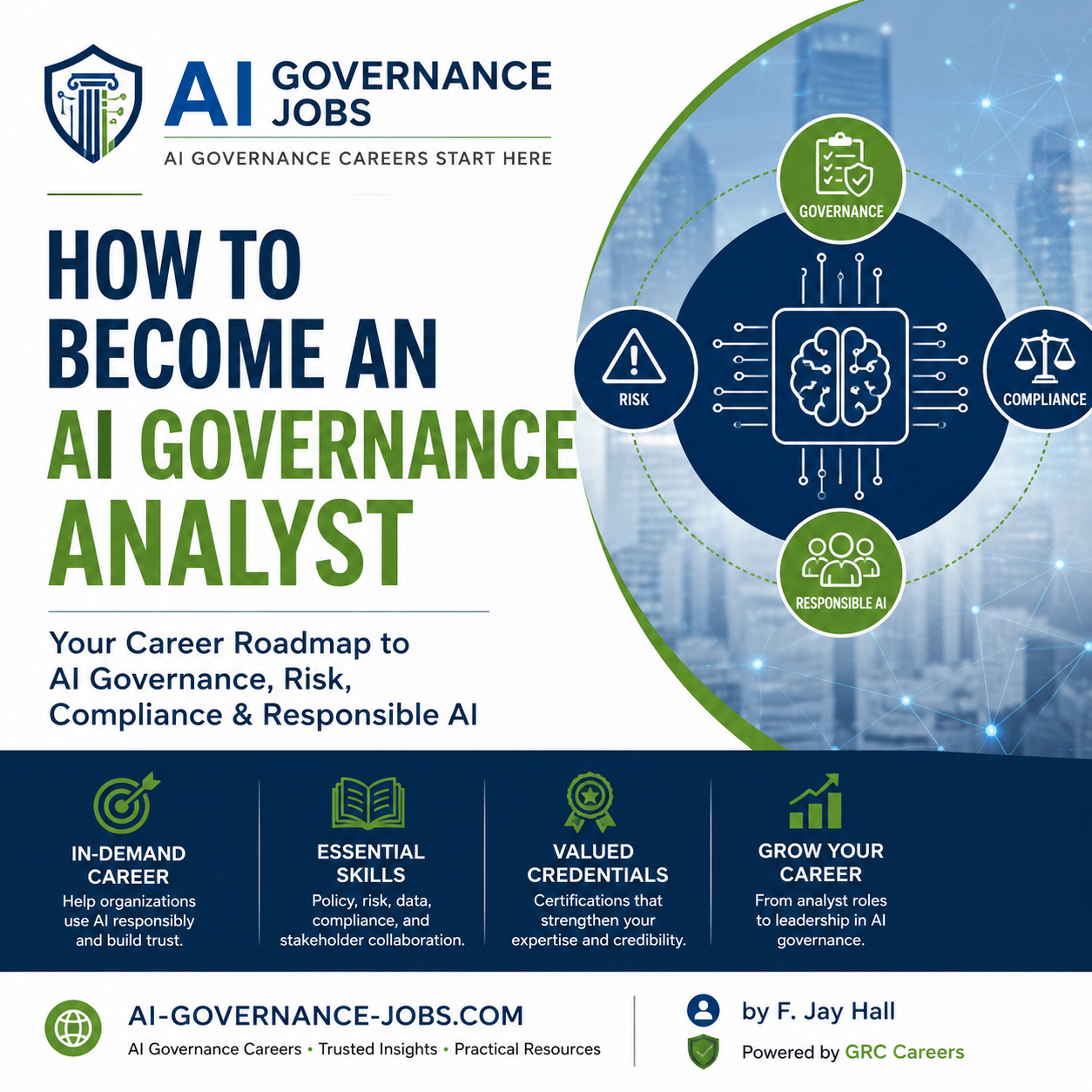
What does an AI Governance Analyst do?
An AI Governance Analyst helps an organization develop the policies, processes, and oversight needed to use artificial intelligence responsibly. The exact mix varies by employer, but the work usually includes:
- Developing AI governance policies.
- Maintaining an inventory of AI systems.
- Conducting AI risk assessments.
- Supporting compliance initiatives.
- Monitoring emerging regulations.
- Coordinating governance committees.
- Evaluating third-party AI vendors.
- Preparing executive and board reports.
- Working with legal, security, privacy, audit, and engineering teams.
Think of the role as helping an organization build trust in the way it develops and deploys AI.
Skills employers are looking for
Most employers are not searching for experts in every AI technology. They value professionals who understand governance, communication, and how a business actually runs. Commonly requested skills include:
- AI governance frameworks.
- Risk management.
- Regulatory compliance.
- Responsible AI principles.
- Data governance.
- Policy development.
- Executive communication.
- Documentation.
- Cross-functional collaboration.
- Critical thinking.
Technical curiosity helps, but strong business judgment is often just as valuable.
Certifications that can strengthen your career
There is no single certification required to become an AI Governance Analyst. But employers increasingly recognize professionals who have invested in learning governance frameworks and responsible AI. Popular options include:
- NIST AI Risk Management Framework training.
- ISO/IEC 42001 education.
- IAPP Artificial Intelligence Governance Professional (AIGP).
- ISACA AI governance programs.
- Cloud provider responsible-AI learning paths.
Choose the credentials that fit your experience and goals rather than collecting as many as possible. For a deeper comparison, see Top AI Governance Certifications Compared.
Where do AI Governance Analysts work?
Demand keeps growing across both the public and private sectors. Organizations hiring AI governance professionals include:
- Healthcare systems.
- Financial institutions.
- Technology companies.
- Government agencies.
- Universities.
- Consulting firms.
- Manufacturers.
- Insurance organizations.
- Nonprofits.
- Global enterprises.
Any organization adopting AI responsibly will likely need governance expertise.
Salary expectations
Compensation varies based on experience, industry, and geographic location. Professionals with backgrounds in governance, cybersecurity, compliance, audit, or enterprise risk often command higher salaries because they bring transferable experience. As the profession matures, organizations are increasingly creating dedicated AI governance positions rather than bolting AI duties onto an existing role.
AI Governance Insight
You do not break into this field by claiming to know every model. You break in by showing you can turn principles into practice: a policy people follow, a risk assessment leadership trusts, a board report that makes a hard decision clear. Lead with the judgment, and the title follows.
How to get started
You do not need to wait for the perfect opening. Start building your expertise today. Learn the leading governance frameworks. Study responsible-AI principles. Follow developments in AI regulation. Complete a respected certification. Read job descriptions closely. Join professional communities. Most of all, begin thinking about AI through the lens of governance, accountability, transparency, and trust.
Your career roadmap
Many successful AI Governance Analysts follow a path that looks like this:
- Governance or compliance experience.
- Learn AI governance fundamentals.
- Study the NIST AI RMF and ISO/IEC 42001.
- Earn a relevant certification.
- Gain practical experience.
- Apply for AI Governance Analyst roles.
From there, careers often expand into AI Risk Manager, Responsible AI Lead, AI Compliance Manager, AI Governance Program Manager, and eventually Chief AI Governance Officer or Chief AI Officer.
The Bottom Line
Artificial intelligence is creating extraordinary opportunities, but successful AI adoption depends on more than technology. Organizations need people who can build governance, manage risk, support compliance, and earn trust. That is exactly where AI Governance Analysts make their impact. If you want a career that combines strategy, ethics, technology, and leadership, there has never been a better time to begin.
Related Guides
- AI Governance vs. AI Risk vs. AI Compliance: how the three disciplines connect.
- The AI Governance Frameworks Every Hiring Manager Expects You to Know: NIST AI RMF, ISO 42001, and the EU AI Act.
- Top AI Governance Certifications Compared: which credential fits your background.
- Five Data Observability Metrics Every AI Governance Team Should Track: getting practical with data quality.
- What Is AI Observability?: the skill employers now ask for by name.
- How to Become an AI Governance Analyst: the step-by-step roadmap version.
- Browse open roles in AI Governance, AI Risk, Responsible AI, AI Compliance, and AI Audit.
Frequently Asked Questions
Do you need to be a machine learning engineer to become an AI Governance Analyst?
No. AI governance is a bridge role. Employers want people who understand governance frameworks, risk, compliance, and how a business operates, and who can communicate across legal, security, privacy, audit, and engineering teams. Technical curiosity helps, but business judgment is often just as valuable.
What does an AI Governance Analyst do?
An AI Governance Analyst helps an organization use AI responsibly by developing governance policies, maintaining an inventory of AI systems, conducting AI risk assessments, supporting compliance, monitoring emerging regulations, coordinating governance committees, evaluating third-party AI vendors, and preparing executive and board reports.
What skills do employers look for in AI governance candidates?
Commonly requested skills include AI governance frameworks, risk management, regulatory compliance, responsible-AI principles, data governance, policy development, executive communication, documentation, cross-functional collaboration, and critical thinking.
What certifications help you become an AI Governance Analyst?
There is no single required certification. Useful options include NIST AI Risk Management Framework training, ISO/IEC 42001 education, the IAPP AIGP, ISACA AI governance programs, and cloud-provider responsible-AI learning paths. Choose the ones that match your background and goals.
Where do AI Governance Analysts work?
Across both the public and private sectors: healthcare systems, financial institutions, technology companies, government agencies, universities, consulting firms, manufacturers, insurance organizations, nonprofits, and global enterprises. Any organization adopting AI responsibly will likely need governance expertise.
- Founder of ExecSearches and GRC Careers
- Executive search across corporate, higher education, financial services, and nonprofit sectors
- Focus on AI governance and GRC hiring
- More than a decade in risk advisory and internal audit in financial services
- Led SOX and regulatory audits for Citi, Goldman Sachs, Morgan Stanley, and McKesson
- Public Accounting Certification, Cornell University
Who's Hiring AI Governance Professionals?
Explore current openings in:
AI Governance Jobs · Responsible AI · AI Risk · AI Compliance · AI Audit · AI Policy · Privacy · Cybersecurity · Public Policy
Search the latest opportunities at GRC Careers › · nonprofit GRC jobs ›