
Home › AI Governance Insights › The Language of AI Governance: New Field, or Old Discipline in New Clothes?
The Language of AI Governance: New Field, or Old Discipline in New Clothes?
By F. Jay Hall and Stephan Pochet, GRC & AI Governance, GRC Careers · July 2, 2026 · 4 min read
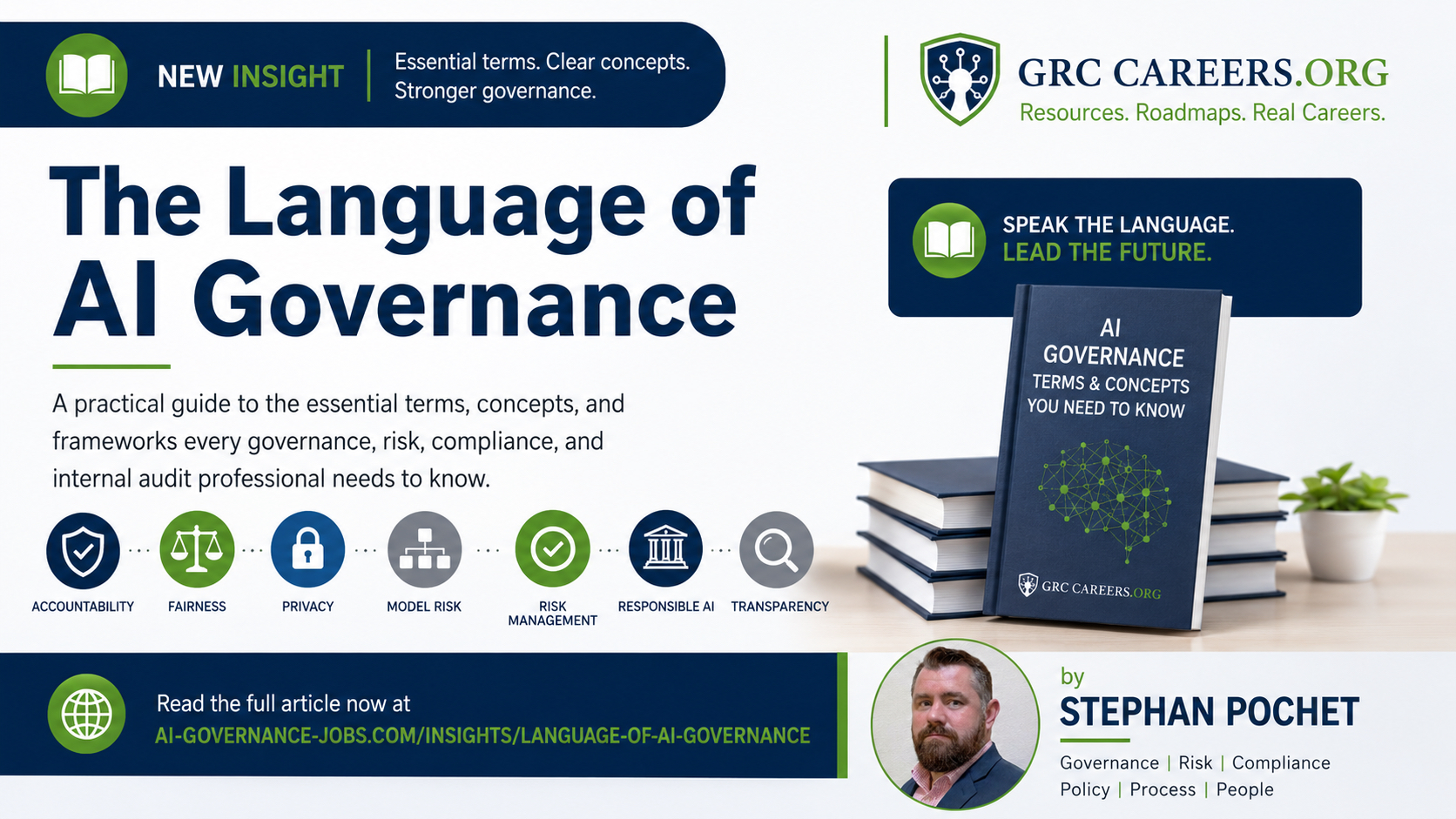
Every new field arrives with a new vocabulary. Some of it is genuinely new. Much of it is old wine in new bottles.
AI governance is both. And knowing which is which is worth a great deal, especially to anyone building a career in it.
The words that are borrowed
Risk. Control. Compliance. Audit. Inventory. Ownership. Oversight. Documentation. None of these are new. They are the spine of governance, risk, and compliance, refined over decades of financial regulation, SOX, and information security. AI governance did not invent them. It inherited them, on purpose.
Look at the major frameworks and the inheritance is obvious. NIST's AI Risk Management Framework is built on map, measure, manage. ISO/IEC 42001 is a management system with the same plan-do-check-act spine as every ISO standard before it. The bones are pure GRC.
The words that are new
Then there is the genuinely new vocabulary, the part specific to the object being governed. Model cards. Red-teaming. Alignment. Guardrails. Hallucination. Training data provenance. AI inventory. Model risk in a new sense. These describe things that did not exist to be governed until recently.
This is the layer that takes real learning. It is where an experienced GRC professional has to actually study, because the risks behave differently: a model drifts, a dataset carries hidden bias, a system produces confident nonsense.
Why this is good news for your career
Here is the payoff. AI governance is not a brand-new discipline you have to learn from zero. It is mature GRC practice applied to a new, fast-moving object. If you already know how to run a control, document a decision, assess a risk, and answer to an auditor, you are most of the way there. You add the AI-specific vocabulary and the AI-specific failure modes on top of a foundation you already have.
The field looks intimidating because the words are unfamiliar. Strip the vocabulary back and it is a discipline you may already know, pointed at a harder target.
See how the pieces fit in the AI Governance Essentials series, and browse roles on GRC Careers.
Frequently Asked Questions
Is AI governance a completely new discipline?
No. AI governance is largely mature governance, risk, and compliance practice applied to a new object. Its core vocabulary (risk, control, compliance, audit, inventory, oversight) is inherited from decades of GRC, and frameworks like NIST AI RMF and ISO/IEC 42001 deliberately reuse the GRC spine. A layer of genuinely new, AI-specific concepts sits on top.
What AI governance terms are genuinely new?
The AI-specific vocabulary includes model cards, red-teaming, alignment, guardrails, hallucination, training-data provenance, and AI inventory. These describe risks that behave differently from traditional ones, and they are the part that takes real study.
Can a GRC professional move into AI governance?
Yes, and readily. If you can run a control, document a decision, assess a risk, and answer to an auditor, you already have the foundation. You add the AI-specific vocabulary and failure modes on top of skills you have.
- Founder of ExecSearches and GRC Careers
- Executive search across corporate, higher education, financial services, and nonprofit sectors
- Focus on AI governance and GRC hiring
- More than a decade in risk advisory and internal audit in financial services
- Led SOX and regulatory audits for Citi, Goldman Sachs, Morgan Stanley, and McKesson
- Public Accounting Certification, Cornell University
Who's Hiring AI Governance Professionals?
Explore current openings in:
AI Governance Jobs · Responsible AI · AI Risk · AI Compliance · AI Audit · AI Policy · Privacy · Cybersecurity · Public Policy
Search the latest opportunities at GRC Careers › · nonprofit GRC jobs ›