
Home › AI Governance Insights › NIST AI RMF Explained: Govern, Map, Measure, Manage
NIST AI RMF Explained: Govern, Map, Measure, Manage
By F. Jay Hall and Stephan Pochet, Frameworks, Standards & Regulations · August 15, 2026 · 12 min read min read
Key Takeaways
- The AI RMF turns responsible AI principles into risk-management outcomes that organizations can document and evaluate.
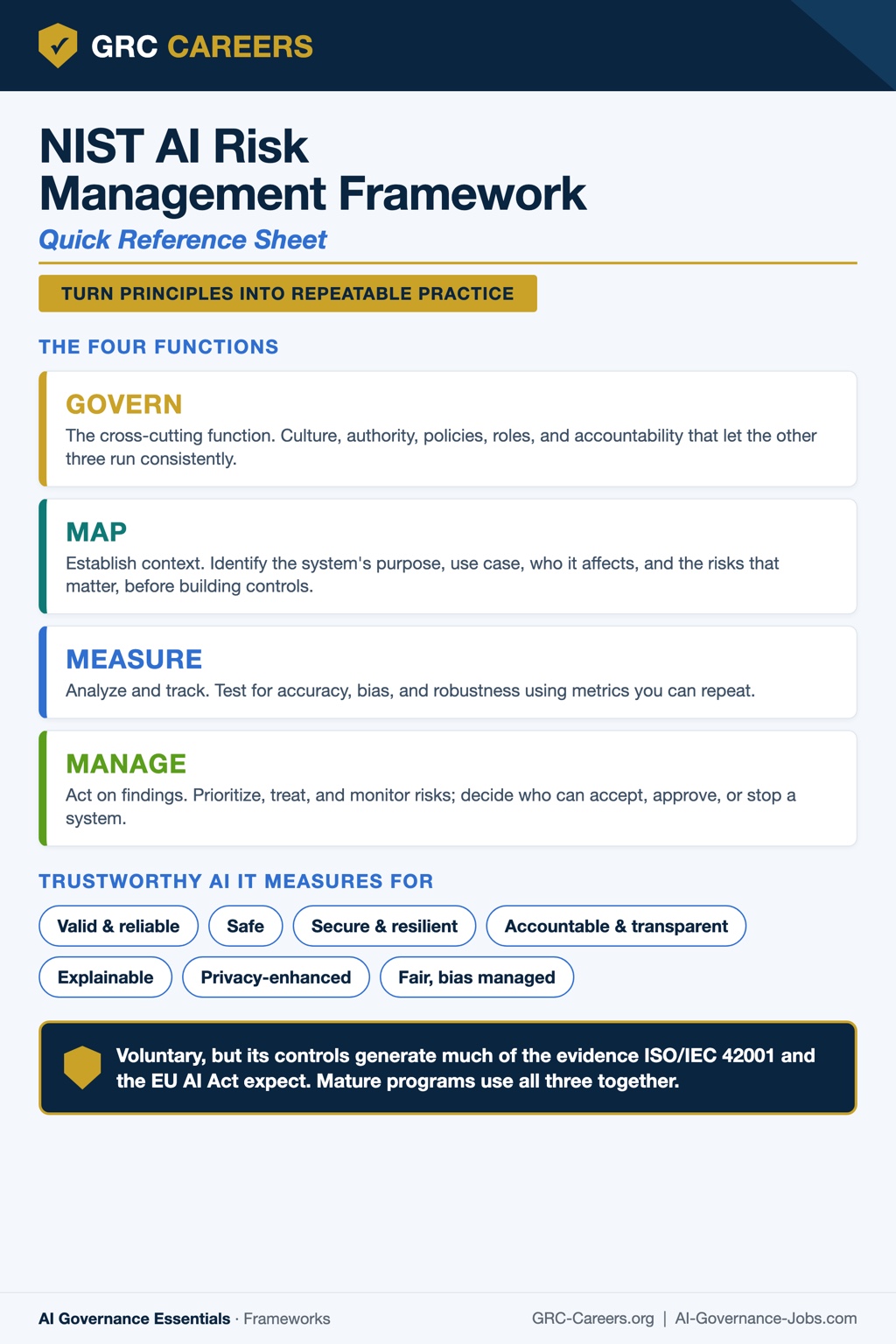
- Its four functions are GOVERN, MAP, MEASURE, and MANAGE, with GOVERN operating across the other three.
- The framework is flexible by design. Organizations tailor it to their risks, resources, industry, use cases, and legal obligations.
- Trustworthy AI is multidimensional. Performance, safety, security, transparency, privacy, explainability, and fairness must be considered together.
- Effective AI governance requires technical, legal, business, risk, and stakeholder perspectives rather than ownership by a single team.
1. Responsible AI Must Become an Operating Practice
The AI RMF moves the conversation beyond broad statements about fairness, transparency, and accountability. It asks organizations to establish the policies, processes, roles, testing practices, and response mechanisms needed to manage AI risk throughout the lifecycle.
That shift matters because AI risk is not limited to a defective model or a software failure. NIST treats AI systems as sociotechnical systems. Their outcomes are shaped by data, models, people, organizational choices, deployment environments, and the ways individuals and communities experience their use. A technically accurate system can still create harm if it is used for an unsuitable purpose, deployed without adequate oversight, or applied to people who have no meaningful way to question an outcome.
Operationalizing responsible AI therefore requires evidence. Depending on the system and its risk, that evidence might include:
- A documented purpose, intended users, and prohibited uses
- An inventory of AI systems and third-party models
- Named system owners and clearly assigned risk responsibilities
- Impact assessments and documented risk tolerances
- Testing methods, metrics, limitations, and acceptance thresholds
- Human-oversight and escalation procedures
- Incident records, monitoring results, and corrective actions
- Decisions to approve, restrict, suspend, or retire a system
The framework does not prescribe one required set of documents. It does, however, make a central point clear: responsible AI becomes credible when an organization can show how its commitments influence real decisions.
2. The Four Functions Create a Practical Governance Cycle
The AI RMF Core is organized around four functions: GOVERN, MAP, MEASURE, and MANAGE. Each contains categories and subcategories that describe desired outcomes. These functions are not a rigid sequence or a checklist that must be completed once. NIST expects them to be used iteratively throughout the AI lifecycle.
| Function | Central question | Examples of governance evidence | | --- | --- | --- | | GOVERN | How does the organization direct, oversee, and sustain AI risk management? | Policies, roles, accountability, risk tolerance, training, inventory requirements, third-party governance, and executive oversight | | MAP | What is the system, where will it operate, who may be affected, and what risks could arise? | Intended purpose, context, stakeholders, dependencies, foreseeable misuse, impact analysis, and risk identification | | MEASURE | How will the organization analyze and track identified risks and system trustworthiness? | Testing plans, metrics, benchmarks, bias evaluation, security testing, uncertainty analysis, monitoring, and documented limitations | | MANAGE | What will the organization do about the risks it has identified and measured? | Risk prioritization, mitigations, approval conditions, residual-risk decisions, incident response, monitoring changes, and system retirement |
The 19 categories inside the four functions
The four functions are the top level. Underneath them the AI RMF Core defines 19 categories and 72 subcategories, each written as an outcome rather than a control. This is the level most people never see, and it is the level that actually tells you what evidence to produce.
GOVERN — 6 categories
The only cross-cutting function. GOVERN runs continuously and feeds the other three.
- GOVERN 1 — Policies, processes and procedures for mapping, measuring and managing AI risk are in place, transparent and effectively implemented.
- GOVERN 2 — Accountability structures exist so teams and individuals are empowered, responsible and trained.
- GOVERN 3 — Workforce diversity, equity, inclusion and accessibility are prioritized across the AI lifecycle.
- GOVERN 4 — Organizational culture considers and communicates AI risk.
- GOVERN 5 — Processes exist for robust engagement with relevant AI actors, including affected communities.
- GOVERN 6 — Policies address AI risks and benefits arising from third-party software, data and the wider supply chain.
MAP — 5 categories
Establishes context before anything is built or bought. Skipping MAP is the most common failure we see in AI governance programs.
- MAP 1 — Context is established and understood.
- MAP 2 — The AI system is categorized.
- MAP 3 — Capabilities, targeted usage, goals, and expected benefits and costs are understood against appropriate benchmarks.
- MAP 4 — Risks and benefits are mapped for all components, including third-party software and data.
- MAP 5 — Impacts to individuals, groups, communities, organizations and society are characterized.
MEASURE — 4 categories
Turns identified risk into evidence. This is where the seven trustworthy AI characteristics get tested.
- MEASURE 1 — Appropriate methods and metrics are identified and applied.
- MEASURE 2 — AI systems are evaluated for trustworthy characteristics.
- MEASURE 3 — Mechanisms for tracking identified AI risks over time are in place.
- MEASURE 4 — Feedback about the efficacy of measurement is gathered and assessed.
MANAGE — 4 categories
Acts on what MAP and MEASURE produced: prioritize, treat, monitor, and decide what to accept.
- MANAGE 1 — Risks from MAP and MEASURE are prioritized, responded to and managed.
- MANAGE 2 — Strategies to maximize benefits and minimize negative impacts are planned, implemented and documented.
- MANAGE 3 — AI risks and benefits from third-party entities are managed.
- MANAGE 4 — Risk treatments, response and recovery, and communication plans are documented and monitored regularly.
What MEASURE is measuring: the seven trustworthy AI characteristics
MEASURE 2 asks you to evaluate systems for trustworthiness, and the framework is specific about what that means. AI RMF 1.0 names seven characteristics:
- Valid and reliable — the system does what it claims, repeatably, on data it will actually meet.
- Safe — it does not endanger life, health, property or the environment.
- Secure and resilient — it withstands adversarial use and recovers from failure.
- Accountable and transparent — someone owns it, and how it works is disclosed appropriately.
- Explainable and interpretable — its outputs can be understood by the people affected by them.
- Privacy-enhanced — it protects the data it touches.
- Fair, with harmful bias managed — disparate impact is identified and addressed, not assumed away.
Validity and reliability come first deliberately. NIST treats them as prerequisites: a system that does not work reliably cannot be safe, fair or trustworthy no matter what else you document.
How to actually use the Core
Do not attempt all 19 categories at once. Three things make the framework tractable:
- The AI RMF Playbook gives suggested actions, references and documentation for every subcategory. It is the companion that turns an outcome statement into a task.
- Profiles let you select the subset of subcategories relevant to your use case, sector or risk tolerance — a current profile for where you are, a target profile for where you intend to be.
- The Generative AI Profile (NIST AI 600-1) applies the Core specifically to generative systems, which is where most 2026 hiring pressure sits.
A first pass that covers GOVERN 1, GOVERN 2, MAP 1 and MANAGE 1 with real evidence is worth more than a spreadsheet claiming all 72 subcategories are green.
GOVERN is intentionally cross-cutting. It establishes the culture, authority, policies, and accountability that allow mapping, measurement, and management to occur consistently. A strong policy alone is not strong governance. If an organization cannot identify the context of a system, evaluate important risks, or act on its findings, its governance structure is incomplete.
The same is true in reverse. A data science team may conduct sophisticated testing, but the results will have limited value if no one is responsible for deciding whether a failed test should block deployment. The four functions are designed to connect institutional authority with system-level analysis and action.
3. Context Determines What Good Governance Requires
The AI RMF is outcome-focused and non-prescriptive. A low-impact internal productivity tool should not necessarily receive the same review as an AI system influencing employment, lending, education, healthcare, housing, or access to public services. The appropriate controls depend on the system’s purpose, affected parties, deployment environment, potential impact, legal requirements, and the organization’s risk tolerance.
This flexibility is not permission to ignore difficult risks. It requires an organization to explain why its level of governance is appropriate. For higher-impact systems, that usually means deeper documentation, more independent testing, stronger human oversight, greater stakeholder engagement, and closer post-deployment monitoring.
One practical way to tailor the framework is through AI RMF Profiles. A Current Profile describes how an organization currently addresses selected AI RMF outcomes. A Target Profile describes the outcomes it wants or needs to achieve. Comparing the two reveals gaps and provides a basis for a prioritized improvement plan.
Profiles can also be created for a sector, technology, or use case. For example, an organization could develop a profile for AI-assisted hiring, a customer-service chatbot, a clinical decision-support tool, or the acquisition of third-party generative AI services. NIST does not require a single profile template, which allows organizations to adapt the method to existing enterprise risk, compliance, audit, and product-governance processes.
This is a more defensible approach than assigning a generic maturity label. The AI RMF itself does not define “Crawl, Walk, Run” stages or formal implementation tiers. Organizations may use a separate maturity model if it helps manage a program, but they should not present those levels as components of the NIST AI RMF.
4. Trustworthy AI Requires More Than Accuracy
NIST identifies seven characteristics of trustworthy AI systems:
1. Valid and reliable 2. Safe 3. Secure and resilient 4. Accountable and transparent 5. Explainable and interpretable 6. Privacy-enhanced 7. Fair, with harmful bias managed
These characteristics are related, and they can create tradeoffs. Increasing transparency may create privacy or security concerns. A model that performs well on average may produce unacceptable errors for a particular group. A highly accurate system may still be inappropriate if users cannot contest a consequential decision or if the organization cannot monitor changing performance after deployment.
NIST treats validity and reliability as necessary foundations for trustworthiness, but technical performance is not sufficient on its own. The characteristics that matter most, and the evidence needed to evaluate them, depend on context. The purpose of the framework is not to produce a single universal “trustworthy AI score.” It is to help organizations examine the relevant characteristics, document tradeoffs, and decide whether remaining risks are acceptable.
For AI governance teams, this means measurement plans should begin with the risks identified during MAP. Teams should select metrics because they help evaluate a meaningful risk, not simply because a metric is familiar or easy to calculate. When an important risk cannot be measured reliably, that limitation should also be documented and managed.
5. AI Risk Management Is a Cross-Functional Responsibility
AI systems are designed, acquired, deployed, and monitored by people working in different parts of an organization. Effective governance may require participation from product, engineering, data science, cybersecurity, privacy, legal, compliance, procurement, internal audit, human resources, accessibility, operations, and senior leadership.
The AI RMF also emphasizes diverse and multidisciplinary perspectives, including input from people outside the organization when appropriate. Potentially affected individuals, domain experts, customers, civil-society organizations, and community representatives may identify harms or contextual factors that an internal technical team would otherwise miss.
This input is particularly valuable during MAP, when the organization defines the system’s context and identifies potential impacts. It also matters during MEASURE and MANAGE. External or independent perspectives can inform evaluation methods, challenge assumptions, interpret real-world outcomes, and assess whether mitigation or redress mechanisms work as intended.
Cross-functional participation does not mean that everyone owns every decision. Mature governance assigns decision rights clearly. Teams should know who can accept residual risk, who may approve deployment, who monitors performance, who investigates incidents, and who has authority to restrict or stop a system.
What Implementation Can Look Like
The framework is broad, but an organization does not have to solve every AI governance problem at once. A practical first implementation can focus on one consequential system or one well-defined class of use cases.
An initial implementation might include the following steps:
1. Establish scope and ownership. Select the system or use case, identify accountable leaders, and document applicable policies and legal obligations. 2. Map the context. Describe the intended purpose, users, affected parties, data and model dependencies, foreseeable misuse, potential benefits, and potential harms. 3. Prioritize risks. Determine which risks require measurement, mitigation, escalation, or a decision not to proceed. 4. Design the measurement plan. Choose appropriate tests, metrics, thresholds, review methods, and monitoring signals. Document risks that cannot be measured adequately. 5. Make and record risk decisions. Implement safeguards, assign owners, document residual risk, and establish approval conditions. 6. Monitor and respond. Track performance and incidents after deployment, reassess when the system or context changes, and maintain a process for correction, appeal, suspension, or retirement. 7. Create Current and Target Profiles. Record the present state, define the desired outcomes, and prioritize gaps according to impact and available resources.
The NIST AI RMF Playbook provides suggested actions aligned with the framework’s categories and subcategories. Like the framework, the Playbook is not meant to be followed in full as a universal checklist. Organizations can select actions that fit their systems, risks, and operating environment.
What the NIST AI RMF Means for AI Governance Careers
For professionals entering or advancing in AI governance, the framework offers more than vocabulary. It provides a map of the work organizations need people to perform.
GOVERN activities appear in roles involving policy, program design, regulatory analysis, accountability, training, and board or executive reporting. MAP activities require professionals who can conduct impact assessments, document use cases, analyze stakeholders, and identify sociotechnical risks. MEASURE creates demand for testing, evaluation, validation, model risk, bias assessment, security, privacy, and audit skills. MANAGE connects those findings to remediation, control design, risk acceptance, incident response, and lifecycle decisions.
The strongest practitioners can work across these boundaries. They do not need to be experts in every discipline, but they must be able to translate among technical teams, legal and compliance functions, business owners, auditors, executives, and affected stakeholders. Understanding how the four functions connect is therefore useful for AI governance analysts, AI risk managers, model risk professionals, responsible AI leads, internal auditors, compliance specialists, and AI assurance professionals.
Conclusion: From Principles to Evidence
The NIST AI RMF does not eliminate the need for judgment, and it does not turn AI governance into a simple compliance exercise. Its contribution is a practical structure for asking better questions, assigning responsibility, generating evidence, and acting on risk throughout the AI lifecycle.
Organizations that use the framework well will not stop at publishing responsible AI principles. They will be able to show how systems are governed, how impacts are mapped, how important risks are measured, and how findings change decisions. That is the difference between ethics as an announcement and governance as an operating capability.
Official NIST Resources
- Artificial Intelligence Risk Management Framework (AI RMF 1.0)
- NIST AI Risk Management Framework overview
- NIST AI RMF Core
- NIST AI RMF Playbook
- NIST AI RMF Profiles
- NIST Generative Artificial Intelligence Profile
Careers Insight
NIST AI RMF fluency is one of the most requested skills in AI governance hiring. See the frameworks side by side in NIST vs ISO/IEC 42001 and The EU AI Act, Explained, then browse open NIST AI RMF roles and AI risk jobs on GRC Careers.
Frequently Asked Questions
Is the NIST AI RMF mandatory?
No. The AI RMF is a voluntary framework. Laws, regulations, contracts, procurement requirements, or sector-specific rules may separately create mandatory obligations. Organizations can use the AI RMF to structure their risk-management practices while mapping those practices to applicable requirements.
Does adopting the AI RMF prove that an AI system is compliant or trustworthy?
No. The framework does not provide certification, and using it does not automatically establish legal compliance or eliminate risk. Its outcomes can help an organization build a more consistent and documented approach to identifying, evaluating, and managing risk.
How is the NIST AI RMF different from ISO/IEC 42001?
The NIST AI RMF is a voluntary, flexible framework organized around AI risk-management outcomes. ISO/IEC 42001 specifies requirements for an artificial intelligence management system and can support formal certification. The two can complement each other, but they are not interchangeable.
Does the AI RMF apply to generative AI?
Yes. The core framework can be applied to generative AI, and NIST published the Generative Artificial Intelligence Profile, NIST AI 600-1, in July 2024. The profile describes risks that are unique to or intensified by generative AI and suggests actions across GOVERN, MAP, MEASURE, and MANAGE.
Where should a smaller organization begin?
Begin with a limited scope. Identify one important AI use case, assign an accountable owner, map its context and potential impacts, and document the most significant gaps between current practices and the outcomes the organization needs. Expand the program as the organization learns and as risk warrants.
- Founder of ExecSearches and GRC Careers
- Executive search across corporate, higher education, financial services, and nonprofit sectors
- Focus on AI governance and GRC hiring
- More than a decade in risk advisory and internal audit in financial services
- Led SOX and regulatory audits for Citi, Goldman Sachs, Morgan Stanley, and McKesson
- Public Accounting Certification, Cornell University
Who's Hiring AI Governance Professionals?
Explore current openings in:
AI Governance Jobs · Responsible AI · AI Risk · AI Compliance · AI Audit · AI Policy · Privacy · Cybersecurity · Public Policy
Search the latest opportunities at GRC Careers › · nonprofit GRC jobs ›