
Home › AI Governance Insights › What Is an AI Risk Register? A Practical Guide to Tracking and Managing AI Risk
What Is an AI Risk Register? A Practical Guide to Tracking and Managing AI Risk
By F. Jay Hall and Stephan Pochet, AI Governance Essentials · August 15, 2026 · 11 min read min read
Key Takeaways
- An AI risk register is a living record of identified risks associated with an organization's AI systems and uses.
- It is different from an AI System Inventory, which tells you what AI systems exist, and an AI Policy Register, which tracks the governance policies that apply to them.
- A useful AI risk register assigns every material risk a named owner, rating, treatment decision, monitoring approach, and review status.
- The register should evolve throughout the AI lifecycle. It is not a one-time compliance worksheet.
- NIST's AI Risk Management Framework emphasizes continuous identification, measurement, management, documentation, accountability, and monitoring of AI risks. A risk register is one practical way organizations can operationalize those activities.
- ISO/IEC 42001 similarly calls for a structured management approach that includes AI risk assessment, risk treatment, monitoring, and continual improvement.
- For organizations subject to the EU AI Act, Article 9 requires a documented and continuously maintained risk-management system for high-risk AI systems. The law does not require an artifact specifically named an "AI risk register," but a well-designed register can provide important evidence of how the process is being managed.
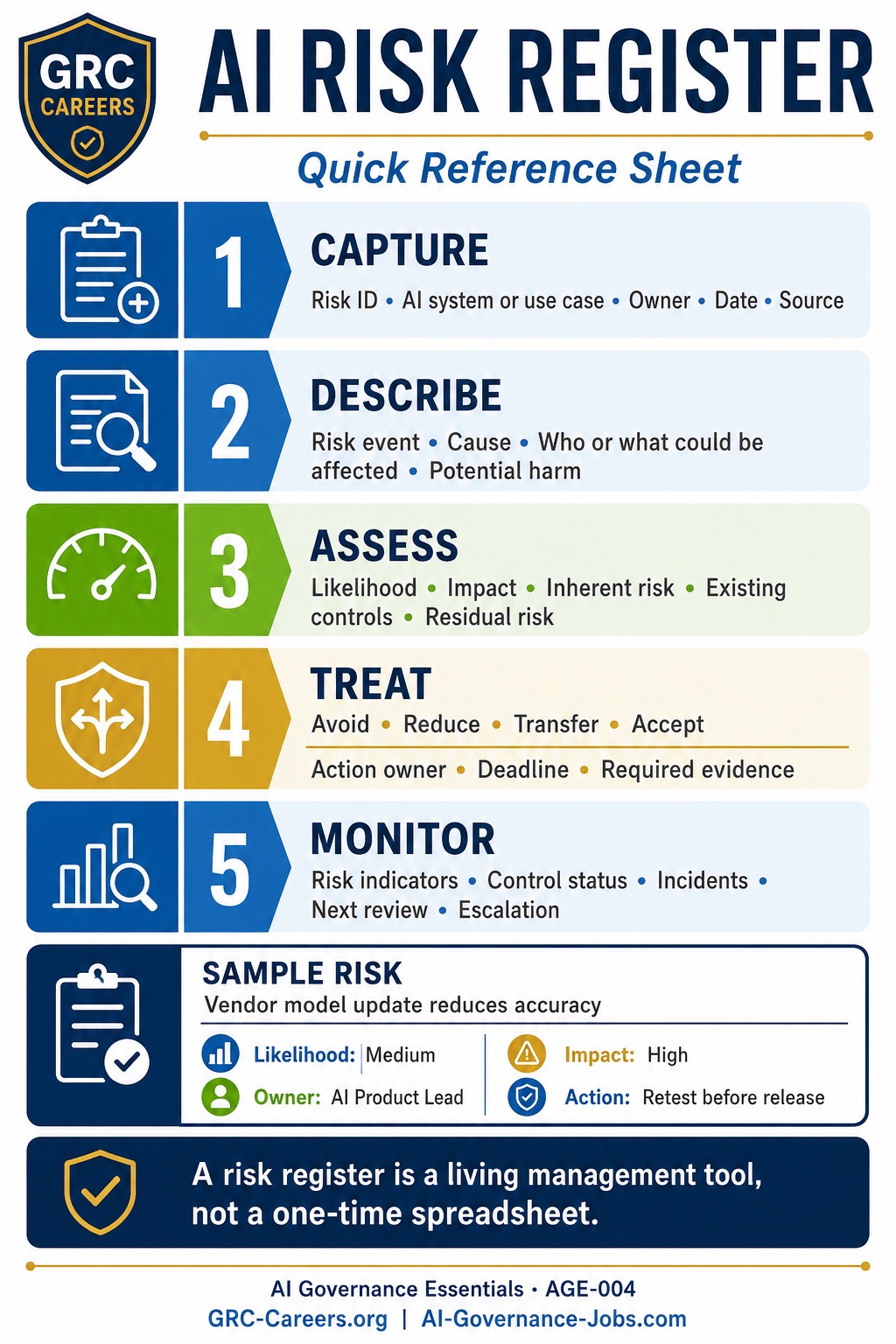
What Is an AI Risk Register?
An AI risk register is a structured record used to identify, assess, assign, treat, monitor, and document risks associated with artificial intelligence systems.
Think of it as the operational memory of an AI risk-management program.
An organization may have policies declaring that AI must be safe, fair, secure, transparent, privacy-conscious, and appropriately supervised. Those policies establish expectations. The risk register answers a more immediate set of questions:
What could actually go wrong with this AI system? How serious is the risk? Who owns it? What are we doing about it? What risk remains? And who decided that remaining risk was acceptable?
That distinction matters.
Governance becomes difficult to demonstrate when risk exists only in meeting discussions, emails, slide decks, or someone's memory. A risk register turns those discussions into a durable management record.
A mature register typically connects an identified risk to the AI system that creates or encounters it, the individual accountable for it, the controls being used, the treatment decision, the residual risk after controls, and the evidence showing that the organization continues to monitor it.
This is why the register is much more than a list of things that could go wrong.
It is a decision-management tool.
---
# Why Organizations Need an AI Risk Register
AI creates risks that can change rapidly and sometimes behave differently from traditional software risks.
Model behavior can drift. Data can change. A vendor can replace an underlying foundation model. A seemingly harmless use case can expand into a consequential one. Generative AI can produce unexpected outputs. An agentic system can gain new tools or permissions. A model can perform well overall while creating harmful outcomes for particular populations.
NIST's AI RMF treats AI risk management as a continuous lifecycle activity organized around four functions: Govern, Map, Measure, and Manage. NIST specifically calls for organizations to inventory AI systems, identify and document risks and impacts, measure risk, establish accountability, prioritize risks, develop responses, and continually monitor deployed systems.
A well-designed risk register gives those activities somewhere to live.
It can help an organization answer questions such as:
- Which AI risks are currently rated high?
- Which systems have unresolved risks?
- Who owns each risk?
- What treatment has been selected?
- Which risks are approaching their review date?
- Where has residual risk been formally accepted?
- Which controls are failing or overdue?
- Which risks changed after deployment?
- Which systems should be escalated to the AI Governance Committee?
- Which risk decisions can the organization prove it actually made?
That last question becomes particularly important during audits, incidents, procurement reviews, regulatory inquiries, board reporting, or customer due diligence.
---
# AI Risk Register vs. AI System Inventory vs. AI Policy Register
These three records are frequently confused.
They should not be.
| Governance Record | Primary Question | Typical Unit | |---|---|---| | AI System Inventory | What AI do we have? | One entry per AI system or use case | | AI Risk Register | What could go wrong, how serious is it, and what are we doing about it? | One or more risks associated with each system | | AI Policy Register | What governance policies exist and what is their status? | One entry per policy |
An AI System Inventory might tell you that the organization uses an AI-assisted recruiting platform.
The AI Risk Register might contain several risks associated with that system: discriminatory outcomes, inappropriate use of sensitive data, lack of explainability, model drift, inadequate human oversight, vendor dependency, cybersecurity exposure, or improper automated decision-making.
The AI Policy Register, meanwhile, records the organizational policies governing activities such as AI risk management, privacy, acceptable use, model validation, human oversight, third-party AI, and generative AI.
This isn't merely a theoretical distinction. A mature policy library may track dozens of separate governance policies by identifier, owner, approval authority, status, version, effective date, review date, linked controls, and location.
Those policies tell people how the organization expects AI to be governed.
The system inventory tells the organization what it is governing.
The risk register tells it what risk it is actually carrying.
The three records should connect to one another.
---
# What Should an AI Risk Register Contain?
There is no single universal set of columns that every organization must use.
The design should reflect the organization's size, regulatory environment, risk methodology, AI maturity, and existing enterprise risk-management practices.
A useful starting structure is:
| Field | What It Records | |---|---| | Risk ID | Unique identifier | | AI System ID | Link to the AI System Inventory | | System / Use Case | AI application associated with the risk | | Risk Description | Clear description of what could happen | | Risk Category | Privacy, bias, security, safety, legal, performance, etc. | | Impacted Stakeholders | People, groups, organization, customers, public | | Likelihood | Probability or qualitative likelihood | | Impact / Severity | Potential magnitude of harm | | Inherent Risk | Risk before treatment | | Existing Controls | Safeguards already operating | | Risk Owner | Named person accountable for the risk | | Treatment | Avoid, reduce, transfer, or accept | | Treatment Actions | Additional controls or remediation | | Target Date | When treatment should be completed | | Residual Risk | Risk remaining after treatment | | Risk Appetite Status | Whether residual risk falls within approved tolerance | | Approval / Acceptance | Person or body accepting residual risk | | Monitoring Metric | What will indicate changing risk | | Threshold | Point that triggers action or reassessment | | Last Assessment | Most recent assessment date | | Next Review | Required reassessment date | | Status | Open, mitigating, accepted, escalated, closed, etc. | | Evidence | Links to assessments, approvals, tests, or monitoring records |
Not every small organization needs 20-plus columns on day one.
The important principle is that the register should capture enough information to move a risk from identification to accountability to action.
---
# A Simple AI Risk Register Example
Consider an organization deploying an AI-enabled recruiting tool that recommends candidates to hiring managers.
One register entry might look like this:
System: AI Candidate Recommendation Platform Risk: Candidate-ranking outputs may create disparate outcomes affecting protected groups. Category: Fairness / Legal / Employment Likelihood: Medium Impact: High Inherent Risk: High Risk Owner: VP, Talent Acquisition Controls: Bias testing, human review, outcome monitoring, vendor testing requirements Treatment: Reduce Residual Risk: Medium Monitoring: Selection-rate variance and adverse-impact indicators Escalation threshold: Material variance beyond approved threshold Review frequency: Quarterly and following material model changes Status: Active monitoring
But this would probably not be the only risk associated with the system.
The same AI application might also generate separate entries for:
- privacy and applicant-data risk;
- model drift;
- inadequate human oversight;
- vendor model changes;
- explainability;
- accessibility;
- cybersecurity;
- unauthorized secondary use of candidate data;
- improper automated employment decisions;
- inaccurate candidate information.
That is why an AI risk register generally should not be designed as one simple "risk rating" attached to each AI system.
One system can create many different risks.
---
# Risk Identification Comes Before Risk Scoring
One of the easiest mistakes to make is jumping directly to a red-yellow-green rating.
Before scoring risk, determine what the risk actually is.
Useful categories may include:
Performance and reliability: inaccurate outputs, model drift, hallucination, brittleness, unexpected behavior.
Fairness and discrimination: disparate outcomes, proxy discrimination, biased training data, accessibility problems.
Privacy: inappropriate personal-data processing, sensitive-data leakage, excessive collection, unauthorized secondary use.
Security: prompt injection, model extraction, data poisoning, unauthorized access, insecure integrations.
Safety: physical, psychological, financial, professional, or other harm.
Transparency and explainability: inability to understand or appropriately communicate system behavior and limitations.
Human oversight: automation bias, unclear escalation rights, ineffective review, humans technically present but practically unable to intervene.
Legal and regulatory: use inconsistent with applicable law, sector requirements, contractual commitments, or employment rules.
Third-party and vendor risk: dependence on external models, unannounced model changes, unavailable evidence, weak contractual protections.
Operational risk: outages, integration failures, inadequate monitoring, insufficient staff capability.
Reputational risk: stakeholder harm, loss of trust, inappropriate public-facing outputs.
Agentic AI risk: excessive autonomy, unsafe tool access, cascading actions, weak authorization boundaries, or inability to interrupt a process.
The goal is not to create the longest possible list. It is to identify material risks in the context in which the system will actually operate.
NIST's Map function similarly emphasizes understanding intended purpose, use context, affected people, likely impacts, foreseeable misuse, third-party components, and system-specific risks before moving into measurement and treatment.
---
# Inherent Risk and Residual Risk
Two terms are particularly important.
Inherent risk
Inherent risk is the level of risk before considering the effect of controls or mitigation measures.
Suppose an AI system makes recommendations that influence access to an important service.
Without safeguards, the consequences of an incorrect or discriminatory recommendation could be serious. That may create a high inherent risk.
Residual risk
Residual risk is what remains after controls and treatment measures have been applied.
Controls might include independent testing, human review, data-quality requirements, usage restrictions, monitoring, validation, contractual protections, and escalation procedures.
The organization then reassesses the risk.
Perhaps the residual risk becomes medium.
The next question is critical:
Is that remaining risk within the organization's approved risk appetite?
If not, the organization generally has three choices: strengthen treatment, change the system or use case, or escalate the decision to someone authorized to accept the risk.
Your governance structure should specify who can accept which level of residual risk.
The AI Risk Management Policy in the GRC Careers implementation framework follows exactly this principle. It requires named risk owners, documented treatment decisions, evidence, and formal escalation when residual risk exceeds delegated authority.
---
# Who Owns the AI Risk Register?
Usually, one governance function should be accountable for maintaining the process, but that does not mean the governance team owns every risk.
That distinction is essential.
An AI Governance Lead, AI Risk Manager, Responsible AI function, compliance team, or enterprise-risk function may administer the register.
But individual risks should have named business or operational owners.
For example:
- Security Lead owns a model-security risk.
- Privacy Officer owns or co-owns a privacy risk.
- HR leader owns employment-use risk.
- Product leader owns product-performance risk.
- Business Unit Head owns risk associated with a business deployment.
- Model/System Owner is responsible for treatment and monitoring activities.
- AI Governance Committee handles escalations and higher-level risk acceptance.
The underlying principle is simple:
A committee can oversee risk. A committee should not become a substitute for individual accountability.
The AI Risk Management Policy in the GRC Careers policy library similarly separates the AI Governance Lead, system owner, specific Risk Owner, validator, Business Unit Head, Risk/ERM function, and specialist Legal, Privacy, Security, and Compliance roles.
---
# How the AI Governance Committee Uses the Risk Register
The AI Governance Committee should not review every low-level risk every week.
Instead, the register gives the committee a way to focus attention where its authority matters.
A committee dashboard might show:
- number of high-risk AI systems;
- newly identified high risks;
- residual risks requiring acceptance;
- risks outside appetite;
- overdue remediation;
- overdue reassessments;
- unresolved control failures;
- systems approaching deployment;
- material incidents;
- vendor-related changes;
- recurring risks appearing across multiple systems.
The committee can then concentrate on decisions and escalations instead of administrative review.
This is one reason the AI risk register and the AI Governance Committee belong next to each other in a governance architecture.
The register creates visibility. The committee creates authority.
---
# An AI Risk Register Is a Living Record
Creating the register is only the beginning.
AI risk changes.
A system that was low-risk during an internal pilot can become much more consequential when exposed to customers. A vendor can change models. The organization can introduce new data. A regulatory requirement can change. An agent can gain additional tools. A system may be repurposed for a use its original assessment never considered.
NIST explicitly describes AI risk management as continuous and lifecycle-based rather than a one-time exercise. Its Manage function calls for prioritized responses, documented treatment, regular monitoring, and continual improvement.
ISO/IEC 42001 likewise uses a management-system model based on continuing assessment, treatment, monitoring, review, and improvement rather than a single certification-era risk exercise.
Useful reassessment triggers therefore include:
- material model changes;
- new data;
- new integrations;
- change of intended use;
- new user population;
- significant performance drift;
- incidents or near misses;
- control failures;
- changes in vendors or foundation models;
- new legal or regulatory requirements;
- substantial changes in system autonomy;
- deployment into a new geography;
- evidence that assumptions made during the original assessment are no longer valid.
A review date in a spreadsheet is helpful.
A trigger-based reassessment process is better.
---
# How an AI Risk Register Supports the NIST AI RMF
The NIST AI Risk Management Framework does not prescribe a specific artifact called an "AI Risk Register."
That distinction is important.
What NIST does prescribe through its voluntary framework is a collection of outcomes around governance, accountability, documentation, system inventory, risk identification, measurement, response, monitoring, and lifecycle management.
An AI risk register can become one of the practical mechanisms an organization uses to operationalize those outcomes.
For example:
GOVERN: establish ownership, policies, documentation, risk tolerance, accountability, and review processes.
MAP: identify system context, affected stakeholders, potential impacts, foreseeable misuse, and risks.
MEASURE: assess likelihood, severity, performance, controls, uncertainty, and other risk indicators.
MANAGE: prioritize risk, choose treatment, assign resources, accept or escalate residual risk, and monitor changes.
The register connects those activities.
It provides continuity between assessment and management.
---
# How an AI Risk Register Supports ISO/IEC 42001
ISO/IEC 42001 is the international AI management-system standard for organizations developing, providing, or using AI systems. ISO describes it as a framework for establishing, implementing, maintaining, and continually improving an Artificial Intelligence Management System.
ISO also describes the standard as an integrated approach that moves from AI risk assessment to treatment of those risks, supported by ongoing management and improvement.
Again, ISO/IEC 42001 should not be reduced to "keep a spreadsheet."
The register is an implementation mechanism.
The management system is broader.
Organizations pursuing ISO/IEC 42001 alignment or certification will need policies, responsibilities, documented processes, controls, assessments, monitoring, review, corrective action, and evidence. A properly maintained risk register can help connect much of that work.
---
# What About the EU AI Act?
The EU AI Act takes a legally different approach from voluntary frameworks such as the NIST AI RMF.
For high-risk AI systems, Article 9 requires a risk management system that is established, implemented, documented, maintained, and operated as a continuous iterative process across the lifecycle. The required process includes identifying and analyzing known and reasonably foreseeable risks, estimating and evaluating risks, considering information from post-market monitoring, and adopting targeted risk-management measures.
The regulation does not simply say, "Create an AI risk register."
But organizations need a reliable way to document and demonstrate that those activities actually occurred. A structured risk register can become an important component of that evidence architecture.
Following the 2026 AI Omnibus changes, the rules for Annex III high-risk systems apply beginning December 2, 2027, while rules for high-risk AI embedded in regulated products apply beginning August 2, 2028.
Organizations should use the extended implementation period to build the underlying governance capability rather than treating the later date as a reason to postpone risk management.
---
# Seven Common AI Risk Register Mistakes
1. Treating the inventory as the risk register
Knowing an AI system exists does not tell you what risks it creates.
Connect the two records, but do not collapse them into one meaningless row.
2. Giving each AI system only one overall risk score
One system may simultaneously create privacy, security, fairness, performance, vendor, legal, and human-oversight risks.
Those risks may have different owners and treatments.
3. Assigning risk to a committee
"AI Governance Committee" is not a useful entry in the Risk Owner field.
Name an accountable person.
4. Recording inherent risk but not residual risk
Governance needs to show whether controls actually changed the organization's exposure.
5. Recording mitigation with no evidence
"Human review implemented" is not enough.
Where is the procedure? Who performs the review? What is reviewed? Can the reviewer override the AI? Is the control tested?
6. Never updating the register
A beautifully designed risk register that reflects last year's system is worse than a simple register that people actually maintain.
7. Turning the register into compliance theater
The purpose is not to produce an impressive spreadsheet.
The purpose is to make better decisions about real risks.
---
# How to Start an AI Risk Register
For organizations starting from scratch, the process can remain relatively simple.
Step 1: Build the AI System Inventory
You cannot systematically manage risk from AI systems you do not know exist.
Step 2: Assign system owners
Every in-scope AI system or significant use case should have an accountable owner.
Step 3: Identify material risks
Consider system purpose, users, affected people, data, outputs, dependencies, foreseeable misuse, and potential harms.
Step 4: Assess inherent risk
Use an established likelihood-and-impact methodology appropriate to the organization.
Step 5: Identify existing controls
Document what is already reducing the risk.
Step 6: Select treatment
Decide whether to avoid, reduce, transfer, or accept each material risk.
Step 7: Assign a Risk Owner
Name the person responsible for ensuring the treatment happens and the risk continues to be monitored.
Step 8: Assess residual risk
Determine what exposure remains after controls.
Step 9: Escalate when necessary
Residual risk beyond delegated authority should go to the appropriate executive or governance body.
Step 10: Monitor and reassess
Establish metrics, thresholds, review dates, and event-driven reassessment triggers.
A small organization may be able to perform all of this using a controlled spreadsheet.
A large or regulated enterprise may integrate the same process into an enterprise GRC platform, model-risk system, procurement workflow, development lifecycle, change-management platform, and executive risk reporting.
The sophistication of the technology is secondary.
The quality of the accountability and decision process is what matters.
---
# The Bottom Line
An AI risk register answers one of the most important questions in AI governance:
What AI risk are we carrying right now, and what are we doing about it?
It connects systems to risks, risks to owners, owners to treatment, treatment to controls, controls to evidence, and residual risk to decisions.
Without that connection, organizations can have extensive AI policies and still lack a clear view of their actual exposure.
With it, the organization begins to move from principles to operating governance.
And that is where effective AI governance really starts.
---
Frequently Asked Questions
What is an AI risk register?
An AI risk register is a structured, continuously maintained record of identified AI risks, their severity, owners, controls, treatment decisions, residual risk, monitoring requirements, and status.
Is an AI risk register the same as an AI System Inventory?
No. An AI System Inventory records which AI systems and use cases an organization has. An AI risk register records the risks associated with those systems. One AI system can have multiple risks.
Is an AI risk register required by NIST?
NIST's AI Risk Management Framework does not mandate a particular document called an AI risk register. It does call for systematic governance, documentation, inventory, risk identification, measurement, treatment, accountability, monitoring, and lifecycle management. A risk register is one practical method of operationalizing those activities.
Is an AI risk register required by ISO/IEC 42001?
ISO/IEC 42001 establishes requirements for an AI management system that includes risk assessment, risk treatment, monitoring, and continual improvement. Organizations may use a risk register as part of the documented system used to manage those requirements.
Does the EU AI Act require an AI risk register?
Article 9 requires a documented, maintained, continuous risk-management system for high-risk AI systems. It does not specifically require an artifact bearing the title "AI Risk Register." A risk register can nevertheless be a useful mechanism for documenting risk identification, evaluation, treatment, monitoring, and accountability.
Who should own the AI risk register?
A central AI governance, risk, compliance, or Responsible AI function may administer the register, but individual risks should be assigned to named accountable Risk Owners.
How often should an AI risk register be updated?
The register should be updated whenever risk materially changes and reviewed according to risk level. Important triggers include model changes, new data, new uses, incidents, performance drift, control failures, regulatory changes, vendor changes, and changes in system autonomy.
Can a small organization use a spreadsheet?
Yes. A controlled spreadsheet can be entirely appropriate when the number of systems and risks is manageable. The key requirements are clear ownership, consistent assessment, controlled access, evidence, review discipline, and escalation. ---
- Founder of ExecSearches and GRC Careers
- Executive search across corporate, higher education, financial services, and nonprofit sectors
- Focus on AI governance and GRC hiring
- More than a decade in risk advisory and internal audit in financial services
- Led SOX and regulatory audits for Citi, Goldman Sachs, Morgan Stanley, and McKesson
- Public Accounting Certification, Cornell University
Who's Hiring AI Governance Professionals?
Explore current openings in:
AI Governance Jobs · Responsible AI · AI Risk · AI Compliance · AI Audit · AI Policy · Privacy · Cybersecurity · Public Policy
Search the latest opportunities at GRC Careers › · nonprofit GRC jobs ›