
Home › AI Governance Insights › What Is an AI Vendor Assessment? A Practical Guide to Third-Party AI Risk
What Is an AI Vendor Assessment? A Practical Guide to Third-Party AI Risk
By F. Jay Hall and Stephan Pochet, AI Governance Essentials · August 15, 2026 · 12 min read min read
Key Takeaways
- An AI vendor assessment evaluates the product, the provider, the intended use, and the customer’s ability to govern the system after purchase.
- Traditional security and privacy reviews remain necessary, but they do not answer questions about model performance, bias, explainability, human oversight, training-data rights, or AI-specific change risk.
- The depth of review should follow the use case and potential impact, not the size or reputation of the vendor.
- Vendor claims are not evidence. Higher-risk uses require documentation, testing results, contract protections, and independent validation where appropriate.
- The assessment does not end at purchase. Monitoring, change notification, incident response, renewal, and exit planning are part of the same lifecycle.
Organizations rarely build every artificial intelligence system themselves. They buy software with embedded AI, connect to general-purpose models through an API, license specialized models, use vendor data, adopt AI features inside systems they already own, and allow contractors to operate AI services on their behalf.
Each arrangement can create value. Each can also introduce risk that the customer cannot see directly. The model may change without warning. Training data may be poorly documented. Customer information may be retained or used to improve the product. Performance may look strong in a vendor demonstration but weaken in the customer’s population or operating environment. A critical feature may depend on another provider several layers down the supply chain.
An AI vendor assessment is the process for making those risks visible before the organization becomes dependent on the product.
What is an AI vendor assessment?
An AI vendor assessment is a structured, risk-based evaluation of a third party that provides an AI system, model, data source, platform, component, or AI-enabled service. It examines whether the product is suitable for its intended use, whether the vendor’s claims are supported by evidence, whether important risks can be controlled, and whether the customer will retain enough information and authority to govern the system throughout its lifecycle.
The assessment usually brings together procurement, business ownership, legal, privacy, cybersecurity, compliance, enterprise risk, data governance, technology, and the people responsible for AI oversight. Higher-risk uses may also require model validation, accessibility, human resources, safety, ethics, internal audit, or sector-specific expertise.
The question is not whether the vendor is trustworthy in general. The question is whether this product is trustworthy enough for this use, with these people, data, controls, and consequences.
Why an ordinary vendor review is not enough
Existing third-party risk programs give AI governance a valuable foundation. They already examine financial stability, cybersecurity, privacy, service continuity, legal terms, subcontractors, and regulatory compliance. Those questions still matter.
AI adds risks that conventional questionnaires may not reach:
- Performance varies by context. A model can perform well in one population, language, workflow, or data environment and poorly in another.
- Outputs are probabilistic. The same or similar input may not always produce the same result.
- Models and services change. A vendor may update the model, safety filters, training data, integrations, or terms after approval.
- The system may be difficult to explain. The customer may not receive enough information to understand why a result occurred or to contest it.
- Data rights may be uncertain. Questions can arise about training data, generated content, confidential information, personal data, and intellectual property.
- Human reliance changes the risk. A tool described as advisory may function like an automated decision when employees routinely accept its recommendation.
- The supply chain may be layered. The vendor may rely on a model provider, cloud platform, data supplier, plug-in, or subcontractor that the customer never selected directly.
NIST addresses this directly in the AI Risk Management Framework. Its Govern function calls for policies covering third-party software, data, hardware, and supply-chain issues, including transparency, testing, instructions, intellectual-property concerns, auditability, incident response, and contingency planning. Its Manage function calls for third-party resources and controls to be monitored and documented, not merely reviewed once.
What counts as an AI vendor?
The review should not be limited to companies that advertise themselves as AI vendors. Relevant third parties include:
- Software providers that have added generative or predictive AI features.
- General-purpose model and API providers.
- Cloud platforms hosting models, data, or AI workloads.
- Recruiting, healthcare, education, financial, marketing, or case-management systems that use automated scoring or recommendations.
- Data brokers, labeling providers, and synthetic-data suppliers.
- Consultants or contractors who build, configure, or operate AI for the organization.
- Open-source models or components incorporated into a vendor product.
- Subprocessors and subcontractors supporting the vendor’s AI service.
Start with the intended use, not the questionnaire
The same product can be low risk in one use and high risk in another. A language model used to brainstorm internal meeting titles is different from the same model used to rank job applicants, draft clinical guidance, determine eligibility, investigate fraud, or communicate legal rights.
Before sending questions to the vendor, document:
- The business problem and expected benefit.
- The exact decision or workflow the system will influence.
- Who will use the system and who will be affected by its outputs.
- The data the system will receive, create, infer, retain, or share.
- Whether outputs affect rights, safety, employment, health, education, credit, public services, or other significant interests.
- The role of human review and whether the reviewer can realistically disagree with the system.
- The harm that could follow from error, bias, misuse, unavailability, or unauthorized disclosure.
- The alternatives available if the product is rejected or fails.
This use-case description becomes the basis for risk tiering, evidence requests, testing, contract terms, approval, and monitoring.
Use risk tiers to determine the depth of review
| Tier | Typical characteristics | Review approach |
|---|---|---|
| Lower risk | Internal productivity, approved tools, nonsensitive data, no meaningful decision about a person, easy human verification, and limited consequences if wrong. | Basic registration, security and privacy checks, acceptable-use controls, standard contract review, and confirmation of data handling. |
| Moderate risk | Customer-facing content, operational recommendations, important business processes, confidential data, integrations, or outputs that require skilled human review. | Expanded documentation, use-case testing, legal and compliance review, defined performance limits, monitoring, change notification, and incident terms. |
| Higher risk | Meaningful influence over employment, education, healthcare, credit, insurance, housing, public benefits, safety, law enforcement, legal rights, vulnerable populations, or essential services. | Enhanced impact and risk assessment, independent testing or validation, strong evidence requirements, senior approval, formal human oversight, audit rights, strict change control, continuous monitoring, and an exit plan. |
| Prohibited or unacceptable | The use violates law, policy, contract, organizational values, or risk appetite, or the vendor cannot provide minimum evidence for a consequential use. | Reject or stop the use. A commercial need does not cure an unacceptable risk. |
Risk tiering should consider both the product and the proposed use. A respected provider does not lower the impact of a harmful decision. A small vendor does not automatically create high risk if the use is limited and the controls are strong.
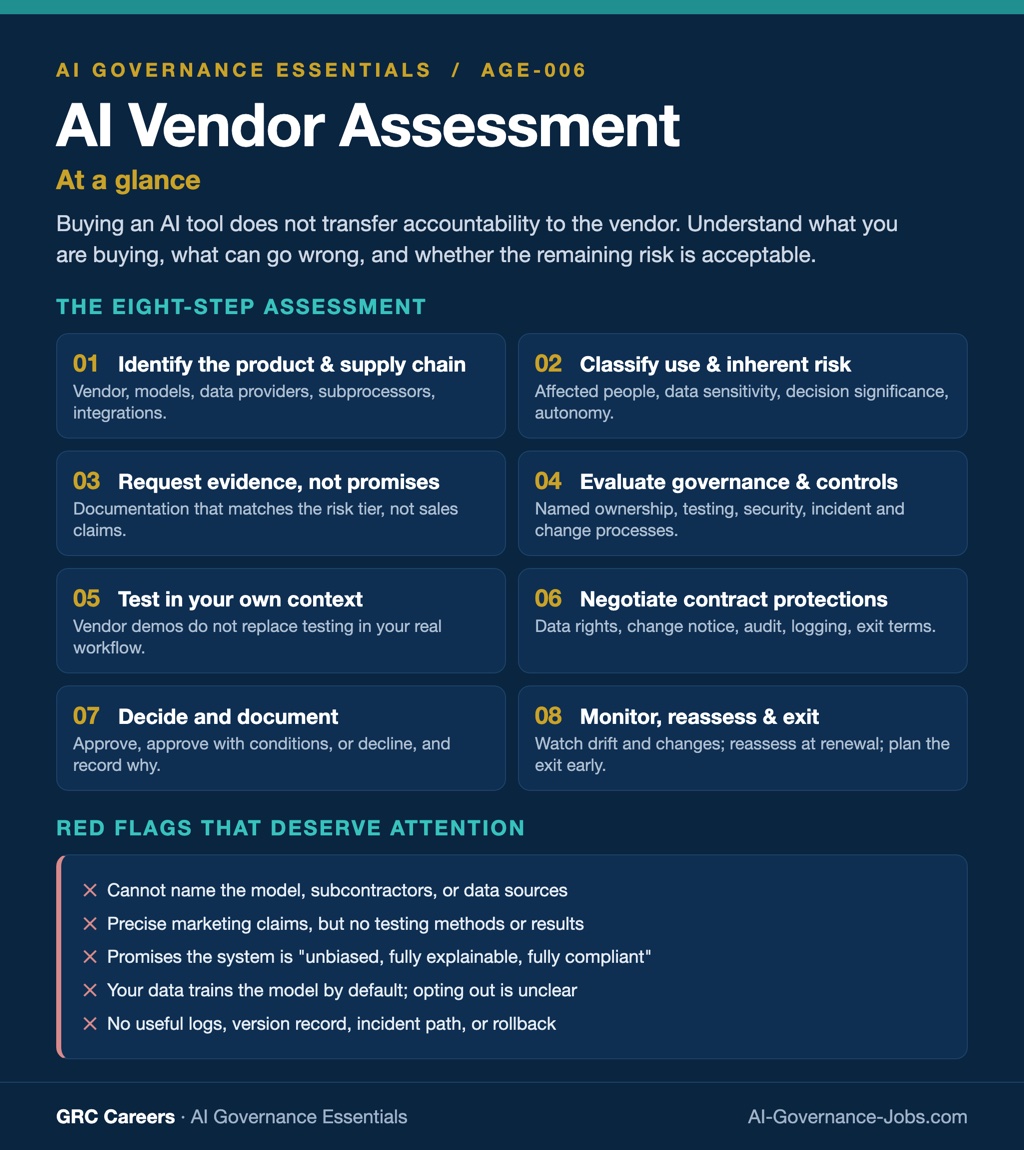
The eight-step AI vendor assessment
1. Identify the product and supply chain
Document the legal vendor, the product, the AI features, the underlying models, data providers, hosting environment, subprocessors, plug-ins, and critical integrations. Determine whether the vendor developed the model, fine-tuned another model, or simply provides access to a third party.
2. Classify the intended use and inherent risk
Assess the risk before new controls are applied. Consider affected people, sensitivity of data, decision significance, scale, autonomy, reversibility, visibility, and the consequences of failure. Identify legal or policy triggers that require enhanced review.
3. Request evidence, not promises
Ask the vendor for current documentation that supports its claims. Sales presentations and broad responsible-AI principles are not enough for a consequential use. The required evidence should match the risk tier.
4. Evaluate the vendor’s governance and controls
Review how the vendor manages AI risk internally. Look for named ownership, risk assessment, documented testing, security and privacy controls, incident management, complaint handling, model and data change processes, subcontractor oversight, monitoring, and governance that extends beyond product marketing.
5. Test the product in the customer’s context
Vendor testing does not replace customer testing. Evaluate performance with representative data, users, languages, edge cases, accessibility needs, adversarial inputs, and realistic workflows. Compare the results to documented thresholds and to a non-AI alternative where appropriate.
6. Negotiate contract protections
Convert important controls into enforceable obligations. The contract should address data use, confidentiality, security, documentation, changes, incidents, audit or assurance, subcontractors, intellectual property, service continuity, deletion, transition support, and responsibility for failures.
7. Decide and document
The decision may be approve, approve with conditions, pilot within limits, defer pending evidence, or reject. Record the evidence reviewed, unresolved limitations, compensating controls, owner, risk acceptance, monitoring plan, conditions, expiration, and events that require reassessment.
8. Monitor, reassess, and prepare to exit
Track product performance, incidents, complaints, vendor changes, control effectiveness, new subcontractors, legal developments, and concentration risk. Reassess at renewal and after material changes. Maintain a practical plan for data return or deletion, replacement, continuity, and safe decommissioning.
What evidence should the vendor provide?
| Evidence area | Examples | What it helps establish |
|---|---|---|
| System documentation | System card, model card, intended-use statement, architecture summary, integration guide, and operating instructions. | What the system is designed to do, how it works at a useful level, and where its limitations begin. |
| Performance and testing | Evaluation methods, datasets, results by relevant subgroup, error analysis, robustness testing, red-team findings, and known failure modes. | Whether claims are supported and whether performance is relevant to the customer’s context. |
| Data governance | Data sources, provenance, rights, quality controls, retention, customer-data practices, training and fine-tuning rules, and deletion procedures. | Whether data is lawful, suitable, protected, and used as expected. |
| Privacy and security | Privacy impact material, encryption and access controls, security testing, incident response, vulnerability management, penetration testing, and assurance reports. | Whether systems and information are protected and failures can be detected and managed. |
| Responsible-AI controls | Risk or impact assessments, fairness testing, explainability approach, human-oversight design, abuse prevention, content controls, and complaint processes. | Whether risks to people and society are treated as operating issues rather than principles alone. |
| Lifecycle management | Release notes, model versioning, change policy, monitoring approach, rollback capability, decommissioning plan, and support commitments. | Whether the customer can remain in control after the original approval. |
| Supply chain | Underlying models, open-source components, data providers, subprocessors, hosting providers, geographic locations, and dependency changes. | Which parties and components can affect the service and where hidden concentration or transfer risk exists. |
| Independent assurance | Relevant certifications, audits, conformity assessments, validation reports, or qualified third-party reviews. | Whether important claims have been examined by someone other than the sales team or product owner. |
No single document proves that a product is safe or compliant. Certifications and audit reports may support the assessment, but their scope, date, exclusions, testing depth, and relationship to the proposed use must be examined.
Core questions to ask an AI vendor
Product and intended use
- What is the system designed to do, and which uses do you prohibit or advise against?
- Which model or models power the product, and which party developed each one?
- What decisions does the product make, recommend, rank, generate, or automate?
- What are the known limitations and foreseeable failure modes?
Data and rights
- What customer data is collected, retained, logged, shared, or used for training or product improvement?
- What are the sources and usage rights for training, fine-tuning, evaluation, and retrieval data?
- Can the customer prevent its data from being used to train or improve models?
- How are deletion, retention, residency, access, and data-subject obligations handled?
Performance and testing
- Which performance measures do you use, and why are they appropriate for the intended use?
- How does performance vary across populations, languages, environments, or relevant subgroups?
- What independent evaluation, validation, red teaming, or adversarial testing has been completed?
- What evidence can the customer review, and what testing can the customer perform?
Oversight and operation
- What information does a human reviewer receive, and can that person meaningfully challenge or override the system?
- What logs, explanations, confidence information, or audit trails are available?
- How are complaints, appeals, harmful outputs, vulnerabilities, and incidents reported and resolved?
- What monitoring does the product provide for performance, drift, bias, misuse, and control failure?
Change and supply chain
- Which changes can occur without customer approval, and how much notice will the customer receive?
- Can the customer remain on an approved model version or roll back after a harmful change?
- Which subprocessors, model providers, data sources, and infrastructure providers support the service?
- How are those third parties assessed, monitored, replaced, and disclosed?
Accountability and exit
- Who is accountable inside the vendor for AI governance, security, privacy, and incidents?
- Which contract commitments support the vendor’s statements about performance, data use, and controls?
- What happens if the product becomes unavailable, noncompliant, unsafe, or materially different?
- How will data, configurations, logs, and records be returned, transferred, retained, or deleted at termination?
Do not confuse the questionnaire with the assessment
A completed questionnaire is one source of information. The assessment is the organization’s evaluation of that information against the use case and risk appetite.
Reviewers should identify claims that need verification, contradictions between documents, missing evidence, unclear ownership, outdated reports, broad exclusions, and conditions the customer would need to impose. For higher-risk uses, the organization may need a product demonstration, access to technical specialists, customer testing, references from comparable deployments, independent validation, or a limited pilot.
A vendor’s refusal to disclose proprietary model details does not automatically end the review. Some information may legitimately remain confidential. The question is whether the vendor can provide enough documentation, testing, assurance, contractual accountability, and operational visibility for the customer to manage the risk. For a consequential use, “trust us” is not a control.
Test the system in the real workflow
Testing should reflect how the organization will actually use the product. That includes normal cases, difficult cases, misuse, foreseeable workarounds, and the pressures employees face in real operations.
A practical evaluation may examine:
- Accuracy, reliability, false positives, false negatives, and uncertainty.
- Performance for relevant groups, languages, disabilities, and operating conditions.
- Hallucination, unsupported claims, harmful content, or unsafe recommendations.
- Prompt injection, data leakage, unauthorized access, and other security threats.
- Whether explanations are understandable and useful to the intended reviewer.
- Whether human reviewers notice errors, have enough time, and possess the authority to intervene.
- Whether logs and records support investigation, challenge, appeal, and audit.
- Whether the product creates a measurable improvement over the existing process.
Pass and fail thresholds should be defined before the test where possible. Otherwise, a team that wants the product may rationalize disappointing results after the fact.
Contract protections that matter
Legal counsel should tailor contract language to the organization, jurisdiction, sector, and risk. Common areas for AI-specific terms include:
- Permitted use of customer data: whether information may be retained, reviewed by humans, used for training, or shared.
- Confidentiality and security: controls, incident notice, cooperation, evidence preservation, and remediation.
- Documentation and instructions: information needed to use the system safely and comply with customer obligations.
- Performance commitments: defined service levels or product claims where the risk justifies them.
- Model and product changes: notice, impact information, customer testing time, consent where necessary, version control, and rollback.
- Subcontractors and underlying models: disclosure, approval rights, flow-down obligations, and change notice.
- Intellectual property: rights in inputs and outputs, infringement claims, training-data issues, indemnity, and acceptable use.
- Audit and assurance: access to relevant reports, testing results, records, and additional evidence after incidents or material changes.
- Legal and regulatory cooperation: information and support needed for assessments, notices, investigations, complaints, and regulators.
- Human oversight and controls: features and information the customer relies on to review or intervene.
- Suspension and termination: the right to stop unsafe or noncompliant use without being trapped by commercial terms.
- Exit and continuity: data portability, deletion, transition support, retention of necessary records, and contingency arrangements.
Approval outcomes and conditions
An assessment should end with a clear outcome:
| Outcome | When it fits | What to document |
|---|---|---|
| Approve | Evidence and controls are sufficient for the intended use and risk tier. | Owner, approved use, baseline configuration, monitoring, renewal, and change triggers. |
| Approve with conditions | Risk is acceptable only with additional restrictions or actions. | Conditions, responsible owners, deadlines, validation, and consequences if unmet. |
| Limited pilot | Evidence is promising but the organization needs controlled testing. | Scope, data limits, users, duration, success criteria, monitoring, and stop conditions. |
| Defer | Important documentation, testing, contract terms, or controls are incomplete. | Missing items, responsible parties, and what is required for reconsideration. |
| Reject | Risk is prohibited, unsuitable, unsupported by evidence, outside appetite, or cannot be controlled. | Decision basis, alternatives considered, and whether future reconsideration is possible. |
Approval should identify the exact use. A system approved to summarize internal documents is not automatically approved to score employees or answer questions from the public.
Red flags that deserve attention
- The vendor cannot identify the underlying model, material subcontractors, or important data sources.
- Marketing claims are precise, but testing methods and results are unavailable.
- The vendor promises the system is unbiased, fully explainable, or completely compliant.
- Customer data may be used for training by default, and opting out is unclear or ineffective.
- The vendor can materially change the model or data practices without notice.
- The product offers no useful logs, version record, incident path, or rollback mechanism.
- Human oversight exists only on paper, with no information or authority needed to intervene.
- The contract disclaims all responsibility while restricting the customer’s ability to test or audit.
- The vendor has no clear process for complaints, harmful outputs, vulnerabilities, or significant incidents.
- The vendor resists reasonable questions by calling all AI information confidential.
A red flag does not always require rejection. It requires an explanation, evidence, compensating controls, restricted use, stronger contract terms, or escalation. Several red flags together may show that the customer cannot govern the product responsibly.
Monitoring after purchase
Third-party AI risk changes over time. Monitoring should match the product’s importance and risk. It may include:
- Performance, error, drift, bias, override, and complaint measures.
- Vendor notices, release notes, model versions, and changed subprocessors.
- Security vulnerabilities, privacy events, service outages, and AI incidents.
- Changes to terms, data use, retention, intellectual-property protections, or pricing that affect control.
- New regulatory classifications or obligations.
- Overreliance, workarounds, unauthorized uses, and use beyond the approved scope.
- Vendor financial condition, acquisition, strategic change, or loss of critical personnel.
- Concentration risk created by dependence on one model, platform, or infrastructure provider.
Material changes should trigger reassessment. Examples include a new model, a changed use case, new personal or sensitive data, new autonomy, new integrations, a different hosting location, altered training practices, a significant incident, or evidence that performance no longer meets the approved threshold.
Build the exit plan before you need it
A high-risk or operationally important AI service needs a contingency plan. The organization should know how it will continue critical work if the vendor fails, the product becomes unsafe, access is suspended, a regulator intervenes, the vendor changes direction, or the contract ends.
The exit plan should address:
- Alternative manual processes, vendors, models, or systems.
- Export of data, configurations, prompts, records, logs, and documentation.
- Secure deletion and proof of deletion.
- Retention of records needed for audit, complaint, investigation, or legal obligations.
- Transition time, assistance, cost, and responsibility.
- Communication to users and affected people.
- Safe decommissioning without losing oversight of past decisions.
NIST’s AI RMF specifically connects third-party risk with contingency planning and safe decommissioning. Exit is not merely a procurement term. It is a governance control.
A practical approach for smaller organizations
A small nonprofit, school, public agency, or business may not have separate AI, model-risk, privacy, procurement, and security teams. It can still perform a disciplined assessment.
For a lower-risk tool, document the use, confirm data handling, review security and privacy, identify the underlying provider, check whether customer data trains the model, test representative tasks, restrict sensitive uses, name an owner, and record the decision.
For a consequential use, obtain qualified legal, security, privacy, and technical help. A small organization should not lower its standard because it has fewer staff. It should narrow the use, choose a better-documented product, use independent expertise, or decide not to automate the decision.
How the assessment fits leading frameworks and regulation
The NIST AI RMF treats acquisition and third-party resources as part of AI governance across the full lifecycle. Govern 6 calls for policies addressing third-party AI systems, data, transparency, testing, instructions, intellectual property, procurement, supply-chain risk, and contingency processes. Manage 3 calls for third-party resources and their controls to be regularly monitored and documented.
ISO/IEC 42001 applies to organizations that develop, provide, or use AI, including AI supplied by third parties. Its management-system approach connects leadership, responsibilities, risk management, lifecycle controls, transparency, performance evaluation, monitoring, and continual improvement. An assessment can provide evidence that those responsibilities are being applied to procurement and vendor oversight.
The European Union AI Act assigns different responsibilities to providers, deployers, importers, distributors, and other actors. The customer’s obligations depend on its role, the system, the use, and the applicable implementation date. Official European Commission guidance emphasizes documentation across the AI value chain and, for relevant high-risk uses, operating instructions, monitoring, human oversight, input-data quality, incident response, and information for affected people. Organizations should obtain legal advice for their specific role and jurisdiction rather than relying on a vendor’s general statement of compliance.
CISA’s software-acquisition guidance provides an additional foundation for evaluating supplier and software-assurance risk. AI review should connect to that existing procurement discipline, not operate as a separate island.
The bottom line
An AI vendor assessment is not designed to eliminate all third-party risk. Its purpose is to make the intended use, evidence, limits, controls, responsibilities, and remaining risk clear enough for an accountable decision.
A strong assessment answers five questions: Do we understand what the system does? Is there credible evidence that it works for our use? Can we control the risks that matter? Will the vendor give us the information and rights needed to govern it? Can we monitor it, respond when it changes, and leave safely if necessary?
If the organization cannot answer those questions, it is not ready to buy the product, no matter how impressive the demonstration looks.
Frequently Asked Questions
What is an AI vendor assessment?
An AI vendor assessment is a risk-based review of a third party's AI system, model, data, controls, documentation, contract terms, and ongoing support before and during its use by an organization.
How is an AI vendor assessment different from a security review?
A security review focuses mainly on protecting systems and data. An AI vendor assessment also considers intended use, model performance, bias, explainability, human oversight, data and intellectual-property rights, regulatory obligations, monitoring, model changes, and potential harm to people.
Does every AI vendor need the same assessment?
No. The depth of review should match the intended use and potential impact. A low-risk internal drafting tool does not require the same evidence as a system influencing employment, healthcare, education, credit, safety, or access to services.
What evidence should an AI vendor provide?
Evidence may include system and model documentation, intended-use statements, limitations, evaluation results, data governance information, security reports, privacy documentation, incident history, change-management procedures, subcontractor details, monitoring capabilities, and independent assurance reports.
When should an AI vendor be reassessed?
Reassessment should occur at renewal and after material changes such as a new model, new training or customer-data practices, a changed use case, new integrations, a significant incident, a control failure, or a change in law or risk classification.
- Founder of ExecSearches and GRC Careers
- Executive search across corporate, higher education, financial services, and nonprofit sectors
- Focus on AI governance and GRC hiring
- More than a decade in risk advisory and internal audit in financial services
- Led SOX and regulatory audits for Citi, Goldman Sachs, Morgan Stanley, and McKesson
- Public Accounting Certification, Cornell University
Who's Hiring AI Governance Professionals?
Explore current openings in:
AI Governance Jobs · Responsible AI · AI Risk · AI Compliance · AI Audit · AI Policy · Privacy · Cybersecurity · Public Policy
Search the latest opportunities at GRC Careers › · nonprofit GRC jobs ›