
Home › Resources › AI Governance Degree Pathways
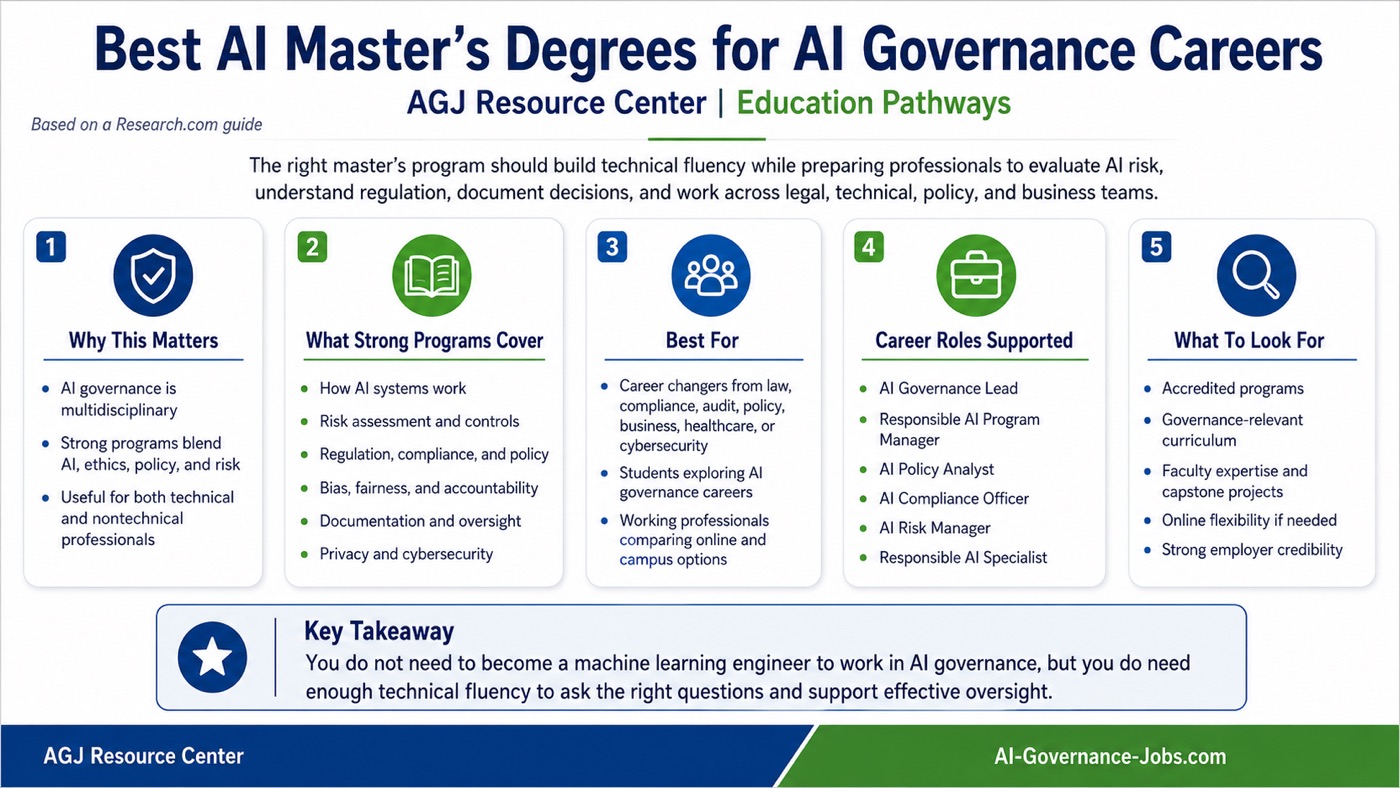
AI Governance Degree Pathways: Choosing the Right Education for an AI Governance Career
AI governance is one of the fastest-emerging career paths, and unlike traditional professions there is no single correct degree. That is an advantage. You can enter from a technical, legal, policy, security, or business background, as long as you build the right combination of technical understanding, risk and control thinking, regulatory awareness, and communication skills.
What AI governance professionals actually do
Governance jobs exist to make sure AI systems are safe, compliant, explainable, auditable, and aligned with business and ethical goals. The day-to-day work includes reviewing AI use cases before deployment, performing AI risk assessments, writing policies and governance frameworks, supporting regulatory compliance, monitoring systems after they go live, and translating technical risk into decisions leaders can act on.
Core knowledge every pathway must build
No matter your degree, you will need working exposure to five domains:
- AI fundamentals: machine learning basics, generative AI and large language models, and model evaluation and limitations.
- Risk management: the NIST AI Risk Management Framework frames AI risk as continuous, lifecycle oversight.
- Regulation and standards: the EU AI Act is a risk-based legal framework governing AI across industries.
- Ethics and responsible AI: the UNESCO Recommendation on the Ethics of AI centers human rights, fairness, and transparency.
- Governance and controls: ISO/IEC 42001 is the formal AI management system standard for governance programs.
The seven core degree pathways
There is not one path, there are several strong entry points. Each maps to a different part of the governance job.
Choosing the right path
| Your goal | Best degree path |
|---|---|
| Deep technical oversight | AI / Data Science |
| Secure AI systems | Cybersecurity |
| Interpret regulation | Law / Privacy |
| Shape policy | Public Policy |
| Lead governance programs | MBA / Business |
| Audit and risk management | GRC / Information Systems |
What to look for in a strong program
Focus on the curriculum, not the title. The strongest programs include AI and governance crossover courses; ethics, bias, and explainability; risk and compliance modules; real-world case studies; a capstone or practicum; and industry-relevant frameworks. Weigh accreditation and career outcomes, not the degree name alone.
Turn your degree into career proof
A degree alone will not land the job. Hiring managers want evidence of capability. Graduate with artifacts you can show: AI risk assessments, model cards and data sheets, AI governance policies, AI system inventories, impact assessments, control frameworks mapped to standards, and executive briefing memos.
Certifications that complement a degree
Pairing a degree with a certification signals job-ready knowledge. Common ones include the IAPP AIGP (AI Governance Professional), CISSP and CCSP for security, CISA and CRISC for audit and risk, and cloud security certifications.
This guide draws on a Research.com guide to AI master's degrees for AI governance careers. GRC Careers is not affiliated with Research.com and does not endorse any specific program. Evaluate accreditation, curriculum, faculty, and alumni outcomes for yourself.