
Home › Resources › STAR Method for AI Governance Interviews
Master the STAR Method for AI Governance Interviews
Structure your answers so they land. A simple framework that turns your experience into clear, memorable, results-driven stories.
Landing a role in AI governance requires more than understanding regulations, risk frameworks, and responsible AI principles. Employers want evidence that you can apply that knowledge in real-world situations.
One of the most effective ways to demonstrate your experience is by using the STAR method, a simple framework that helps you organize your answers so they are clear, structured, and memorable.
What Is the STAR Method?
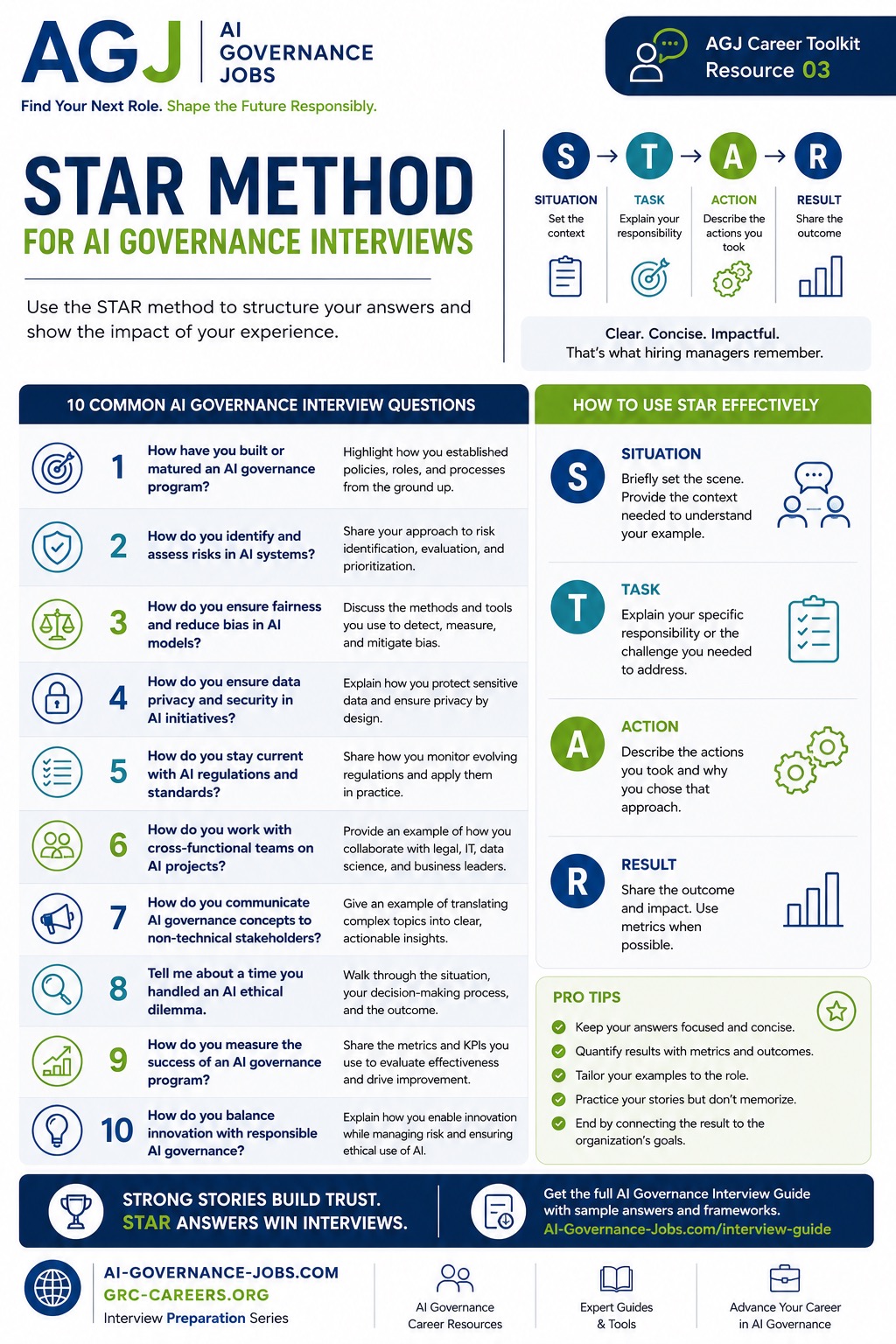
STAR stands for:
- Situation — briefly describe the context.
- Task — explain your responsibility or the challenge you faced.
- Action — describe the specific steps you took.
- Result — share the outcome and, whenever possible, quantify the impact.
Rather than giving broad or theoretical answers, STAR lets interviewers understand how you think, solve problems, and collaborate with others.
Why Hiring Managers Use STAR Questions
AI governance professionals are expected to balance innovation with responsibility. Interviewers want to understand how you make decisions, manage risk, communicate across teams, and build trust. STAR helps you demonstrate:
- Strategic thinking
- Leadership under uncertainty
- Risk management experience
- Cross-functional collaboration
- Ethical decision making
- Measurable business impact
Ten Common AI Governance Interview Questions
- How have you built or matured an AI governance program? Describe how governance initiatives were introduced, expanded, or improved. Discuss policies, oversight structures, executive sponsorship, and measurable outcomes.
- How do you identify and assess risks in AI systems? Explain your approach to technical, legal, operational, and reputational risks, and how they are prioritized and monitored over time.
- How do you ensure fairness and reduce bias in AI models? Share examples of bias assessments, testing procedures, stakeholder reviews, or governance controls that improved fairness and transparency.
- How do you protect data privacy and security in AI initiatives? Discuss privacy by design, data governance, security controls, and compliance with applicable regulations or policies.
- How do you stay current with AI regulations and standards? Explain how you monitor emerging regulations, standards, and best practices, then translate them into practical governance improvements.
- Tell me about a time you worked with cross-functional teams. Describe collaborating with legal, compliance, security, data science, technology, procurement, or executive leadership toward a shared objective.
- How do you communicate AI governance concepts to non-technical stakeholders? Strong leaders translate complex ideas into language executives, boards, regulators, and business leaders understand.
- Tell me about an ethical challenge involving AI. Describe how you evaluated competing priorities, gathered input, made a decision, and balanced innovation with responsible AI.
- How do you measure the success of an AI governance program? Consider KPIs, audit findings, policy adoption, training completion, incident reduction, risk mitigation, or improved business confidence.
- How do you balance innovation with responsible AI governance? Explain how governance creates confidence rather than unnecessary bureaucracy.
Building Strong STAR Answers
Keep your responses focused and concise. Give just enough context to understand the situation, clearly explain your role and the challenge, spend most of your answer on the specific actions you took, and finish with the results, including measurable outcomes whenever possible. Strong metrics include:
- Reduced compliance risk
- Faster review cycles
- Improved audit readiness
- Increased stakeholder participation
- Higher policy adoption
- Lower incident rates
- Greater operational efficiency
Specific outcomes make your answers far more compelling than general statements.
Preparing Before Your Interview
Identify five to ten professional experiences that demonstrate your strengths. Think about projects involving:
- AI governance program development
- Enterprise risk management
- Regulatory compliance
- AI policy creation
- Privacy and security
- Responsible AI initiatives
- Cross-functional leadership
- Executive communication
- Change management
- Ethical decision making
Each experience can often be adapted to answer several different questions.
Final Thoughts
The STAR method is not about memorizing scripts. It is about telling authentic stories that demonstrate your judgment, leadership, and ability to deliver results. As AI governance matures, organizations want professionals who can guide responsible innovation while earning the trust of executives, regulators, employees, and customers. Whether you are pursuing your first AI governance role or an executive leadership position, strong examples backed by measurable results set you apart.
Explore more interview guides and reference sheets in the AGJ Professional Resource Center, browse AI Career Guides and open roles, and find certification roadmaps at GRC-Careers.org.