
| Title | AI Ethics Officer |
|---|---|
| Department | AI Governance / Ethics / Responsible AI |
| Reports to | [Head of AI Governance / Chief Ethics Officer / Chief AI Officer] |
| Location | [Remote / Hybrid / On-site] |
| Employment type | Full-time |
| Salary | [Salary range. Postings with a range perform significantly better, and several states require one.] |
Position overview
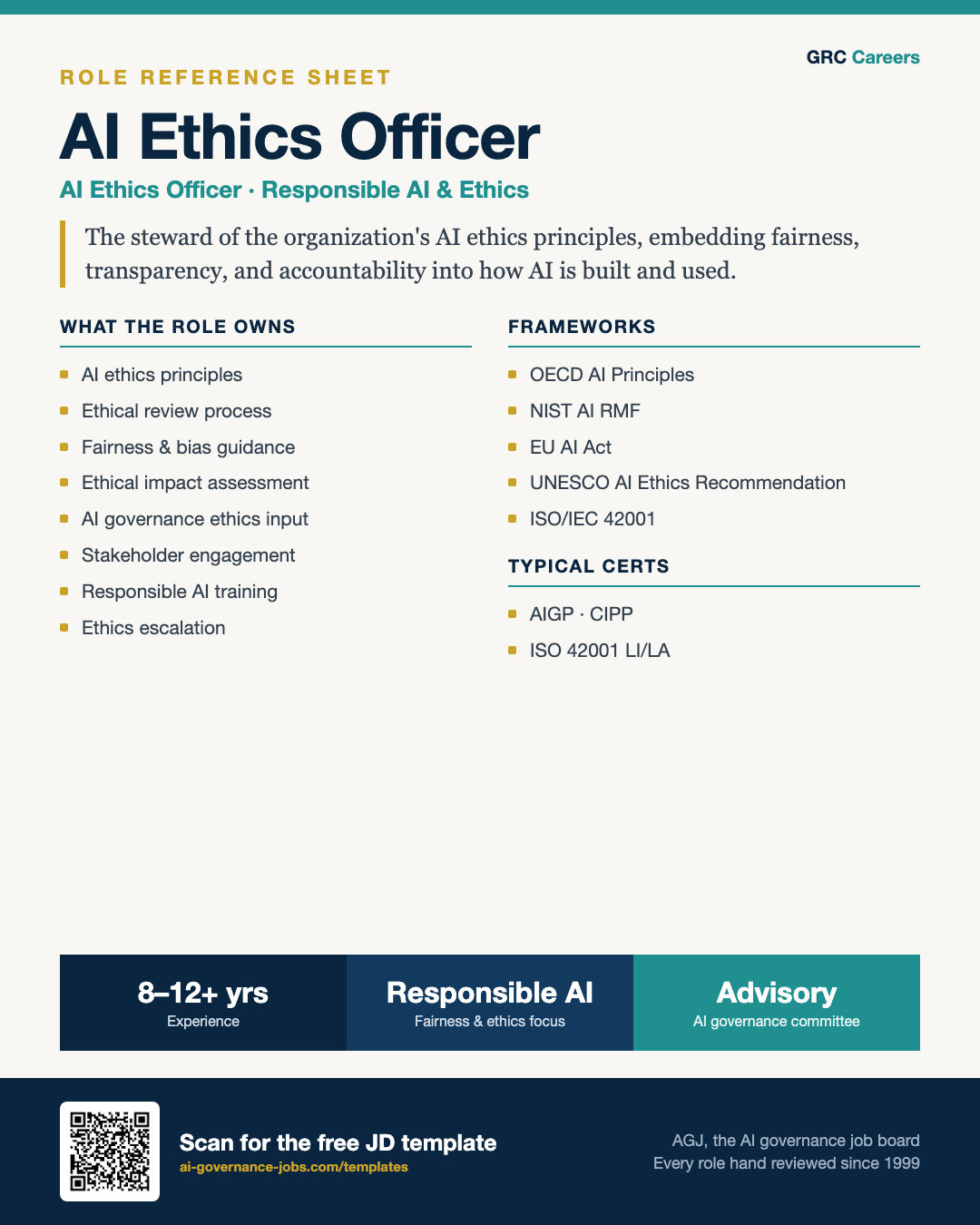
The AI Ethics Officer sets and stewards [Company]'s ethical principles for artificial intelligence. This role ensures AI systems are built and used in ways that are fair, transparent, accountable, and aligned with organizational values.
The AI Ethics Officer partners with data science, engineering, product, legal, privacy, and governance teams to embed ethical review into the AI lifecycle, assess societal and stakeholder impact, and advise on difficult ethical questions.
As AI reshapes how organizations operate, the AI Ethics Officer serves as the trusted authority on responsible AI, helping the organization innovate while protecting people and trust.
Key responsibilities
Ethical principles and policy
- Develop and steward enterprise AI ethics principles.
- Translate principles into practical policies and guidance.
- Align with the OECD AI Principles, NIST AI RMF, and the EU AI Act.
- Advise leadership on ethical AI strategy and posture.
- Report on responsible AI to governance bodies.
Ethical review
Embed ethical review into the AI lifecycle, evaluating use cases for:
- Fairness, bias, and potential for discrimination
- Transparency, explainability, and disclosure
- Human oversight and meaningful control
- Societal, stakeholder, and reputational impact
Fairness and bias
- Advise on bias detection and mitigation approaches.
- Review datasets and outcomes for fairness concerns.
- Support impact assessments for high-risk AI.
- Recommend safeguards and remediation.
Governance and escalation
Contribute to the AI governance committee, provide ethics input on high-risk AI decisions, and escalate significant ethical concerns to leadership with clear recommendations.
Stakeholder engagement
Engage internal and external stakeholders on responsible AI, incorporate diverse perspectives, and represent the organization's commitment to ethical AI.
Awareness and enablement
Build responsible AI awareness across the organization through training and guidance so teams understand ethical expectations and how to apply them in practice.
Required qualifications
- Bachelor's degree in Ethics, Philosophy, Law, Computer Science, Data Science, or a related discipline. Advanced degree a plus.
- 8 to 12+ years of experience across ethics, AI, data, policy, or governance roles.
- Working knowledge of AI and machine learning concepts.
- Experience with responsible AI, fairness, or ethical impact assessment.
- Ability to advise senior leaders on sensitive ethical questions.
- Strong understanding of AI ethics frameworks and emerging regulation.
Preferred certifications
One or more of: AIGP, CIPP, or ISO/IEC 42001 Lead Implementer or Lead Auditor.
Technical knowledge
AI ethics, responsible AI, fairness and bias assessment, transparency and explainability, ethical impact assessment, human oversight, AI risk concepts, AI policy, and regulatory frameworks including the OECD AI Principles, NIST AI RMF, and the EU AI Act.
Essential competencies
Sound ethical judgment, executive communication, cross-functional facilitation, stakeholder engagement, analytical thinking, discretion, and the ability to influence without authority.
Success measures: first 12 months
- Publish enterprise AI ethics principles.
- Embed ethical review into the AI lifecycle.
- Establish fairness and bias review practices.
- Support impact assessments for high-risk AI use cases.
- Contribute ethics input to the AI governance committee.
- Deliver responsible AI awareness and training.
- Establish stakeholder engagement on responsible AI.
- Build responsible AI reporting to governance bodies.
About [Company]
[Two or three sentences about your organization, the maturity of your program, and what the first year looks like. Candidates in this field respond to honesty about whether they are joining a build or an established function.]
Post this role on GRC Careers
Reach professionals who specialize in AI ethics and responsible AI rather than hoping they find you in a general feed. Hand reviewed, live within one business day.
See how others are hiring
Review live GRC leadership jobs postings to benchmark scope, level, and posted salary before you publish yours.
Stay close to the market
Job alerts
Get new GRC leadership jobs roles sent to you as they post.
Newsletter
Hiring trends, salary signals, and new templates from GRC Careers.
Frequently asked questions
What does an AI Ethics Officer do?
The AI Ethics Officer sets and stewards the organization's AI ethics principles. They embed ethical review into the AI lifecycle, advise on fairness, transparency, and human oversight, and help the organization use AI responsibly and in line with its values.
What qualifications and certifications does an AI Ethics Officer need?
Most bring 8 to 12 or more years across ethics, AI, data, policy, or governance, with working knowledge of machine learning. Helpful certifications include AIGP, CIPP, and ISO/IEC 42001 Lead Implementer or Lead Auditor.
Who does an AI Ethics Officer report to?
The role commonly reports to the Head of AI Governance, the Chief Ethics Officer, or the Chief AI Officer, and partners with data science, product, legal, privacy, and governance teams.
What frameworks does an AI Ethics Officer use?
Core reference points include the OECD AI Principles, the NIST AI Risk Management Framework, the EU AI Act, and the UNESCO Recommendation on the Ethics of AI, supported by ISO/IEC 42001.
Want to edit it, not just read it?
Copying from the page works, and this template stays free. But if you want the real thing to make your own, the editable Word file is in the toolkit, along with all 44 job descriptions, 38 career guides, 21 reference sheets, and 16 executive briefs. Yours to adapt, rename, and reuse, commercially, forever.