
| Title | Chief Ethics Officer |
|---|---|
| Department | Ethics & Compliance / Legal / Executive Leadership |
| Reports to | [Chief Executive Officer / General Counsel / Board Audit Committee] |
| Location | [Remote / Hybrid / On-site] |
| Employment type | Full-time |
| Salary | [Salary range. Postings with a range perform significantly better, and several states require one.] |
Position overview
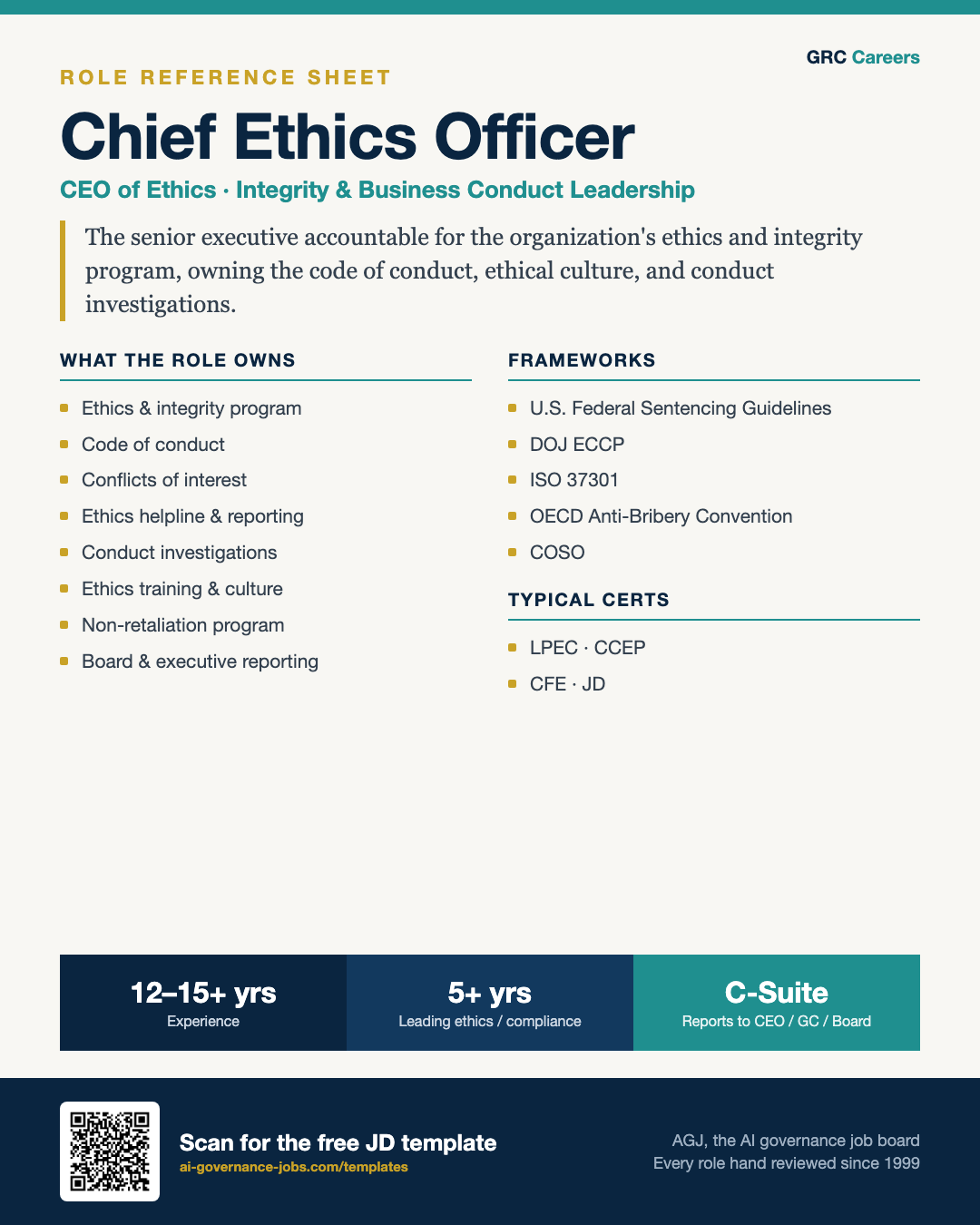
The Chief Ethics Officer provides executive leadership for [Company]'s ethics and integrity program. This role owns the code of conduct, ethical decision making, and the culture that keeps the organization acting with integrity.
The Chief Ethics Officer partners closely with executive leadership, legal, compliance, human resources, internal audit, and the Board to set ethical standards, resolve conflicts of interest, oversee conduct investigations, and reinforce a speak-up culture.
As stakeholders hold organizations to higher standards of conduct, the Chief Ethics Officer serves as the senior authority on ethics, integrity, and responsible business behavior.
Key responsibilities
Ethics program strategy
- Develop and execute the enterprise ethics and integrity program.
- Own the code of conduct and business ethics policies.
- Set ethical standards and expectations across the organization.
- Present ethics program updates to executive leadership and the Board.
- Build a long-term roadmap for ethics program maturity.
Code of conduct and policy
Maintain the code of conduct and supporting policies, including:
- Conflicts of interest and outside activities
- Gifts, entertainment, and hospitality
- Anti-corruption and business courtesies
- Fair dealing and responsible conduct
Ethical culture
- Reinforce a speak-up and non-retaliation culture.
- Deliver ethics training and awareness campaigns.
- Advise leaders and employees on ethical decision making.
- Measure and report on ethical culture indicators.
Conduct investigations
Oversee intake, triage, and investigation of ethics and conduct concerns, including whistleblower reports, conflicts of interest, retaliation allegations, and misconduct, with appropriate escalation and remediation.
Reporting channels
- Oversee the ethics helpline and reporting mechanisms.
- Ensure confidential and non-retaliatory reporting.
- Track and trend conduct issues and outcomes.
- Report significant matters to leadership and the Board.
Governance and oversight
Align the ethics program with regulatory expectations and recognized standards, including the U.S. Federal Sentencing Guidelines, the DOJ Evaluation of Corporate Compliance Programs, and ISO 37301, and coordinate with compliance and audit.
Advisory and escalation
Serve as a trusted advisor on sensitive ethical questions, provide guidance on gray areas, and escalate significant integrity risks to executive leadership and the Board.
Required qualifications
- Bachelor's degree in Law, Ethics, Business, Philosophy, or a related discipline. Advanced degree such as JD or MBA preferred.
- 12 to 15+ years of progressive experience in ethics, compliance, legal, or governance roles.
- 5+ years leading ethics or compliance programs.
- Experience conducting or overseeing sensitive investigations.
- Experience briefing executive leadership and Boards of Directors.
- Strong understanding of ethics program standards and regulatory expectations.
Preferred certifications
One or more of: LPEC (Leadership Professional in Ethics and Compliance), CCEP, CFE, or a JD.
Technical knowledge
Ethics and integrity program design, code of conduct development, conflicts of interest management, whistleblower and helpline operations, conduct investigations, ethics training, culture measurement, anti-corruption, and regulatory expectations for ethics and compliance programs.
Essential competencies
Strategic leadership, executive communication, Board presentation skills, sound ethical judgment, discretion and confidentiality, investigative rigor, change leadership, and negotiation and influence.
Success measures: first 12 months
- Assess the ethics program against recognized standards.
- Refresh the code of conduct and core ethics policies.
- Strengthen the ethics helpline and reporting channels.
- Establish or improve conduct investigation processes.
- Deliver enterprise ethics training and awareness.
- Baseline and track ethical culture indicators.
- Build executive and Board ethics reporting.
- Advance the maturity of the ethics program.
About [Company]
[Two or three sentences about your organization, the maturity of your program, and what the first year looks like. Candidates in this field respond to honesty about whether they are joining a build or an established function.]
Post this role on GRC Careers
Reach professionals who specialize in ethics, integrity, and business conduct rather than hoping they find you in a general feed. Hand reviewed, live within one business day.
See how others are hiring
Review live GRC leadership jobs postings to benchmark scope, level, and posted salary before you publish yours.
Stay close to the market
Job alerts
Get new GRC leadership jobs roles sent to you as they post.
Newsletter
Hiring trends, salary signals, and new templates from GRC Careers.
Frequently asked questions
What does a Chief Ethics Officer do?
The Chief Ethics Officer owns the organization's ethics and integrity program. They maintain the code of conduct, promote an ethical speak-up culture, manage conflicts of interest, and oversee conduct investigations and reporting channels.
What qualifications and certifications does a Chief Ethics Officer need?
Most Chief Ethics Officers bring 12 to 15 or more years in ethics, compliance, legal, or governance roles, including at least 5 years leading programs. Common credentials include LPEC, CCEP, CFE, and many hold a JD or MBA.
Who does a Chief Ethics Officer report to?
The Chief Ethics Officer typically reports to the Chief Executive Officer, the General Counsel, or the Board Audit Committee, and coordinates closely with compliance, legal, human resources, and internal audit.
What frameworks does a Chief Ethics Officer use?
Common reference points include the U.S. Federal Sentencing Guidelines, the DOJ Evaluation of Corporate Compliance Programs, ISO 37301, and anti-corruption standards such as the OECD Anti-Bribery Convention.
Want to edit it, not just read it?
Copying from the page works, and this template stays free. But if you want the real thing to make your own, the editable Word file is in the toolkit, along with all 44 job descriptions, 38 career guides, 21 reference sheets, and 16 executive briefs. Yours to adapt, rename, and reuse, commercially, forever.