| Title | Privacy Engineer |
|---|---|
| Department | [Engineering / Privacy / Security / Data] |
| Reports to | [Director of Privacy Engineering / Chief Privacy Officer / Security or Engineering leader] |
| Location | [Remote / Hybrid / On-site and location] |
| Employment type | Full-time |
| Salary | [Good-faith salary range, incentive and material benefits] |
Position overview
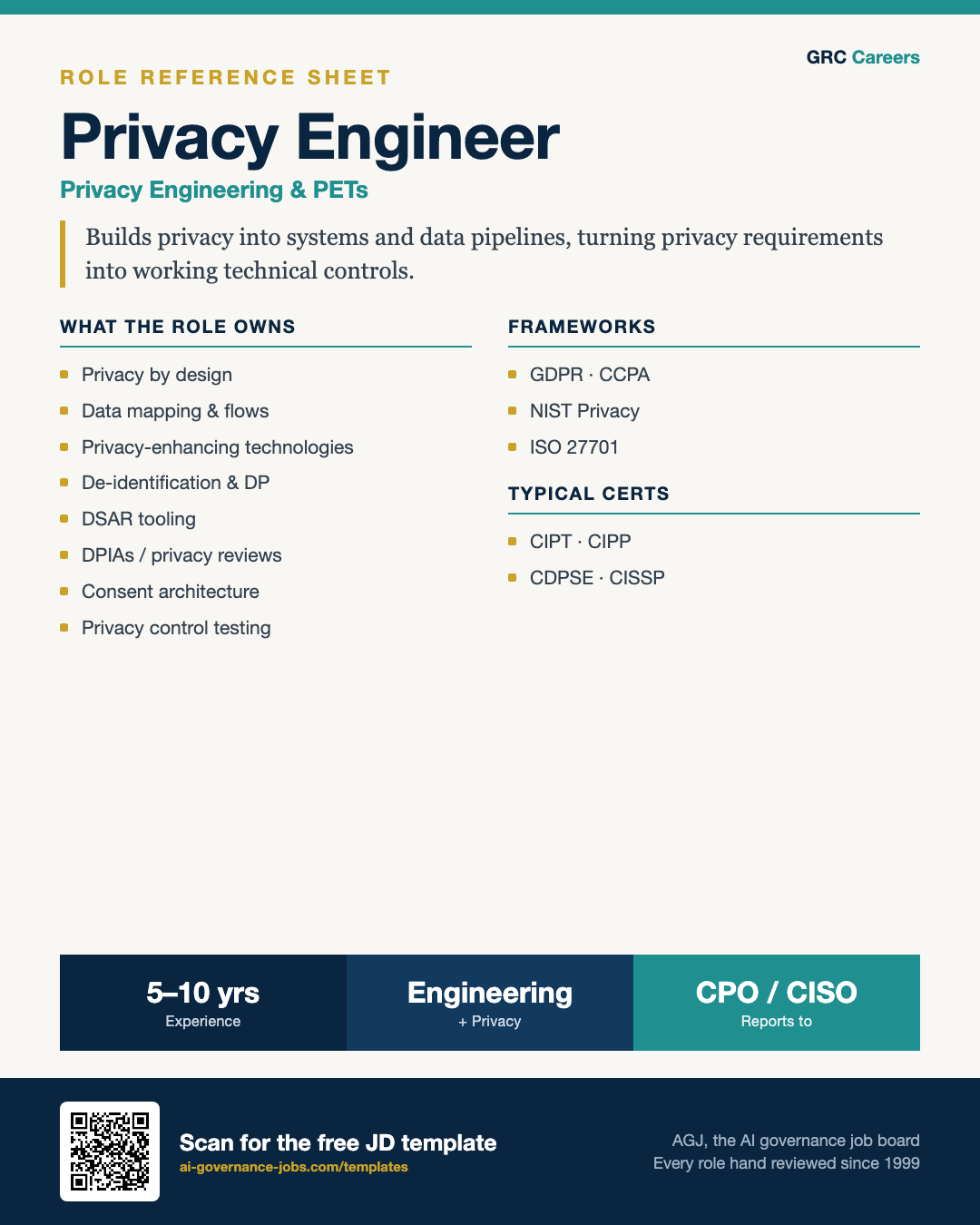
[Company] is hiring a Privacy Engineer to build privacy into products, services, data pipelines and AI systems. You will translate privacy requirements into technical requirements, architecture and controls, then help teams validate that those controls work across the data life cycle.
This role partners with Software Engineering, Data, Security, Product, Legal and Privacy. The successful candidate will combine systems thinking with practical knowledge of privacy principles and technology.
Key responsibilities
- Translate privacy obligations and policy into technical requirements and acceptance criteria.
- Map personal-data flows, stores, interfaces, purposes, recipients and retention.
- Design or implement minimization, access, retention, deletion and audit controls.
- Build or improve consent, preference and individual-rights capabilities.
- Apply de-identification, pseudonymization or privacy-enhancing techniques where appropriate.
- Review product, analytics, vendor and AI designs for privacy risk.
- Automate data discovery, classification, control evidence or compliance workflows.
- Develop reusable privacy design patterns, libraries and engineering guidance.
- Partner with Security on encryption, identity, incidents, logging and threat modeling.
- Test controls and track technical remediation to completion.
Required qualifications
- [Three to seven] years in software, data, security, cloud, architecture or privacy engineering.
- Hands-on experience with [languages, cloud platform, data stack or architecture relevant to the job].
- Understanding of data life cycles, APIs, databases, identity, access and distributed systems.
- Ability to translate a policy or risk statement into a technical design.
- Working knowledge of privacy by design, minimization, retention, individual rights and de-identification.
- Clear communication across technical and non-technical teams.
Preferred certifications
CIPT, CDPSE, CIPP or related credential.
Preferred experience
- Experience shipping privacy controls in production.
- Experience with privacy-enhancing technologies or privacy-preserving analytics.
- Experience with machine learning, AI data governance or model pipelines.
- Familiarity with [GDPR / CCPA and CPRA / applicable sector rules].
Technical knowledge
GDPR, CCPA / CPRA, ISO/IEC 27701, NIST Privacy Framework, privacy impact assessments, data mapping, records of processing.
Essential competencies
Analysis, documentation, judgment, cross-functional collaboration, and clear communication of privacy risk.
Success in the first year
- Teams have reusable privacy patterns rather than starting each review from zero.
- High-risk data flows are documented and receive technical controls.
- Deletion, preference and access requirements work across downstream systems.
- Privacy findings have clear engineering owners and verifiable closure.
- Product teams involve Privacy Engineering early enough to influence design.
About [Company]
[Two or three sentences about your organization, the maturity of your program, and what the first year looks like. Candidates in this field respond to honesty about whether they are joining a build or an established function.]
Post this role on GRC Careers
Reach professionals who specialize in privacy by design and technical controls rather than hoping they find you in a general feed. A person reviews every posting before it goes live, usually within one business day.
See how others are hiring
Review open Privacy jobs to benchmark scope, level, and posted pay before you publish yours.
Stay close to the market
Job alerts
Get new Privacy jobs sent to you as they post.
Newsletter
Hiring trends, salary signals, and new templates from GRC Careers.
Frequently asked questions
What does a Privacy Engineer do?
A Privacy Engineer builds privacy into products, data pipelines and AI systems. They turn privacy requirements into technical requirements and acceptance criteria, map personal-data flows, design minimization, retention, deletion and access controls, build consent and rights capabilities, and review designs for privacy risk.
How is privacy engineering different from security engineering?
Security engineering protects data and systems from unauthorized access. Privacy engineering decides which personal data the organization should hold, how it is used, how long it is kept and who receives it. The two overlap on access control, logging and encryption.
What is privacy by design?
It means building data-protection measures into a system from the start rather than adding them later. Article 25 of the GDPR requires appropriate technical and organizational measures, such as pseudonymization and data minimization, both when the means of processing are decided and during processing, and processing only the data each purpose needs by default.
Which credentials are common?
The IAPP's CIPT and ISACA's CDPSE focus on privacy technology and engineering. CIPP helps when the role works closely with legal requirements.