Home › AI Governance Insights › ISO/IEC 42001 Explained: The World's First AI Management System Standard
ISO/IEC 42001 Explained: The World's First AI Management System Standard
By F. Jay Hall and Stephan Pochet · July 7, 2026
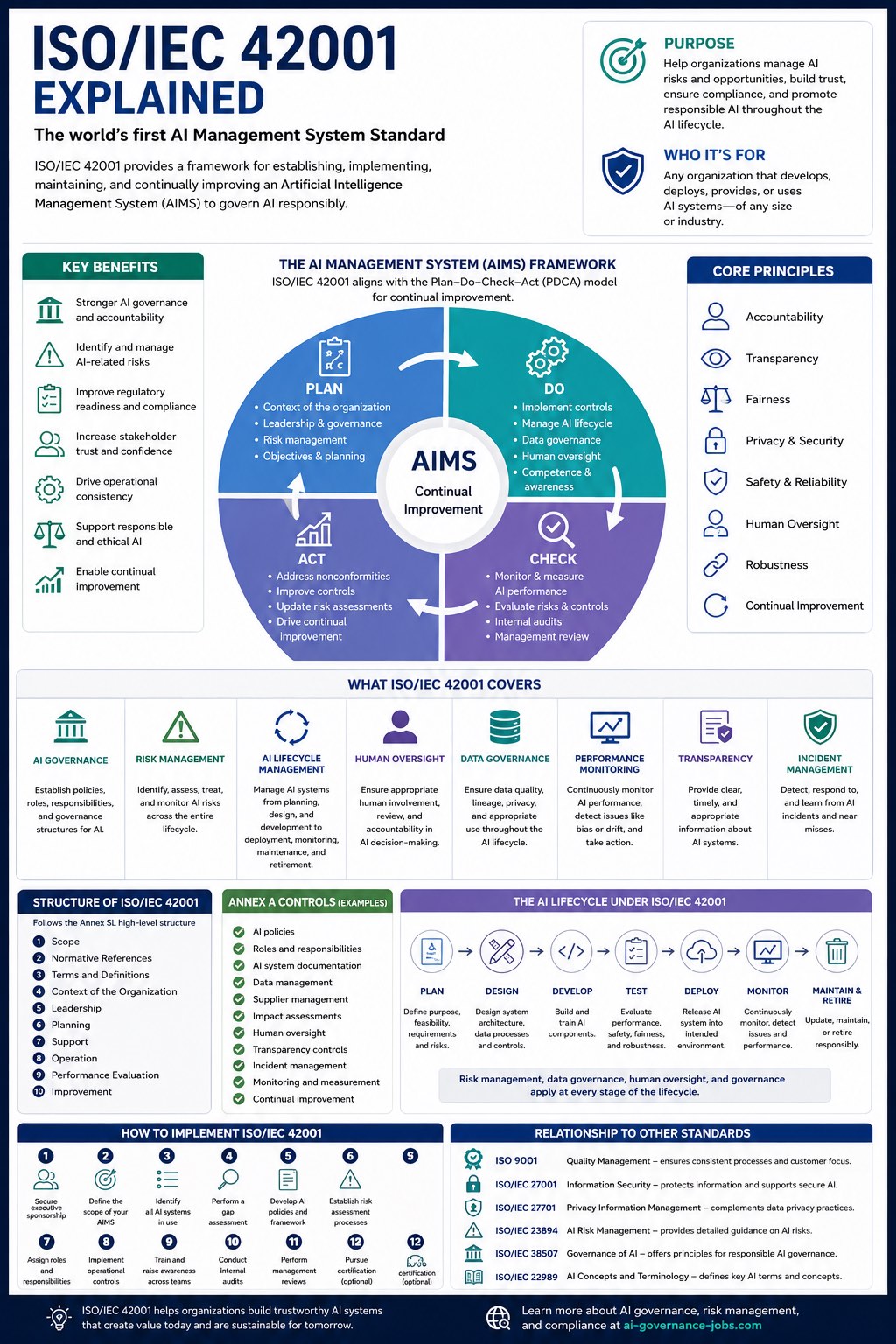
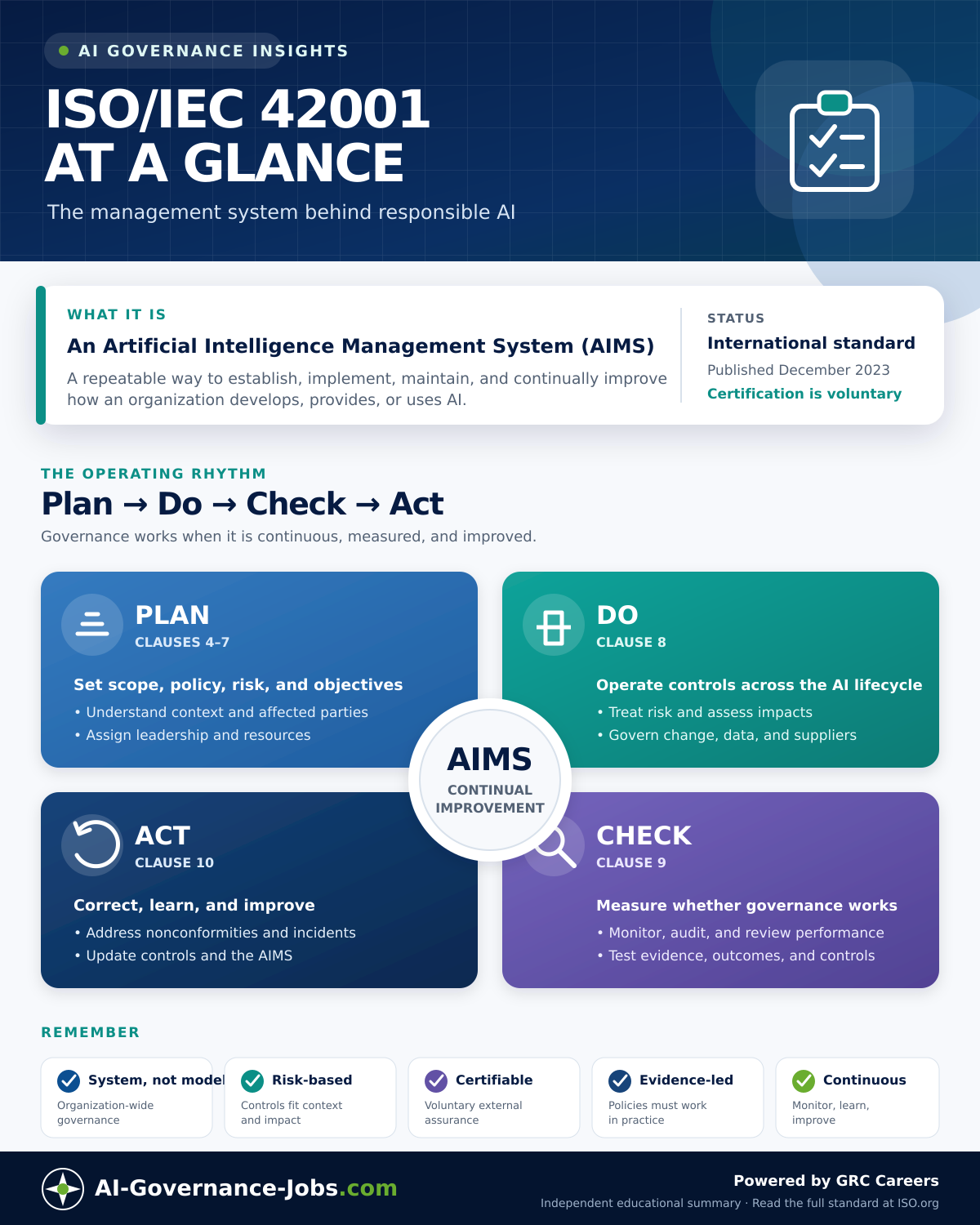
ISO/IEC 42001 is the world's first international management system standard for artificial intelligence. Published in 2023, it provides the requirements for establishing, implementing, maintaining, and continually improving an Artificial Intelligence Management System (AIMS) so an organization can govern AI responsibly, manage its risks and opportunities, build trust, and support regulatory compliance across the entire AI lifecycle.
Purpose and Who It Is For
The standard helps organizations manage AI risks and opportunities, build trust, ensure compliance, and promote responsible AI throughout the lifecycle. It applies to any organization that develops, deploys, provides, or uses AI systems, of any size or industry, from technology companies and financial institutions to healthcare, government, manufacturing, education, and businesses using generative AI internally.
Key Benefits
- Stronger AI governance and accountability
- Ability to identify and manage AI-related risks
- Improved regulatory readiness and compliance
- Increased stakeholder trust and confidence
- Greater operational consistency
- Support for responsible and ethical AI
- A foundation for continual improvement
The AIMS Framework: Plan, Do, Check, Act
ISO/IEC 42001 aligns with the Plan-Do-Check-Act (PDCA) model for continual improvement, with the Artificial Intelligence Management System (AIMS) at the center.
- Plan: Establish the context of the organization, leadership and governance, risk management, and objectives and planning.
- Do: Implement controls, manage the AI lifecycle, apply data governance, ensure human oversight, and build competence and awareness.
- Check: Monitor and measure AI performance, evaluate risks and controls, conduct internal audits, and hold management reviews.
- Act: Address nonconformities, improve controls, update risk assessments, and drive continual improvement.
Core Principles
The standard is built on eight core principles: accountability, transparency, fairness, privacy and security, safety and reliability, human oversight, robustness, and continual improvement.
What ISO/IEC 42001 Covers
- AI Governance — establish policies, roles, responsibilities, and governance structures for AI.
- Risk Management — identify, assess, treat, and monitor AI risks across the lifecycle.
- AI Lifecycle Management — manage AI systems from planning and design through deployment, monitoring, maintenance, and retirement.
- Human Oversight — ensure appropriate human involvement, review, and accountability in AI decision-making.
- Data Governance — ensure data quality, lineage, privacy, and appropriate use throughout the lifecycle.
- Performance Monitoring — continuously monitor AI performance and detect issues like bias or drift.
- Transparency — provide clear, timely, and appropriate information about AI systems.
- Incident Management — detect, respond to, and learn from AI incidents and near misses.
Structure of ISO/IEC 42001
The standard follows the Annex SL high-level structure common to modern ISO management system standards, across ten clauses: (1) Scope, (2) Normative References, (3) Terms and Definitions, (4) Context of the Organization, (5) Leadership, (6) Planning, (7) Support, (8) Operation, (9) Performance Evaluation, and (10) Improvement.
Annex A Controls
Annex A provides a catalogue of control objectives and controls that support the AIMS. Examples include AI policies, roles and responsibilities, AI system documentation, data management, supplier management, impact assessments, human oversight, transparency controls, incident management, monitoring and measurement, and continual improvement.
The AI Lifecycle Under ISO/IEC 42001
The standard applies governance across the full lifecycle: Plan (define purpose, feasibility, requirements, and risks), Design (system architecture, data processes, and controls), Develop (build and train AI components), Test (evaluate performance, safety, fairness, and robustness), Deploy (release into the intended environment), Monitor (continuously detect issues and track performance), and Maintain and Retire (update, maintain, or retire responsibly). Risk management, data governance, human oversight, and governance apply at every stage.
How to Implement ISO/IEC 42001
- Secure executive sponsorship
- Define the scope of your AIMS
- Identify all AI systems in use
- Perform a gap assessment
- Develop AI policies and framework
- Establish risk assessment processes
- Assign roles and responsibilities
- Implement operational controls
- Train and raise awareness across teams
- Conduct internal audits
- Perform management reviews
- Pursue certification (optional)
Relationship to Other Standards
| Standard | Focus |
|---|---|
| ISO 9001 | Quality Management — consistent processes and customer focus |
| ISO/IEC 27001 | Information Security — protects information and supports secure AI |
| ISO/IEC 27701 | Privacy Information Management — complements data privacy practices |
| ISO/IEC 23894 | AI Risk Management — detailed guidance on AI risks |
| ISO/IEC 38507 | Governance of AI — principles for responsible AI governance |
| ISO/IEC 22989 | AI Concepts and Terminology — defines key AI terms and concepts |
ISO/IEC 42001 helps organizations build trustworthy AI systems that create value today and are sustainable for tomorrow.
Continue Learning
See how ISO/IEC 42001 relates to other frameworks in our crosswalks: NIST AI RMF vs. ISO/IEC 42001 and ISO/IEC 42001 and the EU AI Act. Place it in the full ecosystem with the Responsible AI Framework Map, choose a credential with the Certification Comparison Matrix, and browse current ISO 42001 jobs.
Source: ISO/IEC 42001:2023 Artificial Intelligence Management System.
Frequently Asked Questions
What is ISO/IEC 42001?
ISO/IEC 42001 is the first international management system standard specifically designed for artificial intelligence. Published in 2023, it provides requirements for establishing, implementing, maintaining, and continually improving an Artificial Intelligence Management System (AIMS). It helps organizations govern AI responsibly by addressing risk management, accountability, transparency, and continuous improvement.
What does AIMS stand for?
AIMS stands for Artificial Intelligence Management System. It is the governance framework defined by ISO/IEC 42001 that enables organizations to manage AI systems throughout their lifecycle, from planning and development to deployment, monitoring, and retirement.
Who should implement ISO/IEC 42001?
The standard is intended for any organization that develops, provides, deploys, or uses AI systems, including technology companies, financial institutions, healthcare organizations, government agencies, manufacturers, educational institutions, and businesses using generative AI tools internally.
Is ISO/IEC 42001 certification mandatory?
No. Organizations can implement the standard without becoming certified. However, certification provides independent verification that an AI management system meets the requirements of ISO/IEC 42001, which can increase customer confidence and support regulatory compliance efforts.
What are the benefits of ISO/IEC 42001?
It can help organizations improve AI governance and accountability, identify and reduce AI-related risks, strengthen regulatory readiness, increase stakeholder trust, improve documentation and operational consistency, support responsible and ethical AI development, and demonstrate a commitment to continual improvement.
How is ISO/IEC 42001 different from the EU AI Act?
ISO/IEC 42001 is a voluntary international management system standard that provides a framework for governing AI within an organization. The EU AI Act is legislation that establishes legal obligations for AI systems placed on or used within the EU. Organizations can use ISO/IEC 42001 to support EU AI Act compliance, but certification alone does not guarantee legal compliance.
What is the difference between ISO/IEC 42001 and ISO/IEC 27001?
ISO/IEC 27001 focuses on managing information security risks through an Information Security Management System (ISMS). ISO/IEC 42001 focuses on governing artificial intelligence through an Artificial Intelligence Management System (AIMS). Many organizations implement both together because AI governance and information security are closely related.
Does ISO/IEC 42001 include AI risk management?
Yes. AI risk management is one of the core requirements. Organizations are expected to identify, assess, treat, monitor, and continually review risks associated with AI systems, including risks related to fairness, privacy, cybersecurity, transparency, safety, and regulatory compliance.
Does ISO/IEC 42001 apply to generative AI?
Yes. The standard applies to all types of AI systems, including generative AI applications such as large language models, AI assistants, image generation tools, and enterprise AI platforms. Organizations should apply governance controls appropriate to the risks of these technologies.
How long does it take to implement ISO/IEC 42001?
Timelines vary with size, complexity, and AI maturity. Smaller organizations with limited AI use may implement the framework in a few months, while large enterprises with multiple AI systems may need six to twelve months or longer before pursuing certification.
Can small businesses implement ISO/IEC 42001?
Yes. The standard is scalable and can be implemented by organizations of any size. Smaller organizations can tailor the management system to match the complexity and risk profile of their AI activities while still meeting the requirements.
What documents are required for ISO/IEC 42001?
Typical documentation includes an AI policy, AI governance framework, AI inventory, risk assessment methodology, risk register, operational procedures, monitoring records, internal audit reports, management review records, and continual improvement plans, appropriate to the organization's size and AI usage.
How does ISO/IEC 42001 support responsible AI?
It encourages governance processes that promote fairness, transparency, accountability, human oversight, privacy protection, security, and ongoing monitoring, helping organizations develop and use AI in a responsible and trustworthy manner.
What is Annex A in ISO/IEC 42001?
Annex A provides a catalogue of control objectives and controls that support an AIMS, covering areas such as AI governance, data management, supplier relationships, transparency, human oversight, incident management, monitoring, and continual improvement.
Is ISO/IEC 42001 expected to become an industry standard?
Yes. As AI regulations evolve worldwide, ISO/IEC 42001 is increasingly adopted as a best-practice framework for AI governance and viewed as a foundational standard for demonstrating responsible AI management and supporting emerging regulatory requirements.
- Founder of ExecSearches and GRC Careers
- Executive search across corporate, higher education, financial services, and nonprofit sectors
- Focus on AI governance and GRC hiring
- More than a decade in risk advisory and internal audit in financial services
- Led SOX and regulatory audits for Citi, Goldman Sachs, Morgan Stanley, and McKesson
- Public Accounting Certification, Cornell University
Who's Hiring AI Governance Professionals?
Explore current openings in:
AI Governance · Responsible AI · AI Risk · AI Compliance · AI Audit · AI Policy · Privacy · Cybersecurity · Public Policy
Search the latest opportunities at GRC Careers › · nonprofit GRC jobs ›