
Home › AI Governance Insights › What Is an AI Governance Committee? Roles, Membership, and How It Works
What Is an AI Governance Committee? Roles, Membership, and How It Works
By F. Jay Hall and Stephan Pochet, AI Governance Essentials · August 15, 2026 · 10 min read min read
Key Takeaways
- An AI governance committee is a cross-functional decision and escalation body, not a substitute for day-to-day ownership.
- Its central job is to decide who may accept which AI risks, under what conditions, and with what evidence.
- Core members usually represent business leadership, legal, compliance, risk, privacy, security, data, and technology.
- Not every AI use needs committee approval. Risk tiers and delegated authority keep routine decisions moving.
- A useful committee produces decisions, owners, deadlines, and records. A committee that only discusses risk is not governing it.
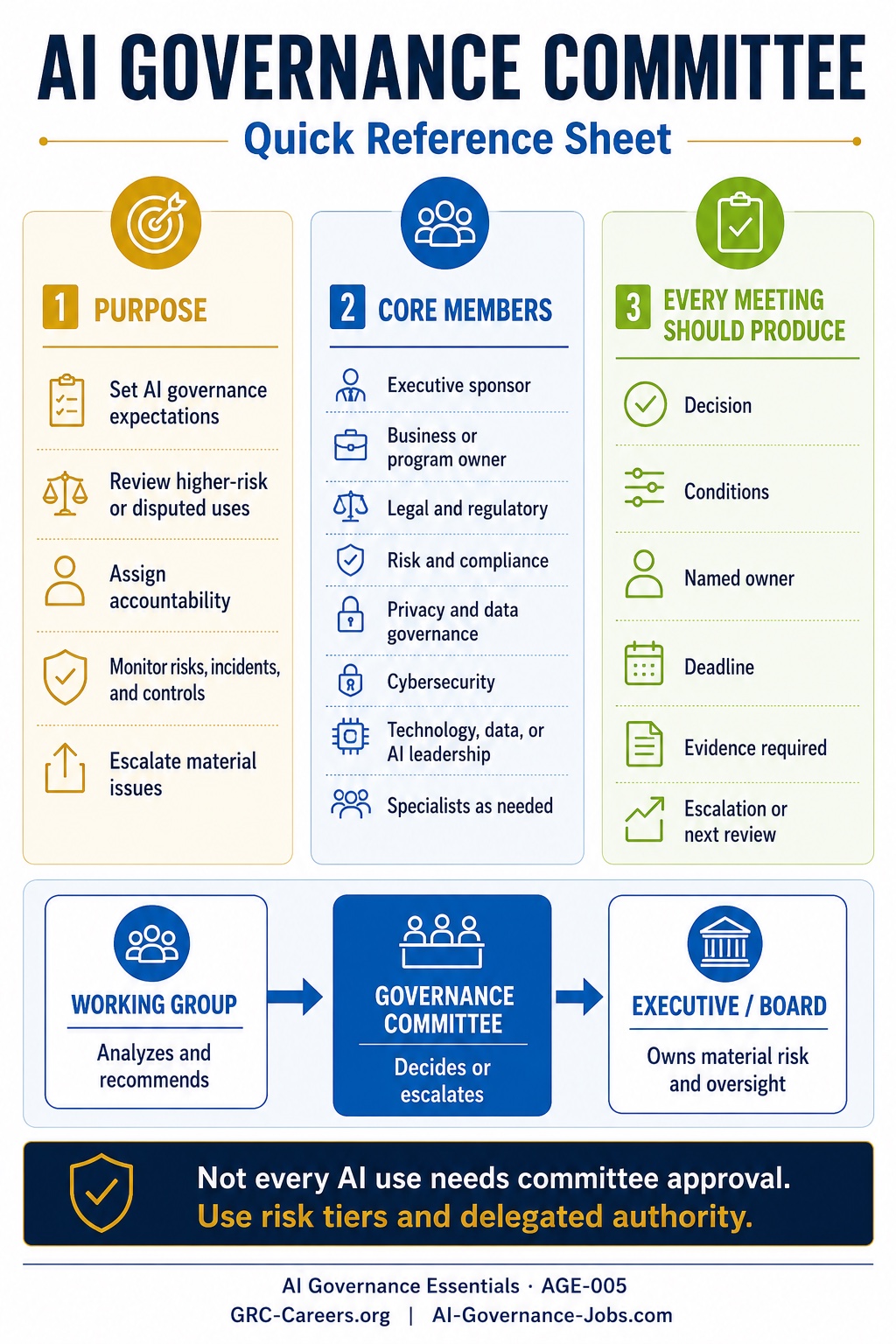
Artificial intelligence rarely fits neatly inside one department. A new system may create privacy questions for legal, security questions for the CISO, fairness questions for compliance, data-quality questions for the data team, operational questions for the business, and reputational questions for senior leadership. If each group evaluates only its own piece, the organization can miss the risk created by the system as a whole.
An AI governance committee connects those perspectives. It creates a repeatable way to decide whether an AI use should proceed, what safeguards it needs, who owns the remaining risk, and when a concern must move to an executive or the board.
What is an AI governance committee?
An AI governance committee is a cross-functional body that oversees how an organization develops, buys, deploys, and uses artificial intelligence. Depending on the organization, it may be called an AI steering committee, responsible AI council, AI risk committee, AI oversight committee, or AI review board.
The name matters less than the authority behind it. The committee needs a written mandate, defined membership, clear decision rights, and an escalation path. It should be able to require safeguards, pause a high-risk deployment, assign corrective action, accept risk within defined limits, or send a decision to someone with greater authority.
A committee becomes governance only when its decisions change what the organization does.
The committee does not replace the people who build, buy, own, or operate an AI system. System owners remain responsible for their systems. Risk, privacy, security, legal, compliance, and audit functions retain their existing responsibilities. The committee coordinates those responsibilities when a decision crosses organizational lines or exceeds normal authority.
Why organizations create one
Many organizations begin with an AI policy. The policy says which tools employees may use, what information must not be entered, and when human review is required. That is an important start, but a policy cannot resolve every real-world disagreement.
Someone still has to decide whether a customer-facing chatbot has been tested enough, whether a hiring model creates unacceptable bias risk, whether a vendor has provided sufficient documentation, or whether a generative AI pilot may use sensitive internal data. Those decisions typically involve competing goals and more than one kind of risk.
A committee gives the organization a durable forum for those choices. It also helps meet the accountability expectations reflected in leading frameworks. The NIST AI Risk Management Framework places governance across the entire AI lifecycle and calls for documented roles, clear lines of communication, executive responsibility, diverse perspectives, monitoring, third-party risk processes, and incident procedures. ISO/IEC 42001 similarly treats AI governance as a management system of policies, objectives, responsibilities, risk management, monitoring, and continual improvement.
What should the committee be responsible for?
1. Establishing the operating model
The committee recommends or approves the governance structure: which policies apply, how AI systems enter the inventory, how risk is classified, which reviews are required, who may approve each risk tier, and what evidence must be preserved.
2. Reviewing higher-risk or disputed uses
Routine uses should move through delegated processes. The committee concentrates on uses that could materially affect people, safety, legal rights, access to services, employment, finances, health, privacy, security, or the organization’s reputation. It also handles novel uses, exceptions, disagreements, and cases where the residual risk remains high after controls are applied.
3. Assigning accountability
Every AI system needs an accountable business owner. Every accepted risk needs someone with the authority to accept it. Every remediation action needs a named owner and due date. The committee makes sure responsibility is explicit rather than shared so broadly that nobody owns the outcome.
4. Setting conditions and guardrails
Approval does not have to be a simple yes or no. The committee may require human review, limited deployment, additional testing, clearer notices, data restrictions, vendor commitments, monitoring thresholds, a rollback plan, or a scheduled re-review before allowing a system to proceed.
5. Monitoring the portfolio
The committee should look beyond individual projects. It reviews the health of the AI inventory, open risks, overdue assessments, exceptions, incidents, complaints, vendor concentrations, control performance, and changes in law or organizational strategy.
6. Escalating material issues
The committee needs a direct route to executive leadership and, where appropriate, the board. Material incidents, unresolved high risks, significant control failures, or decisions outside the committee’s authority should not remain trapped in meeting notes.
What the committee should not do
- It should not approve every AI use. That creates a bottleneck and encourages teams to work around the process.
- It should not replace system owners. The business remains accountable for why a system exists and how it is used.
- It should not perform every technical assessment. Specialists test security, privacy, model performance, fairness, and data quality. The committee uses their evidence to make or escalate decisions.
- It should not serve as a ceremonial review. A committee that always approves whatever arrives is a rubber stamp.
- It should not treat all AI as equally risky. A writing assistant and an automated benefits decision do not require the same scrutiny.
Who should serve on it?
The committee should be small enough to make decisions and broad enough to recognize risks that no single function can see. Most organizations need a core group of standing members, supported by specialists who attend when a particular use case requires their expertise.
| Member or function | What they contribute |
|---|---|
| Executive sponsor or chair | Authority, strategic alignment, funding, and escalation. Often the Chief Risk Officer, Chief Compliance Officer, Chief AI Officer, General Counsel, CIO, or another senior leader. |
| Business or program leadership | The intended benefit, operational context, affected people, and ownership of the outcome. |
| Legal and regulatory | Applicable law, contractual duties, disclosure requirements, privilege, and regulatory exposure. |
| Risk and compliance | Risk methodology, control design, policy alignment, issues management, and independent challenge. |
| Privacy and data governance | Lawful data use, minimization, data quality, retention, provenance, access, and individual rights. |
| Cybersecurity | Threats, access control, model and application security, resilience, logging, and incident response. |
| Technology, data, or AI leadership | System architecture, model limitations, technical feasibility, monitoring, and lifecycle management. |
| Internal audit | Independent assurance perspective. Audit often participates as an adviser or observer to preserve independence. |
| Specialists as needed | Human resources, procurement, accessibility, ethics, safety, communications, sector experts, frontline employees, or representatives of affected communities. |
Committee, working group, management, or board?
| Body | Primary role | Typical decisions |
|---|---|---|
| AI working group | Does the analysis and coordinates implementation. | Prepares assessments, identifies controls, tracks actions, and recommends a decision. |
| AI governance committee | Provides cross-functional oversight and makes decisions within its authority. | Approves conditions, resolves disputes, accepts defined risks, grants exceptions, and escalates material issues. |
| Executive management | Owns enterprise strategy, resources, and risks beyond committee authority. | Accepts major residual risk, funds remediation, changes strategy, or stops a major initiative. |
| Board or board committee | Provides oversight of management and material enterprise risk. | Challenges management, reviews significant exposures and incidents, and evaluates whether governance is effective. |
In a smaller organization, these layers may be combined. The important distinction is not the number of meetings. It is whether analysis, decision-making, risk acceptance, and independent oversight are clearly assigned.
Use risk tiers to keep decisions moving
A committee should approve the risk-classification method and the authority attached to each tier. A simple model might look like this:
| Risk tier | Example | Decision path |
|---|---|---|
| Low | Internal drafting or summarization using approved tools and nonsensitive information. | Preapproved controls and registration in the inventory. No committee review unless an exception arises. |
| Moderate | Operational recommendation systems or external content generation with limited impact. | System owner approval after standard privacy, security, legal, and risk checks. |
| High | AI that materially influences employment, healthcare, education, credit, public benefits, safety, or access to essential services. | Enhanced impact assessment and committee decision, often with executive risk acceptance. |
| Prohibited or unacceptable | A use forbidden by law, policy, contract, or the organization’s risk appetite. | Rejected or stopped. Any exception requires authority above the committee and may not be legally available. |
The committee should define what automatically triggers enhanced review. Triggers may include sensitive personal data, decisions about people, vulnerable populations, safety-critical operations, biometric data, opaque vendor models, material model changes, novel technology, public-facing deployment, or an inability to provide meaningful human review.
What should be in the committee charter?
AI governance committee charter checklist
- Purpose: Why the committee exists and the outcomes it protects.
- Scope: Which AI systems, business units, vendors, and lifecycle stages fall under its oversight.
- Authority: What it may approve, condition, reject, pause, accept, or escalate.
- Membership: Standing members, chair, voting rights, alternates, advisers, and conflicts of interest.
- Decision thresholds: Risk tiers, quorum, voting or consensus rules, and who may accept residual risk.
- Escalation: Which matters go to management or the board and how quickly.
- Records: Required agendas, evidence packages, decisions, conditions, dissent, owners, and deadlines.
- Cadence: Regular meetings, emergency sessions, and periodic portfolio reviews.
- Reporting: Metrics and issues reported to executives and the board.
- Review: How often the charter and operating model are evaluated and improved.
The charter should state clearly that committee approval does not transfer responsibility away from the system owner. It should also distinguish advice from decisions. If a committee can only recommend, the charter must identify who makes the final decision.
How a good meeting works
The committee should receive a short, standardized decision package before the meeting. It normally includes the system’s intended use, owner, affected groups, data sources, risk tier, assessment results, testing evidence, legal and policy considerations, proposed controls, residual risks, monitoring plan, incident path, and the exact decision requested.
A practical agenda includes:
- Review prior decisions, overdue actions, exceptions, and incidents.
- Decide higher-risk or disputed use cases.
- Review material changes to already approved systems.
- Examine portfolio metrics and emerging concentrations of risk.
- Consider regulatory, standards, vendor, or strategy changes.
- Confirm decisions, conditions, owners, deadlines, and escalation.
A decision record should say what was approved or rejected, why, which evidence was considered, which conditions apply, who accepted the residual risk, when the decision expires or must be revisited, and what change would trigger a new review.
How often should it meet?
A new governance program may need meetings every two weeks while it builds the inventory, risk tiers, policies, and review process. A mature committee may meet monthly, with a quarterly portfolio and board-reporting review. Whatever the regular cadence, the organization needs an emergency route for incidents, urgent deployments, and changes that materially affect risk.
The correct cadence depends on the volume and risk of AI use. A committee with no decisions to make should meet less often. A committee with a six-week approval queue needs better delegation, more operating support, or both.
What should the committee measure?
Good metrics show whether the governance system is working, not merely how busy the committee is. Useful measures include:
- Percentage of known AI systems recorded in the inventory.
- Percentage of systems with a named owner and current risk classification.
- High-risk systems with completed impact assessments and monitoring plans.
- Average review time by risk tier.
- Open conditions, exceptions, findings, and overdue remediation.
- Material model or vendor changes awaiting re-review.
- AI incidents, near misses, complaints, appeals, and recurring root causes.
- Control performance, including testing, drift, human-override, and escalation measures appropriate to each system.
- Training completion for system owners, reviewers, operators, and human overseers.
- Concentrations involving one vendor, data source, model, business process, or affected population.
Approval counts alone can be misleading. A high approval rate may mean the intake process is working, or it may mean the committee never challenges anything. A low approval rate may indicate strong scrutiny, or it may indicate that teams do not understand the requirements. Metrics need context.
The first 90 days
Days 1 to 30: establish authority and scope
- Name the executive sponsor and accountable program lead.
- Draft and approve the charter.
- Identify existing bodies that already oversee technology, privacy, model risk, security, compliance, or data.
- Define AI and the systems covered by the process.
- Begin or validate the enterprise AI inventory.
Days 31 to 60: build the decision process
- Approve risk tiers and enhanced-review triggers.
- Define delegated authority and escalation thresholds.
- Create a standard intake form, assessment, decision package, and decision record.
- Select several existing AI uses to test the process before expanding it.
Days 61 to 90: make it operational
- Set the meeting and reporting cadence.
- Resolve the highest-risk unknowns in the existing portfolio.
- Launch training for system owners and reviewers.
- Begin tracking actions, exceptions, incidents, and metrics.
- Report the initial portfolio view, material gaps, and funding needs to executive leadership.
Common ways committees fail
No authority
The committee raises concerns but cannot require action. Fix this in the charter and escalation process.
Too much centralized approval
Every low-risk use waits for the committee. Teams stop cooperating. Use risk tiers, standard controls, and delegated decisions.
Technology-only membership
The committee evaluates whether the system works but misses legal rights, accessibility, operational impact, or harm to affected people. Add the missing perspectives.
Legal-only membership
The committee identifies obligations but cannot evaluate technical evidence or translate requirements into workable controls. Bring data, security, product, and operational expertise into the decision.
No system owner
The project team presents the system, but nobody remains accountable after deployment. Require an owner before review.
Approval without monitoring
The committee treats launch as the end of governance. Define monitoring, incident, change, expiration, and re-review requirements in every material decision.
Poor records
The organization cannot show what evidence was considered, who accepted the risk, or why the decision was made. Use a standard decision record and retain supporting evidence.
What if the organization is small?
A small nonprofit, public agency, school, or business does not need to imitate the committee structure of a global bank. It still needs clear accountability.
A workable small-organization model may consist of one executive sponsor, the technology or data lead, legal or compliance support, the business owner, and an outside specialist when necessary. The group may meet only when a higher-risk use is proposed or a quarterly portfolio review is due. Existing risk, compliance, privacy, security, or technology committees can expand their charters instead of creating another standing body.
The minimum is simple: maintain an inventory, classify risk, name an owner, require the right review, document the decision, monitor important risks, and escalate when the remaining risk exceeds the decision-maker’s authority.
How the committee fits leading frameworks
The NIST AI RMF does not require every organization to establish a committee with a specific name. It does, however, call for governance structures that make roles, accountability, communication, executive responsibility, monitoring, third-party risk, and incident processes clear. A properly designed committee is one practical way to connect those outcomes across functions.
ISO/IEC 42001 takes a management-system approach. It expects organizations to establish policies and objectives, define responsibilities, manage AI risks and opportunities, monitor performance, and continually improve the system. The committee can support that cycle, but certification depends on the full management system operating in practice, not on the existence of a committee.
ISO/IEC 42005 complements that work with guidance for AI system impact assessments across the lifecycle. Those assessments can provide important evidence for committee decisions, especially when an AI use may affect individuals, groups, or society.
The bottom line
An AI governance committee should make responsible AI easier to operate, not harder to understand. It gives teams a clear path for difficult decisions, gives leaders visibility into material risks, and gives the organization evidence that oversight is more than a policy on a shelf.
The test is practical: Can the organization identify its AI systems, assign an owner, distinguish low risk from high risk, review the uses that matter most, document who accepted the remaining risk, monitor what happens after launch, and act quickly when something goes wrong? A strong committee helps make every answer yes.
Frequently Asked Questions
What is an AI governance committee?
An AI governance committee is a cross-functional decision and oversight body that sets AI governance expectations, assigns accountability, reviews or escalates higher-risk AI uses, monitors significant risks and incidents, and reports material issues to executive leadership or the board.
Who should serve on an AI governance committee?
Core membership usually includes an executive sponsor and leaders from legal, compliance, enterprise risk, privacy, cybersecurity, data or technology, and the business. Product, procurement, human resources, internal audit, and subject-matter experts participate when relevant.
Does every AI system need committee approval?
No. A mature program uses risk tiers and delegated authority. Routine low-risk uses follow an approved process, while higher-risk, novel, legally sensitive, or disputed uses reach the committee.
How often should an AI governance committee meet?
A new program often meets every two weeks while it builds the inventory and review process. A mature committee may meet monthly or quarterly, with an emergency path for incidents and urgent decisions.
Is an AI governance committee required by law?
Not every organization is legally required to use a committee with that exact name. However, laws, regulators, boards, customers, and standards increasingly expect clear accountability, documented decisions, risk management, human oversight, and evidence that governance operates in practice.
- Founder of ExecSearches and GRC Careers
- Executive search across corporate, higher education, financial services, and nonprofit sectors
- Focus on AI governance and GRC hiring
- More than a decade in risk advisory and internal audit in financial services
- Led SOX and regulatory audits for Citi, Goldman Sachs, Morgan Stanley, and McKesson
- Public Accounting Certification, Cornell University
Who's Hiring AI Governance Professionals?
Explore current openings in:
AI Governance Jobs · Responsible AI · AI Risk · AI Compliance · AI Audit · AI Policy · Privacy · Cybersecurity · Public Policy
Search the latest opportunities at GRC Careers › · nonprofit GRC jobs ›