
Home › AI Career Guides › Governance Analyst
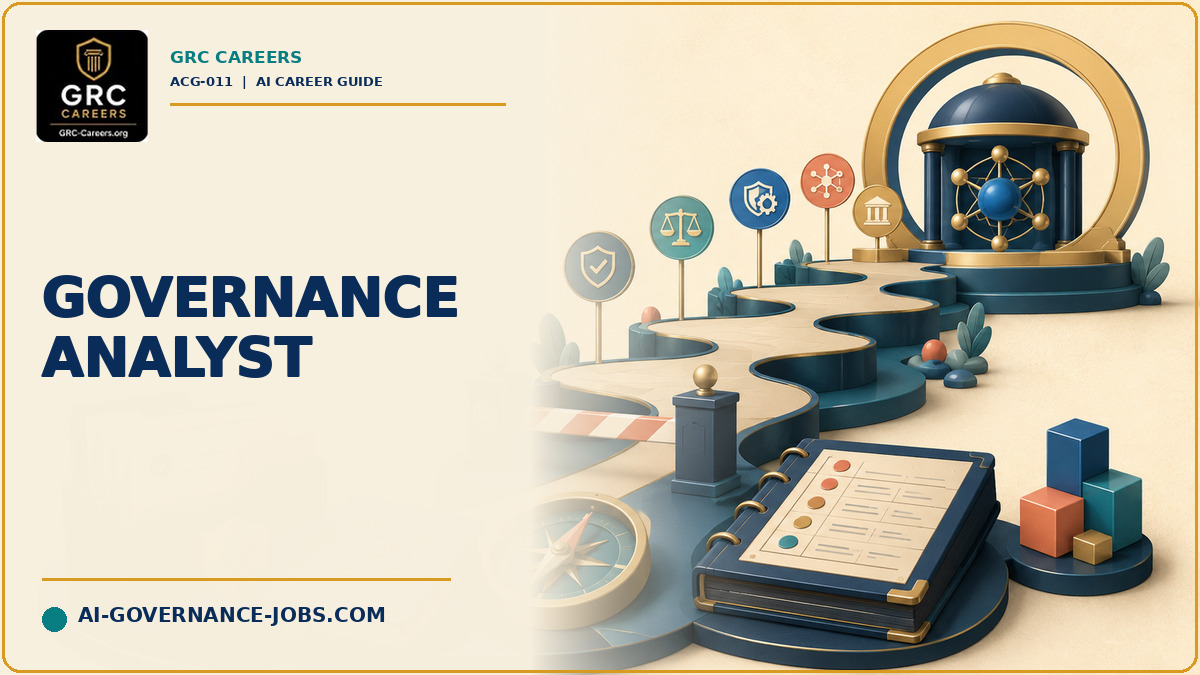
Governance Analyst
The Entry Point into AI Governance
Where most people actually break into the field: what a Governance Analyst does day to day, the skills and certifications that get you hired, and the path from your first role toward manager and the C-suite.
Every AI governance program needs someone who does the work: keeping track of where AI is used, checking new tools before they go live, writing things down, and making sure the organization can prove it acted responsibly. That person is the Governance Analyst.
It is the most common way into the field. The chief officers and program leads get the headlines, but the analyst is where careers in AI governance usually start, and where the practical skills are built. As organizations rush to adopt AI while regulators tighten the rules, demand for analysts who can operate a governance program is growing quickly.
The good news for people entering the field: there is no single required background. Analysts come from privacy, compliance, audit, risk, security, law, policy, and data. What matters is that you can research carefully, write clearly, and stay organized while the rules keep changing.
What a Governance Analyst Actually Does
The role is hands-on and cross-functional. On a given week a Governance Analyst may be responsible for:
- AI inventory upkeep
- Use-case intake and triage
- Initial risk and impact assessments
- Policy and control documentation
- Regulatory and framework tracking
- Vendor and third-party AI reviews
- Audit evidence gathering
- Governance committee support
The analyst is the connective tissue of the program, the person who turns policy on paper into a record of what the organization is actually doing.
Core Responsibilities
Typical responsibilities include:
- Maintain the organization's inventory of AI systems and the use-case intake queue.
- Run first-pass risk and impact assessments on new AI use cases.
- Draft and maintain policies, standards, controls, and procedures.
- Track developments across the EU AI Act, the NIST AI Risk Management Framework, and ISO/IEC 42001.
- Support due diligence on AI vendors and third-party tools.
- Collect and organize evidence for audits and governance-committee reporting.
- Coordinate day to day across legal, security, privacy, data, and product teams.
Skills That Get You Hired
Strong Governance Analysts pair careful analysis with the discipline to document and follow through. Key capabilities include:
- Research and analysis
- Clear writing and documentation
- AI governance frameworks
- Risk assessment fundamentals
- Data literacy
- Attention to detail
- Regulatory awareness
- Cross-functional communication
- Organization and follow-through
- Curiosity about how AI systems work
Certifications Worth Considering
No certification is required to start, but a few signal that you can do the work and help a resume stand out. The IAPP's AIGP is the first credential built specifically for AI governance and a strong early target. The CIPP covers privacy, and ISACA's CISA and CRISC cover the audit and risk foundations the field draws on. For a vendor-neutral GRC baseline, OCEG's GRC Professional (GRCP) is a good entry credential. Underneath all of it, get fluent in the EU AI Act, the NIST AI RMF, and ISO/IEC 42001.
For certification roadmaps and learning paths, credential by credential, visit GRC-Careers.org.
Where the Role Leads
Governance Analyst is a launch point, not a ceiling. A common progression looks like:
- Governance Analyst → Senior Governance Analyst → AI Governance Manager (ACG-009) → Director of AI Governance → chief roles such as Chief Compliance Officer, Chief Risk Officer, or Chief Privacy Officer.
The analyst years are where you learn the frameworks, the tools, and the judgment that every later role is built on. Compensation ranges are shown on the live role pages and reflect what employers actually post, never an estimate.
Explore current GRC and AI governance analyst openings on AI-Governance-Jobs.com.
Browse GRC Analyst jobs →Who Should Read This Guide?
This resource is designed for:
- Aspiring GRC and AI governance analysts
- Privacy, compliance, and audit coordinators
- Recent graduates in law, policy, or data
- Career changers from adjacent fields
- Risk and security professionals moving into AI
- Anyone preparing for a first AI governance role
Related AI Governance Essentials
- AGE-001 — What Is an AI Inventory?
- AGE-002 — AI Use Policy
- AGE-003 — AI Risk Assessment
- Browse the full AI Governance Essentials series →
Related AI Career Guides
- ACG-009 — AI Governance Manager
- ACG-001 — CISO With AI Security Focus
- ACG-002 — Chief Compliance Officer: AI Compliance Edition
- Browse all AI Career Guides →
AI Career Guides (ACG) is an ongoing series created to help professionals understand how artificial intelligence is reshaping careers across governance, risk, and compliance. Each guide explores the responsibilities, in-demand skills, certifications, and career pathways that help people enter and advance in the field.