
Home › Career Guides › AI Governance Manager Career Guide
AI Governance Manager Career Guide
A GRC Careers roadmap
Updated November 2, 2026
Overview
Artificial intelligence is reshaping every industry, but organizations are discovering that successful AI adoption requires more than cutting-edge technology. It requires governance.
The AI Governance Manager is responsible for ensuring AI systems are developed, deployed, and monitored responsibly while balancing innovation, regulatory compliance, business value, and organizational risk. Working across legal, compliance, cybersecurity, privacy, internal audit, data science, and executive leadership, AI Governance Managers establish the frameworks that allow organizations to embrace AI with confidence.
Rules such as the EU AI Act, which has applied in stages since February 2025, and board questions about who owns AI risk have made this work hard to leave unassigned. Some employers hire a dedicated AI Governance Manager. Many others place the same duties inside risk, compliance, privacy or security under a different title, so read the responsibilities as well as the job name.
Why This Role Matters
Organizations are asking questions they have never had to answer before:
- Can we trust AI-generated decisions?
- Are our AI systems compliant with emerging regulations?
- How do we document AI use?
- Who owns AI risk?
- How do we monitor AI after deployment?
- How do we govern hundreds of AI tools used by employees?
The AI Governance Manager helps answer every one of these questions.
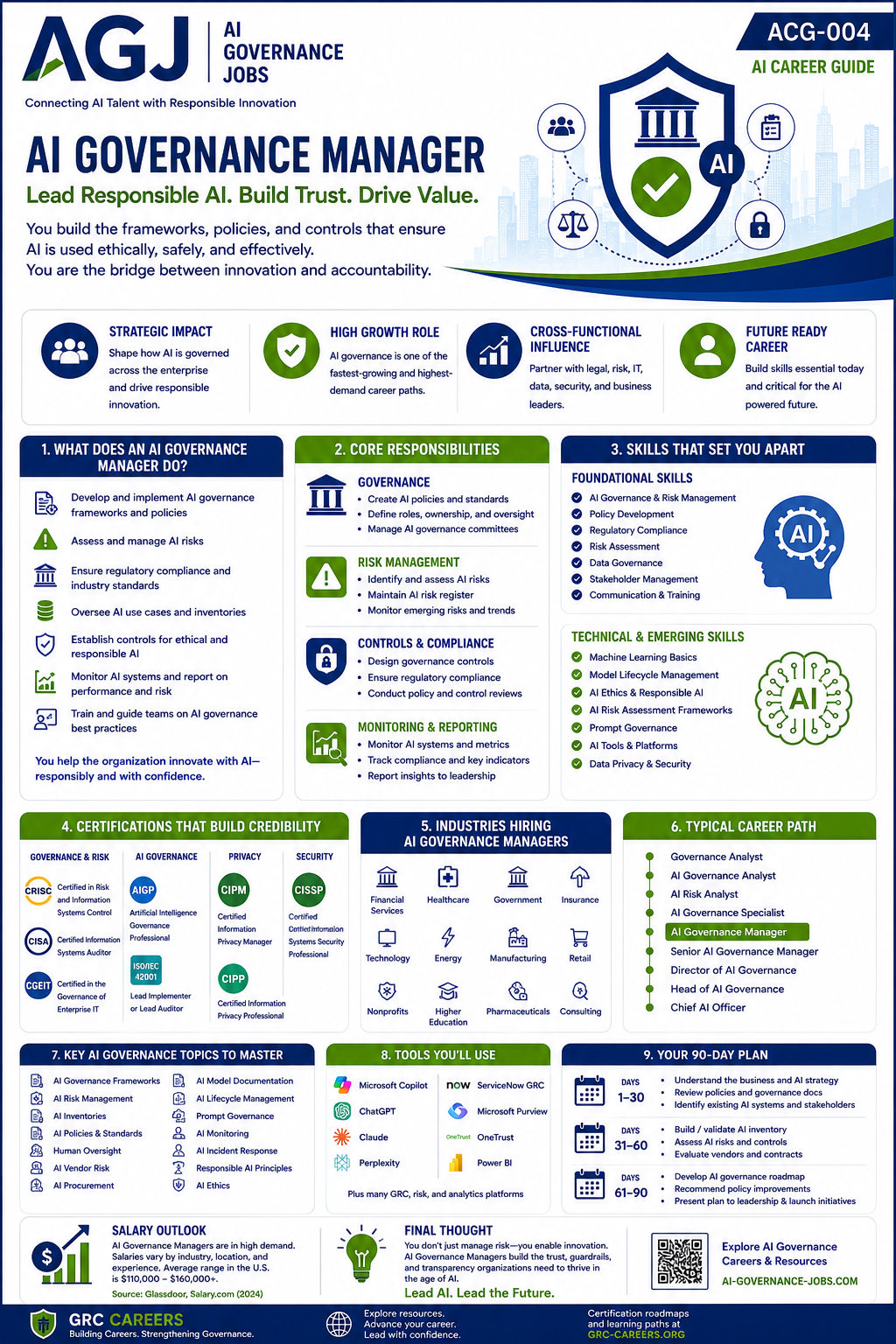
Primary Responsibilities
Build the Governance Program
- Develop AI governance frameworks
- Create AI policies and standards
- Establish governance committees
- Define AI approval processes
- Maintain AI inventories
Manage AI Risk
- Conduct AI risk assessments
- Develop AI risk registers
- Evaluate model risk
- Assess third-party AI vendors
- Monitor emerging AI threats
Regulatory Compliance
- Monitor AI legislation
- Align governance with regulatory requirements
- Support compliance initiatives
- Coordinate internal audits
- Prepare executive reporting
Operational Oversight
- Review new AI use cases
- Measure governance effectiveness
- Track AI performance metrics
- Improve governance processes
- Promote responsible AI practices
Knowledge Areas
AI Governance
- Responsible AI
- AI governance frameworks
- AI lifecycle management
- AI inventories
- Human oversight
- AI documentation
Risk Management
- Enterprise Risk Management
- AI risk assessments
- Model risk
- Vendor risk
- Operational risk
- Scenario analysis
Compliance
- Regulatory compliance
- Privacy
- Internal controls
- Policy management
- Audit readiness
- Governance reporting
Technology
- Generative AI
- Large Language Models
- Machine Learning basics
- Data governance
- Cybersecurity
- Cloud computing fundamentals
Essential Skills
Leadership Skills
- Executive communication
- Strategic thinking
- Change management
- Project leadership
- Stakeholder engagement
- Cross-functional collaboration
Technical Skills
- AI fundamentals
- Data governance
- Risk analysis
- Control design
- Policy development
- Governance documentation
Business Skills
- Business process analysis
- Regulatory interpretation
- Decision-making
- Problem solving
- Presentation skills
- Organizational influence
Certifications That Add Value
No single credential is required by law for this role, and none replaces evidence that you have run part of a governance program. When a posting names one, check whether it is listed as required or preferred. Treat the list below as professional development, chosen to fill the gaps in your own background.
AI Governance
- Artificial Intelligence Governance Professional (AIGP)
Governance and Risk
- CRISC
- CISA
- CGEIT
Privacy
- CIPM
- CIPP
Security and Standards
- CISSP
- ISO/IEC 42001 Lead Implementer
- ISO/IEC 42001 Lead Auditor
ISO/IEC 42001 is the AI management system standard that a company or public body is certified against. The Lead Implementer and Lead Auditor courses are personal training certificates from training providers, not ISO, and holding one is not the same as an employer holding ISO/IEC 42001 certification. Check current requirements with each issuer: IAPP for the AIGP and CIPM, ISACA for CRISC, CISA and CGEIT, which all require documented work experience as well as the exam, and ISC2 for the CISSP, which asks for five years of relevant work experience. To compare them side by side, see the AI governance certification comparison.
Tools You'll Use
- Microsoft Copilot
- ChatGPT
- Claude
- Perplexity
- Microsoft Purview
- ServiceNow IRM (Integrated Risk Management)
- AI inventory and governance modules, such as ServiceNow AI Control Tower or OneTrust AI Governance
- Archer
- OneTrust
- Jira
- Confluence
- SharePoint
- Power BI
Industries Hiring
- Financial Services
- Healthcare
- Insurance
- Government
- Defense
- Technology
- Manufacturing
- Energy
- Retail
- Pharmaceuticals
- Higher Education
- Consulting
- Nonprofits
Career Progression
- Business Analyst
- Governance Analyst
- AI Governance Analyst
- AI Risk Specialist
- AI Governance Manager
- Senior Manager
- Director of AI Governance
- Head of AI Governance
- Chief AI Officer
Typical Projects
- Building the organization's first AI governance program
- Creating an enterprise AI inventory
- Developing AI acceptable use policies
- Establishing AI approval workflows
- Implementing AI risk assessments
- Reviewing AI vendor contracts
- Preparing for AI regulatory audits
- Developing executive dashboards
- Designing governance metrics
- Training employees on responsible AI
Work You Can Show
A concrete work product says more than a list of frameworks. Build one of these for a fictional or anonymized system and bring it to the interview:
- An AI intake and approval workflow: one page showing who submits a new AI use case, the questions asked, the risk tier that decides the review path, who approves at each tier, and what gets recorded.
- An AI risk register entry for one system: the risk, the inherent rating, the controls, the residual rating, the named owner who accepted the residual risk, and the next review date.
- A short governance committee report: systems in the inventory by risk tier, open exceptions with due dates, overdue remediation, and the one decision you need from the committee.
Your First 90 Days
Month One
- Learn the business
- Meet stakeholders
- Review governance documentation
- Identify AI systems already in use
Month Two
- Build or validate the AI inventory
- Assess AI risks
- Review policies
- Evaluate governance maturity
Month Three
- Recommend improvements
- Develop governance roadmap
- Present findings to leadership
- Launch governance initiatives
Resume Keywords
Recruiters often search for: AI Governance, Responsible AI, AI Risk Management, AI Policy, AI Compliance, AI Inventory, AI Framework, AI Controls, AI Ethics, AI Assurance, AI Risk Assessment, Enterprise Risk, Governance Framework, Third-Party Risk, and Regulatory Compliance.
Future Outlook
AI governance is a young specialty, and titles, reporting lines and pay still vary a great deal between employers. What carries across them is the work itself: an AI inventory, intake and approval, risk assessment and residual-risk decisions, control testing, exception handling, vendor review and regular reporting to leadership. Candidates who can show that work, not only describe it, make the strongest case.
For professionals with backgrounds in governance, risk management, compliance, privacy, cybersecurity, internal audit, or technology, this role builds directly on skills you may already use.
Build the skills behind the job: AI governance skills, governance program management, AI risk assessment, controls testing and evidence documentation. To research what current postings for this role ask for, use the Career Intelligence tools.
Ready to make the move? Browse current AI governance roles, explore more career guides, and read our AI governance insights.
Frequently Asked Questions
What does an AI Governance Manager do?
An AI Governance Manager oversees the organization's AI governance program, developing the policies, standards, and oversight processes that let the organization innovate with AI while managing risks across technology, risk, compliance, legal, privacy, and cybersecurity.
What certifications does an AI Governance Manager need?
None is required for every role. The AIGP (IAPP's Artificial Intelligence Governance Professional) is the credential most specific to AI governance. CRISC and CISA from ISACA add risk and audit depth, CIPM from IAPP adds privacy program management, CISSP from ISC2 adds security, and ISO/IEC 42001 Lead Implementer or Lead Auditor training covers the AI management system standard. Check whether a posting lists a credential as required or preferred; none substitutes for governance program experience.
What is the career path to AI Governance Manager?
A common path runs Governance Analyst, AI Governance Analyst, AI Risk Analyst, AI Governance Specialist, and then AI Governance Manager, advancing to Director or Head of AI Governance, Chief AI Officer, or Chief Risk Officer.
Which industries hire AI Governance Managers?
AI governance work exists wherever AI is used in regulated or high-stakes decisions, including financial services, healthcare, insurance, technology, government, defense, manufacturing, energy, retail, higher education, life sciences, nonprofits and consulting.