
Home › AI Career Guides › CISO With AI Security Focus
CISO With AI Security Focus
The modern Chief Information Security Officer in the age of artificial intelligence: how the mission is changing, the skills employers want, and the certifications that matter.
Artificial intelligence is changing the mission of the Chief Information Security Officer.
For years, CISOs focused on protecting networks, systems, applications, and data from cyber threats. Those responsibilities remain at the core of the role, but AI has introduced an entirely new layer of security challenges that demand executive attention.
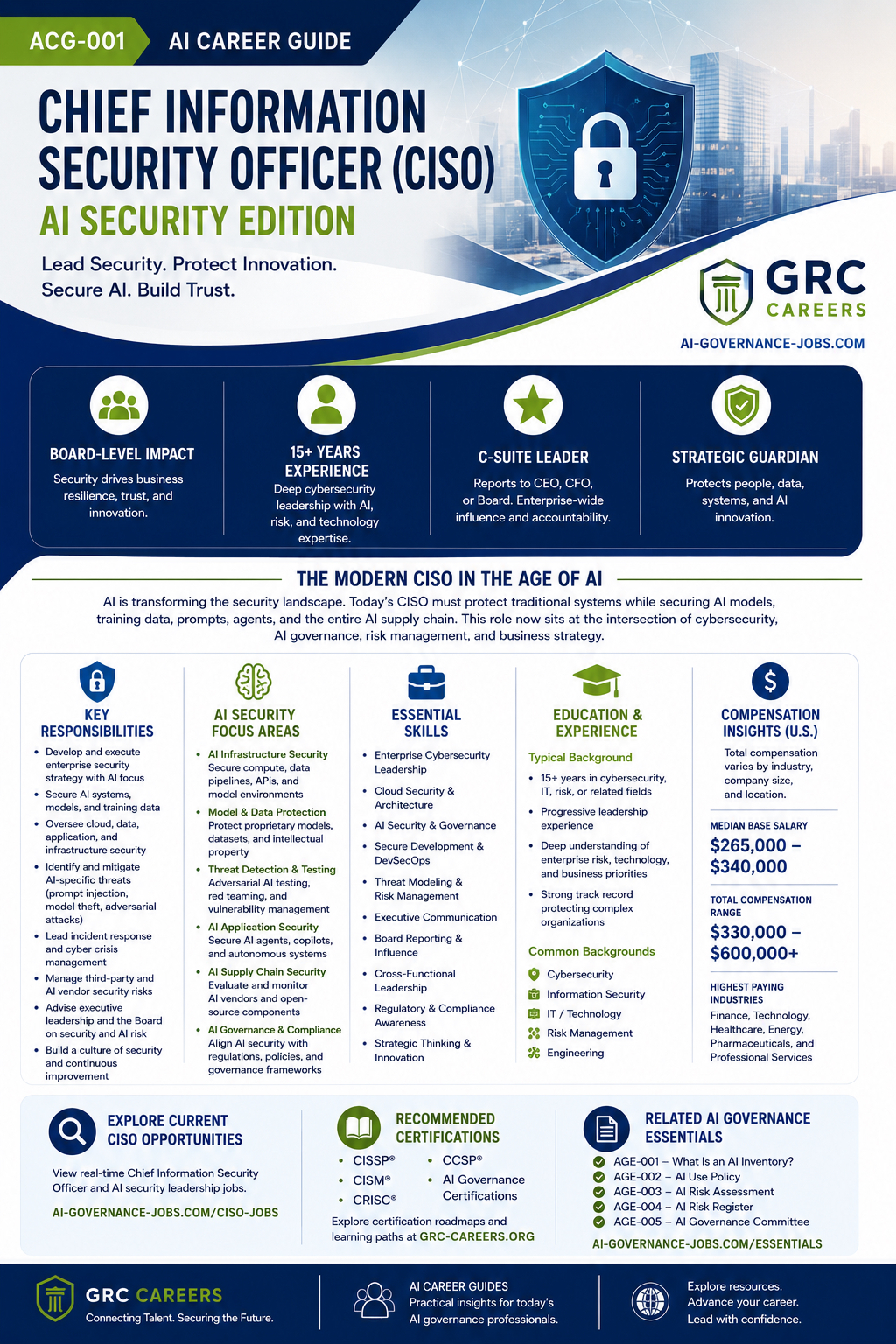
Today’s CISO must understand not only traditional cybersecurity risks, but also the security implications of AI systems, large language models, training data, autonomous agents, prompt injection attacks, model theft, adversarial AI, and AI supply chain risk. Organizations increasingly expect CISOs to help secure AI innovation without slowing it down.
Why This Role Matters More Than Ever
Artificial intelligence is becoming embedded across every business function. That means security leaders are now responsible for protecting technologies that learn, evolve, and make recommendations based on enormous volumes of data.
Modern CISOs are expected to help organizations answer questions such as:
- How do we secure AI systems?
- How do we protect proprietary models and training data?
- How do we defend against prompt injection and adversarial attacks?
- How should AI vendors be evaluated?
- What governance controls should surround AI deployment?
- How do we explain AI security risks to executive leadership and the board?
The role has expanded from cybersecurity leadership to enterprise AI risk leadership.
Core Responsibilities
Modern AI-focused CISOs typically oversee:
- AI security strategy
- Secure AI development practices
- AI infrastructure security
- Model protection
- AI supply chain security
- Prompt injection defense
- Adversarial AI testing
- AI incident response
- Executive reporting
- Security governance for AI initiatives
Skills Employers Are Looking For
Organizations increasingly seek CISOs who combine technical expertise with strategic leadership. High-value skills include:
- Enterprise cybersecurity leadership
- AI governance
- Cloud security
- AI infrastructure
- Threat modeling
- Secure software development
- Risk management
- Executive communication
- Regulatory awareness
- Board reporting
Certifications Worth Considering
Professionals pursuing AI-focused CISO roles often benefit from certifications in CISSP, CISM, CRISC, CCSP, AI governance, cloud security, and risk management.
For certification roadmaps and learning paths, visit GRC-Careers.org.
Who Should Read This Guide?
This guide is designed for:
- Chief Information Security Officers
- Deputy CISOs
- Security Directors
- Cloud Security Leaders
- Security Architects
- AI Security Engineers
- Risk Executives
- Professionals preparing for executive cybersecurity leadership
Explore current Chief Information Security Officer openings and AI security leadership positions on AI-Governance-Jobs.com.
Browse CISO & security leadership jobs →Related AI Governance Essentials
Understanding these topics will strengthen your effectiveness as an AI-focused CISO:
- AGE-001 — What Is an AI Inventory?
- AGE-002 — AI Use Policy
- AGE-003 — AI Risk Assessment
- AGE-004 — AI Risk Register (coming soon)
- AGE-005 — AI Governance Committee (coming soon)
- Browse the full AI Governance Essentials series →
Related AI Career Guides
- ACG-002 — Chief Compliance Officer: AI Compliance Edition
- Chief Risk Officer: AI Risk Edition (coming soon)
- Chief Privacy Officer: AI Privacy Edition (coming soon)
- AI Governance Manager (coming soon)
- AI Security Architect (coming soon)
- Browse all AI Career Guides →
AI Career Guides (ACG) is an ongoing series created to help professionals understand how artificial intelligence is reshaping executive leadership roles. Each guide explores evolving responsibilities, in-demand skills, career pathways, and related AI governance concepts to help leaders prepare for the future of work.