
Home › AI Governance Insights › The Deadline Moved. The Queue Did Not.
The Deadline Moved. The Queue Did Not.
By F. Jay Hall, GRC & AI Governance, GRC Careers · October 5, 2026 · 10 min read
Key Takeaways
- The Digital Omnibus on AI, Regulation (EU) 2026/1744, moved high-risk obligations under Annex III to December 2, 2027 and Annex I to August 2, 2028. It did not move the obligations that are already in force.
- Three AI Act deadlines bind right now, and a fourth lands on December 2, 2026. Almost nobody is tracking that one.
- A governance function behaves like a queue. Wait time rises against how close the team is to capacity, not against how much work arrives, so a team at 90 percent utilization waits nine times longer than one at 50 percent.
- Arrivals keep climbing whatever Brussels does with a date. Deferring the deadline removed the forcing function that was funding reviewers, not the work waiting for them.
- Throughput cannot be bought retroactively. Fifteen months of backlog cannot be cleared by hiring in the fifteenth month, when the people who could clear it are scarcest.
- The binding constraint is skills, not headcount. Sixty percent of CISOs now name the wrong staff, not too few staff, as their top workforce problem.
In the third quarter, the compliance deadline that was going to force a hiring wave slid sixteen months. Most organizations read that as a reprieve. Run the math on what is actually arriving at your governance function and it reads as something else.
The Q3 regulatory ledger
Regulation (EU) 2026/1744, the Digital Omnibus on AI, was published in the Official Journal on July 24 and entered into force on July 27. That is six days before the EU AI Act's original August 2 high-risk deadline. The question of whether the deferral would land in time stopped being a question and became law.
What moved: obligations for standalone high-risk AI systems under Annex III, the category that covers recruitment tools, credit scoring, education, biometrics, and essential services, now apply from December 2, 2027. High-risk AI embedded in products already governed by EU product-safety law under Annex I moves to August 2, 2028.
What did not move is the more useful half of the story.
- February 2, 2025. Article 5 prohibited practices and AI literacy duties. In force for twenty months.
- August 2, 2025. General-purpose AI provider obligations. In force for over a year.
- August 2, 2026. Article 50 transparency and AI content labeling. Landed on schedule this quarter, untouched by the Omnibus.
- December 2, 2026. Two things land together. Providers of systems placed on the market before August 2, 2026 that generate synthetic audio, image, video, or text must meet Article 50(2). And the new prohibitions the Omnibus itself added, covering non-consensual intimate imagery and child sexual abuse material, start applying. Both are inside the current quarter and almost nobody is tracking them.
So the deadline that got attention is the one that moved. The deadlines that bind right now are the ones that got none. If your organization treated August 2 as the date and then exhaled on July 27, you skipped past a transparency obligation that is already live and two more that are eight weeks out.
Worth saying plainly: the Omnibus moved dates and added prohibitions. It did not shrink the work. Risk management, technical documentation, human oversight, post-market monitoring, and the Article 6 classification question all survive intact. The Commission published draft classification guidelines on May 19. The standards bodies whose delays triggered the postponement are still working through harmonized standards into 2027.
The US patchwork got messier, not simpler
Anyone hoping the American picture would resolve into something cleaner got the opposite in Q3.
| Law | Status | What it reaches |
|---|---|---|
| Texas TRAIGA (HB 149) | In force since Jan 1, 2026 | Intent-based prohibitions, AG penalties of $10,000 to $200,000 per violation, NIST AI RMF safe harbor, no private right of action |
| California SB 53 and AB 2013 | In force since Jan 1, 2026 | Frontier model risk frameworks, safety incident reporting, whistleblower protection, training data transparency |
| Colorado SB 26-189 | Effective Jan 1, 2027 | Replaced the 2024 Colorado AI Act, which was repealed May 14 before it ever took effect. Narrower ADMT notice regime |
| New York RAISE Act, Illinois SB 315 | Effective Jan 1, 2027 | Frontier model developers |
Live roles filtered by framework: EU AI Act, NIST AI RMF, ISO/IEC 42001.
Layered on top: a June 2026 executive order created a Department of Justice AI Litigation Task Force specifically to challenge state AI laws in court, and DOJ has already intervened in the Colorado xAI litigation. The March 2026 National AI Legislative Framework urges Congress to pass a preempting national standard. My colleague Stephan Pochet wrote about that collision in When Federal and State AI Law Collide.
Neither has preempted anything. Texas, California, and Colorado statutes all remain enforceable on their own timelines. For a compliance leader, the practical reading is that you now have to satisfy a patchwork while simultaneously tracking a federal effort to dismantle it, and you cannot staff for only one of those outcomes.
The part almost everyone is getting wrong
Here is where I want to be precise, because the standard take on the Omnibus is that governance hiring can wait until 2027, and the standard take is wrong in a way that is measurable.
A governance function is a queue. AI systems arrive to be inventoried, classified, risk-assessed, documented, and signed off. A small number of qualified people clear them. That is the whole structure: an arrival rate, a service rate, and a number of servers.
Look at what is happening to the arrival rate. Gartner has task-specific AI agents going from under 5 percent of enterprise applications in 2025 to 40 percent by the end of 2026. That is not growth in the things your governance function reviews. That is a step change in them.
Now look at the service side. The pool of people who can actually do the work is not expanding at anything like that rate. LinkedIn's 2026 Skills on the Rise report put AI governance demand growth at 150 percent year over year. Executive search firms put Chief AI Officer demand up roughly 400 percent since 2023 against a candidate pool that has barely moved, and average Chief AI Officer tenure sits at 2.1 years, which means a meaningful share of the capacity you hire today walks out before December 2027 arrives.
In a queue, wait time does not rise in proportion to load. It rises against how close you are to capacity. For a single-server queue, average wait runs at ρ / (1 − ρ) times the service time, where ρ is utilization.
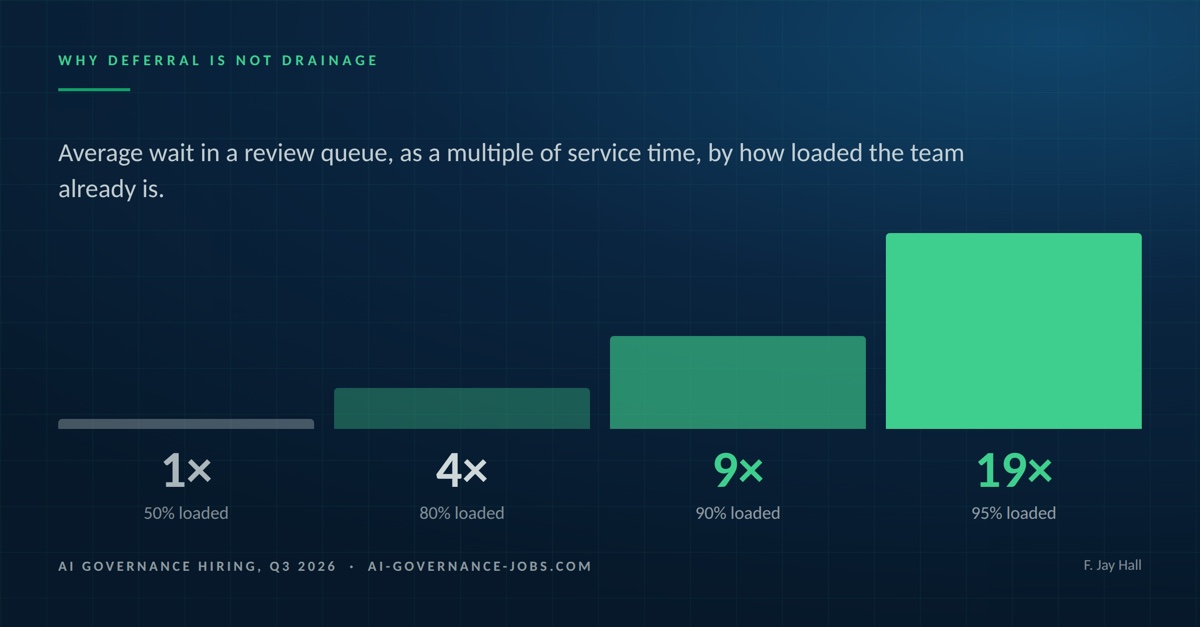
Most teams are already well past eighty. This is why the deferral is a trap rather than a gift. The Omnibus did not drain the queue. It removed the forcing function that was making organizations fund servers to clear it. Arrivals keep climbing on the Gartner curve regardless of what Brussels does with a date.
Little's Law gives you the backlog directly. The number of systems sitting in your governance queue equals the arrival rate multiplied by the average time each one spends in the system. Hold the arrival rate rising and the number of reviewers flat, and the backlog grows every single month between now and December 2027. There are fifteen of those months left.
Then comes the part people miss. You cannot buy throughput retroactively. An organization that arrives at December 2027 with fifteen months of accumulated backlog cannot clear it by hiring in November, because the people who could clear it will be the scarcest they have ever been, and because a queue that deep takes longer to drain than it took to build whenever your drain rate only modestly exceeds your arrival rate.
What the live job data actually shows
I run a job board in this category, so rather than cite someone else's survey I will tell you what is sitting on it today. As of October 5, there are 978 open governance, risk, and compliance roles on the board, with a median posted salary just over $140,000. At the end of July that number was 304.
Be careful with that comparison. A good share of the jump is the board itself growing rather than the market tripling in ten weeks, and I would rather say that than let a number do work it has not earned. What the listings are useful for is composition, not market size. Three things stand out.
Governance is being engineered, not just written. Among the newest postings are a Senior Staff Software Engineer for AI Governance and a Staff Software Engineer for AI Governance at one vendor, and an AI Governance Engineer at another. Two years ago this category was policy people. The build side of governance now has its own job titles and its own pay band.
Federal and federal-adjacent demand is heavy. A striking share of current data governance and AI strategy postings carry clearance requirements, from Public Trust through TS/SCI. If you hold a clearance and framework fluency, you are in the thinnest part of the market.
Salary transparency is still the exception. About four in ten listings carry a range. We require a good-faith range on every new posting, which tells you something about where the rest of the market still is.
Browse the current set: AI governance jobs, AI audit, responsible AI, Chief AI Officer, or the full directory.
The constraint is skills, not headcount
The SANS and GIAC 2026 Workforce Research Report surveyed 947 security leaders and found something that reframes the whole staffing conversation. Sixty percent of CISOs named "not having the right staff" as their top workforce challenge. Only 40 percent chose "not enough staff." That is the first time skills have beaten headcount in that survey, and AI deployment is the named driver.
Put that next to the ISC2 budget picture, where 37 percent of organizations faced budget cuts, 38 percent were under hiring freezes, and 25 percent ran layoffs while the measured workforce gap widened by 19 percent, and you get a market that looks contradictory until you think of it as a queue.
Adding servers only helps if the servers can actually perform the service. Hiring three generalist compliance analysts does not raise your throughput on EU AI Act conformity work. It raises your headcount and leaves your service rate where it was. That is the precise failure the SANS number is describing.
What to measure instead of headcount
- Arrival rate. How many AI systems, models, agents, and vendor tools entered your environment last quarter and needed governance review? If you cannot answer that, you do not have an AI inventory, and the inventory is the one thing the Omnibus did not defer.
- Service time. How many working days does one system take from intake to signed-off classification? Measure the median and the 90th percentile. The gap between them is your real problem.
- Utilization. What fraction of your reviewers' capacity is already committed? Anything above 80 percent means your wait times are being set by congestion, not by how hard the work is.
- Queue depth and aging. How many systems are waiting, and how long has the oldest been waiting? A queue that is growing month over month has already told you the answer to the hiring question.
- Capability coverage, by framework. Not how many people you have. How many people can independently complete an Annex III classification, an ISO 42001 gap assessment, or a NIST AI RMF GOVERN mapping. Usually a smaller number than anyone expects.
Those five numbers turn a budget argument into an engineering argument, and engineering arguments survive contact with a CFO better than "the regulation says so," especially now that the regulation says so sixteen months later.
The hiring window, and the wall behind it
There is a genuine window open right now, and it exists precisely because so many organizations misread the deferral. Requisitions that would have been urgent in Q3 got pushed into 2027 budgets. That means less competition for the same candidates than this field has seen since it started.
Three moves worth making inside it.
Hire the scarce capability, not the open headcount. One person who can independently run an Annex III classification is worth more to your throughput than three who need supervision to do it. Build the requisition around what the person can clear, not what the org chart has room for.
Use fractional to buy service rate without buying a permanent seat. Heidrick reports demand for interim C-suite leaders up 151 percent since 2021. A fractional Chief AI Officer runs roughly $5,000 to $40,000 a month, somewhere around 20 to 40 percent of a full-time hire. For an organization that needs classification work cleared now but cannot defend a permanent executive seat in a flat budget year, that is the arbitrage. We keep a hub for fractional AI governance and GRC roles.
Convert adjacent talent instead of competing for scarce talent. Compliance, internal audit, privacy, and legal professionals already hold most of what the work requires. Framework fluency is learnable in months. Judgment is not. Hiring for judgment and training for frameworks is the only strategy here that actually scales, and it is the one almost nobody runs, which is why the pool stays thin. If you are the person on that side of the trade, start with you are probably already qualified.
Forrester expects 60 percent of Fortune 100 companies to appoint a head of AI governance by the end of this year. IBM's executive study puts the share of organizations with a Chief AI Officer at 76 percent, up from 26 percent a year earlier. The seats are being created. The question is whether they get filled while hiring is easy or after the queue has already backed up.
December 2, 2027 is not a deadline. It is the date you find out what your throughput was for the fifteen months before it.
Where to go next
- Post a governance, risk, or compliance role, hand reviewed and live within one business day
- Free job description templates, including the Ethical AI Specialist and the full AI governance set
- Start here: move into AI governance
- Career roadmaps for 17 roles and the complete AI governance guide
- Free certification practice questions across AIGP, ISO 42001, NIST AI RMF, CISM and more, no signup
- Certification comparison matrix at GRC-Careers.org
- Job alerts, new matching roles the moment they post
- AI governance news and the Insights series
Version française, édition québécoise, avec la Loi 25 et le cadre canadien : L’échéance a bougé. La file d’attente, non.
Sources
- Regulation (EU) 2026/1744, Digital Omnibus on AI, Official Journal July 24, 2026, in force July 27, 2026
- European Commission, draft Article 6 high-risk classification guidelines, May 19, 2026
- Texas HB 149 (TRAIGA); California SB 53 and AB 2013; Colorado SB 26-189, signed May 14, 2026; New York RAISE Act; Illinois SB 315
- Executive Order establishing the DOJ AI Litigation Task Force, June 2026; National AI Legislative Framework, March 2026
- Gartner, enterprise application AI agent adoption forecast, 2026
- SANS Institute and GIAC, 2026 Cybersecurity Workforce Research Report, 947 security leaders
- ISC2 Cybersecurity Workforce Study, budget, hiring freeze, and layoff findings
- LinkedIn, 2026 Skills on the Rise report
- Forrester, AI governance leadership forecast; IBM CEO Study, May 2026
- Heidrick & Struggles, interim and fractional executive demand
- GRC Careers job board data, October 5, 2026
Frequently Asked Questions
Did the Digital Omnibus delay the whole EU AI Act?
No. Regulation (EU) 2026/1744 moved the high-risk obligations only: Annex III standalone high-risk systems to December 2, 2027 and Annex I embedded systems to August 2, 2028. The Article 5 prohibited practices and AI literacy duties from February 2025, the general-purpose AI provider obligations from August 2025, and the Article 50 transparency and labeling rules from August 2, 2026 are all still in force. The Omnibus also added new prohibitions that start applying on December 2, 2026.
What AI Act deadline lands next?
December 2, 2026. Providers of systems placed on the market before August 2, 2026 that generate synthetic audio, image, video, or text have to meet Article 50(2) by then, and the prohibitions the Omnibus added on non-consensual intimate imagery and child sexual abuse material start applying on the same date.
Should we delay AI governance hiring until 2027?
The deferral moved the deadline, not the work. AI systems keep arriving for inventory, classification, and sign-off whatever the compliance date says. Because wait time in a queue rises against utilization rather than volume, a team already running past 80 percent capacity falls further behind every month. Backlog accumulated between now and December 2027 cannot be cleared by hiring in the last month, when qualified people are scarcest.
What should we measure instead of headcount?
Five numbers: the arrival rate of AI systems needing review, the service time from intake to signed-off classification at both the median and the 90th percentile, reviewer utilization, queue depth and aging, and capability coverage by framework, meaning how many people can independently complete an Annex III classification, an ISO 42001 gap assessment, or a NIST AI RMF GOVERN mapping.
Is the shortage about too few people or the wrong skills?
Skills. In the SANS and GIAC 2026 Workforce Research Report, 60 percent of CISOs named not having the right staff as their top workforce challenge against 40 percent who chose not enough staff. Adding generalist compliance analysts raises headcount without raising throughput on conformity work.
Who's Hiring AI Governance Professionals?
Explore current openings in:
AI Governance Jobs · Responsible AI · AI Risk · AI Compliance · AI Audit · AI Policy · Privacy · Cybersecurity · Public Policy
Search the latest opportunities at GRC Careers › · nonprofit GRC jobs ›