Home › AI Governance Insights › The AI Governance Resume Mistake That Costs Great Candidates Interviews
The AI Governance Resume Mistake That Costs Great Candidates Interviews
By F. Jay Hall and Stephan Pochet, Managing Director & Sr. Executive Recruiter · July 16, 2026 · 9 min read
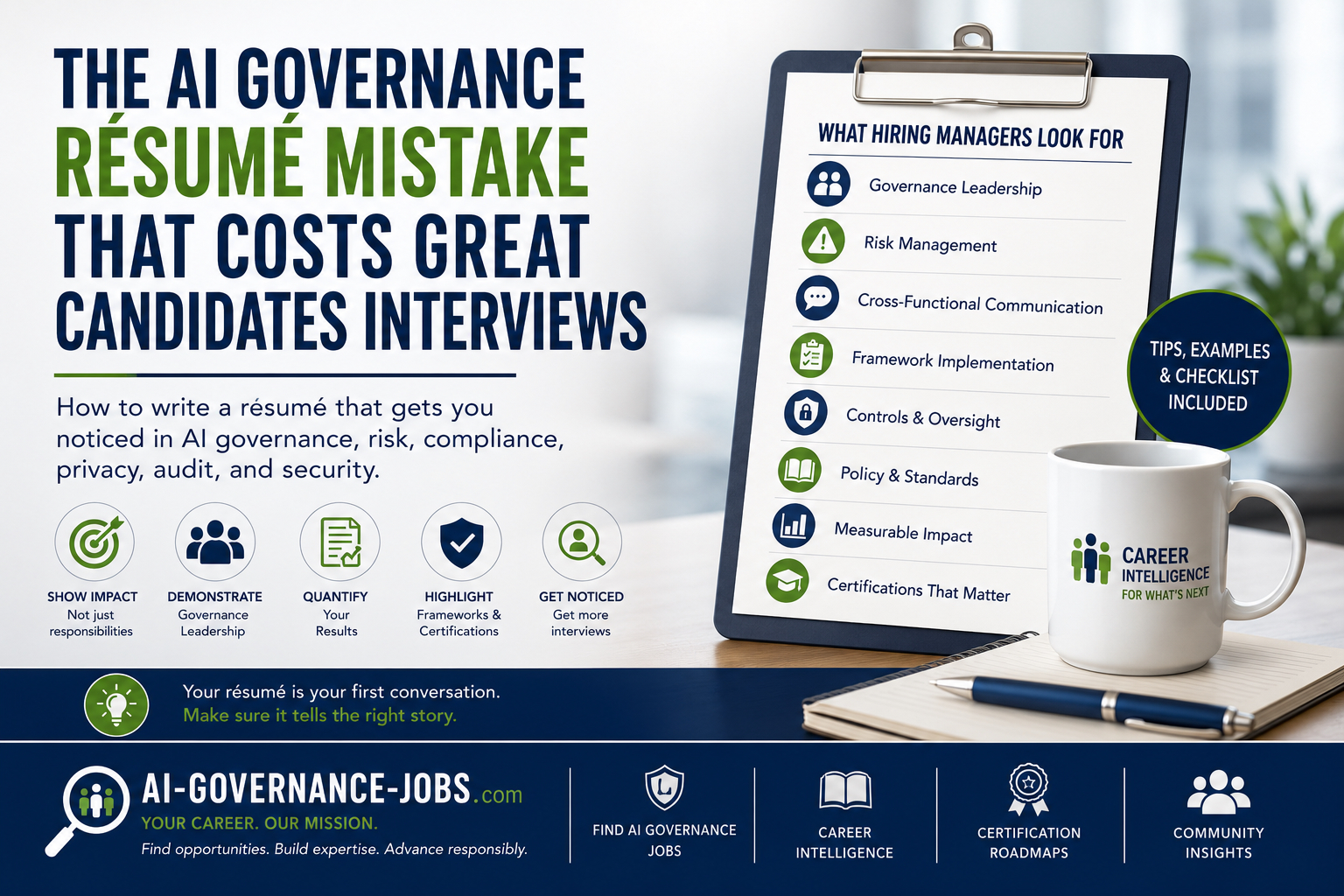
The biggest mistake I see on AI governance resumes has nothing to do with formatting. It is not whether your resume is one page or two. It is not whether you use a modern template. It is not even whether you have the "right" certification.
The mistake is much simpler. Most resumes tell me what someone did. Very few tell me why it mattered.
After more than twenty-five years in executive search, I have reviewed thousands of resumes across nonprofit organizations, higher education, healthcare, government, and the private sector. The best candidates almost never have perfect resumes. What they do have is evidence. Evidence that they solve problems. Evidence that they reduce risk. Evidence that they influence leaders. Evidence that they deliver measurable results.
That matters even more in AI governance. Organizations are not hiring AI governance professionals because they want another policy writer. They are hiring people who can help them deploy AI responsibly, manage emerging risks, satisfy regulators, protect customers, and build trust across the organization. Your resume should demonstrate that. If it doesn't, even an experienced professional may never receive an interview invitation.
This guide explains what hiring managers and executive recruiters are really looking for and how to position yourself as someone who can lead responsible AI initiatives.
Key Takeaways
- Why qualified candidates are often overlooked
- What recruiters notice during the first resume review
- How to write accomplishment-focused resume bullets
- Which AI governance keywords improve discoverability
- How to showcase governance frameworks effectively
- Which certifications deserve prominent placement
- Common resume mistakes to avoid
- How to make your experience relevant even if your current title isn't "AI Governance Manager"
AI Governance Is Bigger Than a Job Title
One of the biggest misconceptions in today's market is that AI governance professionals all have similar career paths. They don't. Some come from cybersecurity. Others arrive through privacy. Some build careers in internal audit. Others come from enterprise risk management, compliance, legal, responsible AI, data governance, or information security.
That diversity is actually a strength. Organizations are assembling multidisciplinary teams because AI governance sits at the intersection of technology, law, ethics, security, business operations, and organizational leadership. Your resume should help employers recognize how your existing experience transfers into this emerging field.
Why Great Candidates Don't Get Interviews
Most resumes fail for one of five reasons.
1. Responsibilities Replace Results
Hiring managers already understand what an AI governance manager does. They don't need another list of duties.
Instead of writing:
Managed AI governance activities.
Write:
Developed an enterprise AI governance program supporting 120 AI use cases across five business units while reducing review time by 40 percent.
The second statement answers the question every employer is asking: "What changed because you were there?"
2. Everything Sounds Technical
Many resumes read like technical documentation. Governance is technical, but it is also organizational. Demonstrate your ability to build executive consensus, lead cross-functional teams, communicate with boards, influence business leaders, and translate technical risk into business language. Those are leadership skills. Leadership is what organizations hire.
3. Metrics Are Missing
Recruiters love numbers. Instead of saying Improved governance, show reduced model approval time, lower compliance findings, increased training completion, improved policy adoption, and reduced vendor risk exposure. Even estimates are often more meaningful than vague statements, provided they are accurate and defensible.
4. The Resume Doesn't Match the Job
One generic resume rarely performs well. If the position emphasizes ISO/IEC 42001, the NIST AI RMF, AI inventory management, third-party AI risk, or the EU AI Act, those topics should appear naturally throughout your resume when they reflect your experience. Tailoring isn't about keyword stuffing. It's about making relevant experience easy to find.
5. The Resume Focuses on Activities Instead of Outcomes
Weak: Participated in AI governance committee meetings.
Stronger: Served on an enterprise AI governance committee that established approval standards, accountability structures, and executive reporting for high-risk AI systems.
The second statement demonstrates influence.
What Hiring Managers Actually Want
The strongest candidates consistently demonstrate competence in several areas.
Governance. Can you establish policies? Create accountability? Implement governance frameworks?
Risk management. Can you identify AI risks before they become organizational problems? Can you prioritize remediation?
Communication. Can you explain AI risk to executives who aren't technical? Can you help business leaders make informed decisions?
Cross-functional leadership. AI governance is collaborative. Employers want professionals who work effectively with legal, compliance, privacy, security, HR, internal audit, data science, product teams, and executive leadership.
Implementation. Anyone can recommend best practices. Organizations hire professionals who can implement them.
The Resume Formula
Here's a simple framework that works remarkably well. Every accomplishment should answer four questions: the action (what did you do?), the problem (what challenge existed?), the governance activity (how did you solve it?), and the result (what measurable business outcome occurred?).
Designed and implemented an enterprise AI governance framework aligned with the NIST AI Risk Management Framework, reducing review time by 35 percent while improving documentation consistency across business units.
Notice that the sentence combines action, governance knowledge, and measurable impact.
Keywords That Improve Discoverability
Many employers use Applicant Tracking Systems (ATS) before a human ever reviews your resume. Include relevant terminology naturally where appropriate.
Governance frameworks: NIST AI RMF, ISO/IEC 42001, EU AI Act, OECD AI Principles, Responsible AI, AI Governance Framework.
Risk: AI Risk Assessment, Model Risk, Enterprise Risk, Third-Party Risk, Operational Risk.
Governance activities: AI Inventory, Model Inventory, Governance Committee, Policy Development, Controls, Oversight, Risk Register, Model Documentation.
Compliance: Regulatory Compliance, Internal Controls, Audit, Privacy Impact Assessment, DPIA, AI Policy.
The goal is relevance, not repetition.
Certifications That Strengthen Your Resume
Certifications should reinforce your experience rather than replace it. Depending on your background, consider highlighting credentials such as AIGP, CRISC, CISA, CISM, CIPP/US, CIPM, an ISO/IEC 42001 Lead Implementer credential, and cloud AI certifications from Microsoft Azure, Google Cloud, or AWS. Place certifications near the top of the resume if they are especially relevant to the position.
Each credential above links to the open roles on GRC Careers that call for it, so you can see exactly how employers are asking for it right now. For a credential-by-credential breakdown of what each certification covers, what it costs, and who it is for, see our network's reference at GRC-Careers.org, and for a plain-English explainer of the AI management-system standard, read ISO/IEC 42001 Explained.
Before and After Resume Examples
Weak: Managed AI risk.
Better: Developed AI risk assessment procedures supporting responsible deployment across multiple business units.
Weak: Created governance policies.
Better: Authored enterprise AI governance policies aligned with emerging regulatory expectations and executive risk management priorities.
Weak: Worked with legal.
Better: Partnered with legal, privacy, compliance, and security leaders to establish governance processes for high-impact AI applications.
Weak: Led training.
Better: Designed and delivered AI governance training that improved policy adoption and increased organizational awareness of responsible AI practices.
Eight Resume Mistakes
- Listing responsibilities instead of accomplishments.
- Omitting measurable results.
- Ignoring governance frameworks.
- Using inconsistent formatting.
- Failing to tailor the resume to the role.
- Burying certifications.
- Writing an executive summary that says very little.
- Forgetting to update LinkedIn so it matches your resume.
Your AI Governance Resume Checklist
Before submitting your next application, ask yourself:
- Does my resume demonstrate measurable business impact?
- Have I highlighted relevant governance frameworks?
- Is leadership experience easy to identify?
- Have I quantified results wherever possible?
- Are certifications clearly visible?
- Does my executive summary explain my value?
- Is my LinkedIn profile consistent with my resume?
- Would a recruiter understand my strengths in less than 30 seconds?
If the answer to any of these questions is "no," your resume may need refinement. If you want a second set of eyes, our career coaching covers resume and LinkedIn positioning for GRC and AI governance roles, and you can browse the current open roles on the board or map your path with the role roadmaps and Career Intelligence tools.
Final Thoughts
The strongest AI governance resumes don't try to impress recruiters with buzzwords. They tell a clear story. They show how you've helped organizations manage risk, improve decision-making, strengthen governance, and build trust. Those are the qualities employers are searching for as AI becomes an integral part of business operations.
As the field continues to mature, professionals who can communicate both technical understanding and business value will be well positioned for leadership opportunities. If your resume focuses on outcomes rather than activities, you'll already be ahead of much of the market.
Continue Building Your Career Intelligence
Explore more Career Intelligence resources on AI-Governance-Jobs.com, including guides on certifications and career paths, interview preparation, salary insights, and current AI governance opportunities.
Coming next in this series: How Recruiters Read AI Governance Resumes in the First 30 Seconds.
Frequently Asked Questions
How long should an AI governance resume be?
For experienced professionals, two pages are generally appropriate. Senior executives may require additional space if every section adds value.
Should I include ChatGPT or other AI tools on my resume?
Yes, when they are relevant to your work and demonstrate practical experience rather than casual use.
Which certifications matter most for AI governance?
The best certification depends on the role. Governance, privacy, audit, security, and risk credentials such as AIGP, CIPP, CISA, CISM, and CRISC all carry weight when paired with meaningful experience.
Can internal auditors transition into AI governance?
Absolutely. Internal audit professionals already understand controls, risk assessment, governance, and assurance, skills that transfer well into AI governance.
Can privacy professionals transition into AI governance?
Yes. Privacy, data protection, consent, and regulatory compliance are increasingly important components of AI governance programs.
Is ISO/IEC 42001 experience valuable?
Yes. As organizations adopt formal AI management systems, experience with ISO/IEC 42001 is becoming increasingly attractive to employers.
Do I need direct AI governance experience to get hired?
Not always. Many professionals successfully transition by demonstrating transferable experience in governance, risk, compliance, privacy, cybersecurity, internal audit, or enterprise technology.
- Founder of ExecSearches and GRC Careers
- Executive search across corporate, higher education, financial services, and nonprofit sectors
- Focus on AI governance and GRC hiring
- More than a decade in risk advisory and internal audit in financial services
- Led SOX and regulatory audits for Citi, Goldman Sachs, Morgan Stanley, and McKesson
- Public Accounting Certification, Cornell University
Who's Hiring AI Governance Professionals?
Explore current openings in:
AI Governance Jobs · Responsible AI · AI Risk · AI Compliance · AI Audit · AI Policy · Privacy · Cybersecurity · Public Policy
Search the latest opportunities at GRC Careers › · nonprofit GRC jobs ›