Home › AI Governance Insights › What Is AI Observability? Why Every AI Governance Professional Should Understand It
What Is AI Observability? Why Every AI Governance Professional Should Understand It
By F. Jay Hall and Stephan Pochet, Founder, GRC Careers LLC · June 28, 2026 · 6 min read
Here is a line worth keeping: you cannot govern what you cannot see. Every governance policy, every risk control, every compliance claim depends on actually knowing what your AI is doing in production. That is what AI observability gives you, and it is fast becoming one of the skills employers ask about by name.
You have the governance, the risk, the compliance, and the frameworks. This is the part that makes all of it real, because it is how you see the system once it is live and out of your hands.
Key Takeaways
- AI observability is continuous monitoring, measuring, and understanding of AI systems in production.
- Its five pillars: Performance, Data Quality, Model Behavior, System Health, and Explainability.
- It is not traditional monitoring: it looks forward and backward, catches issues early, and is built to adapt.
- It is becoming a must-have skill across AI governance, risk, compliance, data science, and platform teams.
- It is the connective tissue: governance sets direction, observability provides the visibility, risk and compliance prove accountability.
What AI observability actually is
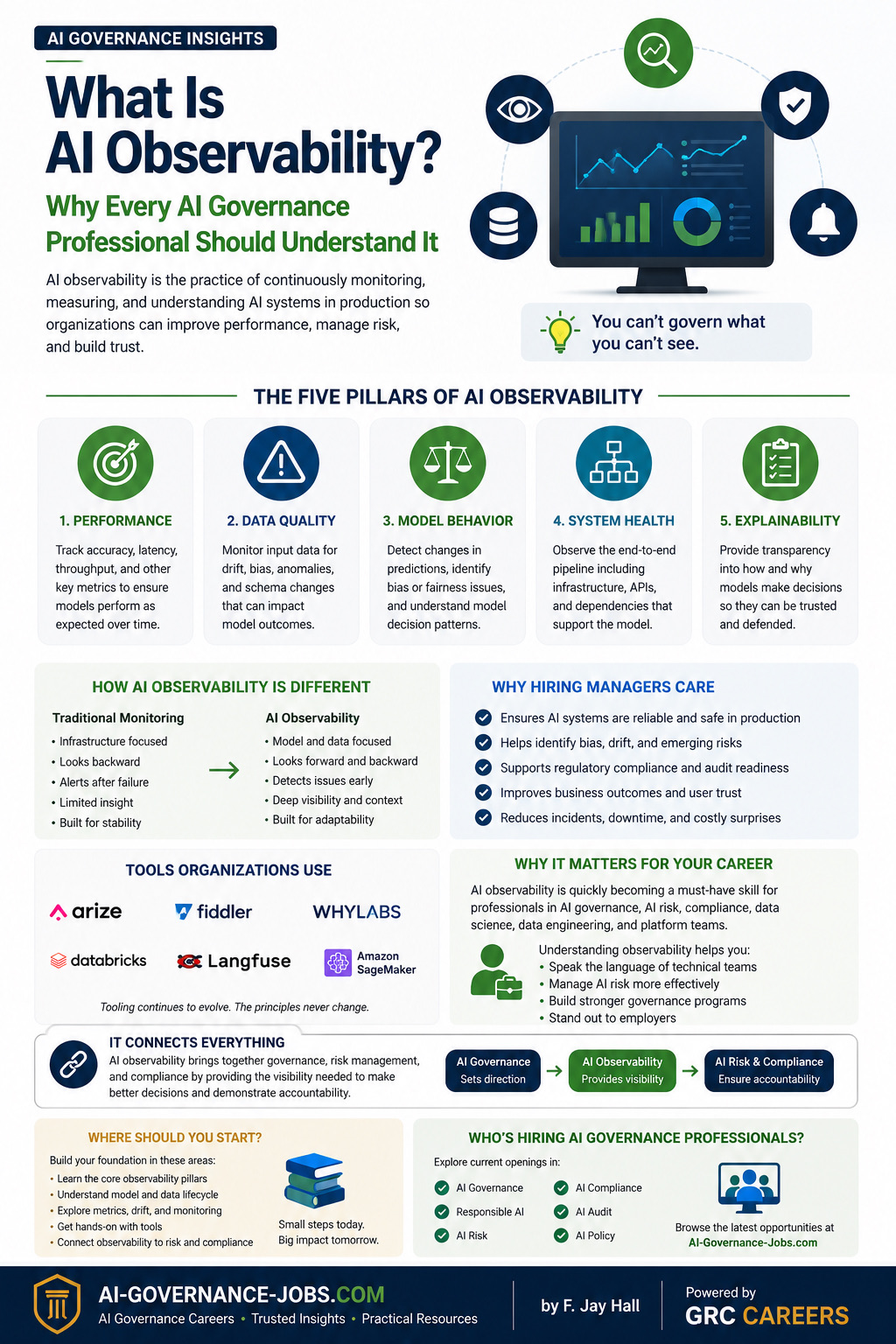
AI observability is the practice of continuously monitoring, measuring, and understanding AI systems once they are running in production, so an organization can improve performance, manage risk, and build trust. Not in the lab. In the wild, where the model meets real data and real users and starts to drift.
The five pillars
Most of the field organizes observability around five pillars. Learn these, because they are the vocabulary:
- Performance: accuracy, latency, throughput, and the other metrics that tell you the model still works as expected over time.
- Data Quality: watching input data for drift, bias, anomalies, and schema changes that quietly wreck model outcomes.
- Model Behavior: detecting shifts in predictions, surfacing bias or fairness issues, and understanding how the model is actually deciding.
- System Health: the end-to-end pipeline, the infrastructure, the APIs, and the dependencies the model leans on.
- Explainability: transparency into how and why a model reaches its decisions, so they can be trusted, defended, and explained to a regulator.
That third and fifth pillar are where observability and governance shake hands. If you want the data-quality pillar in depth, see our companion piece on the five data observability metrics.
How it differs from traditional monitoring
People hear "monitoring" and assume they already do this. They do not, not quite. Traditional monitoring is infrastructure-focused, looks backward, alerts after something fails, and is built for stability. It tells you the server went down.
AI observability is model-and-data-focused. It looks forward and backward, detects issues early, gives deep visibility and context, and is built for adaptability. It tells you the model is starting to drift before anyone files a complaint. Same instinct, different discipline.
Why hiring managers care
When an employer asks about observability, here is what they are really asking whether you can deliver:
- AI systems that stay reliable and safe in production.
- Early detection of bias, drift, and emerging risk.
- Regulatory compliance and audit readiness, with the evidence to back it.
- Better business outcomes and user trust.
- Fewer incidents, less downtime, fewer expensive surprises.
The tools, and why they are not the point
You will see specific platforms named in job descriptions: Arize, Fiddler, WhyLabs, Databricks, Langfuse, Amazon SageMaker, and more arriving every quarter. Learn whichever one your target employer uses. But do not mistake the tool for the skill. Tooling keeps evolving. The principles do not. Understand the five pillars and you can pick up any platform; memorize one platform and you are stuck when it changes.
AI Governance Insight
Observability is the connective tissue of an AI program. Governance sets the direction, observability provides the visibility, and risk and compliance prove accountability. In an interview, say that out loud. It shows you see the whole machine, not just one gear.
Why it matters for your career
AI observability is quickly becoming a must-have for professionals in AI governance, AI risk, compliance, data science, data engineering, and platform teams. Understanding it helps you speak the language of technical teams, manage AI risk more effectively, build stronger governance programs, and stand out to employers who are tired of candidates who can quote a framework but cannot tell when a model has gone wrong.
Where to start
Build your foundation in this order:
- Learn the core observability pillars.
- Understand the model and data lifecycle.
- Get comfortable with metrics, drift, and monitoring.
- Get hands-on with one tool.
- Connect observability back to risk and compliance.
Small steps today, big impact tomorrow. You do not need all of it at once. You need to start.
The Bottom Line
Governance decides what should happen. Observability is how you know whether it actually did. As organizations move AI from experiment to everyday operations, the people who can see inside a live system, and explain what they see, are the ones who get trusted with the keys. Learn to see, and go.
Related Guides
- Top AI Governance Certifications Compared: which credential fits your background.
- Five Data Observability Metrics: a deep dive on the data-quality pillar.
- The AI Governance Frameworks Every Hiring Manager Expects You to Know: NIST AI RMF, ISO 42001, and the EU AI Act.
- AI Governance vs. AI Risk vs. AI Compliance: how the three disciplines connect.
- How to Become an AI Governance Analyst: the step-by-step roadmap.
- AI Observability roles: open jobs that name this skill.
- Responsible AI: turning principles into practice.
- AI Risk Management: spotting and managing model risk.
Frequently Asked Questions
What is AI observability?
AI observability is the practice of continuously monitoring, measuring, and understanding AI systems in production so organizations can improve performance, manage risk, and build trust. It is usually organized around five pillars: performance, data quality, model behavior, system health, and explainability.
How is AI observability different from traditional monitoring?
Traditional monitoring is infrastructure-focused, looks backward, and alerts after a failure. AI observability is focused on the model and its data, looks both forward and backward, detects issues like drift and bias early, and is built for adaptability rather than just stability.
What are the five pillars of AI observability?
Performance (accuracy, latency, throughput), Data Quality (drift, bias, anomalies, schema changes), Model Behavior (changes in predictions, fairness, decision patterns), System Health (pipeline, infrastructure, APIs, dependencies), and Explainability (transparency into how and why models decide).
Do I need to learn a specific AI observability tool to get hired?
Learn whichever tool your target employer uses, such as Arize, Fiddler, WhyLabs, Databricks, Langfuse, or Amazon SageMaker. But the durable skill is understanding the five pillars and the model and data lifecycle. Tools change; the principles do not.
How does AI observability connect to AI governance, risk, and compliance?
Governance sets the direction, observability provides the visibility into what AI systems are actually doing in production, and risk and compliance use that visibility to manage risk and demonstrate accountability. Observability is the connective tissue that makes the other disciplines real.
- Founder of ExecSearches and GRC Careers
- Executive search across corporate, higher education, financial services, and nonprofit sectors
- Focus on AI governance and GRC hiring
- More than a decade in risk advisory and internal audit in financial services
- Led SOX and regulatory audits for Citi, Goldman Sachs, Morgan Stanley, and McKesson
- Public Accounting Certification, Cornell University
Who's Hiring AI Governance Professionals?
Explore current openings in:
AI Governance Jobs · Responsible AI · AI Risk · AI Compliance · AI Audit · AI Policy · Privacy · Cybersecurity · Public Policy
Search the latest opportunities at GRC Careers › · nonprofit GRC jobs ›