Home › AI Governance Insights › The AI Governance Frameworks Every Hiring Manager Expects You to Know
The AI Governance Frameworks Every Hiring Manager Expects You to Know
By F. Jay Hall and Stephan Pochet, Founder, GRC Careers LLC · June 28, 2026 · 6 min read
Open almost any AI governance job description and the same three names keep showing up. NIST AI RMF. ISO/IEC 42001. The EU AI Act. They are not interchangeable, and you do not need to memorize a single clause. You need to know what each one is for, and how they snap together.
Get that, and you stop sounding like someone who read about the field. You start sounding like someone ready to run it.
Key Takeaways
- Three frameworks come up again and again in AI governance hiring: NIST AI RMF, ISO/IEC 42001, and the EU AI Act.
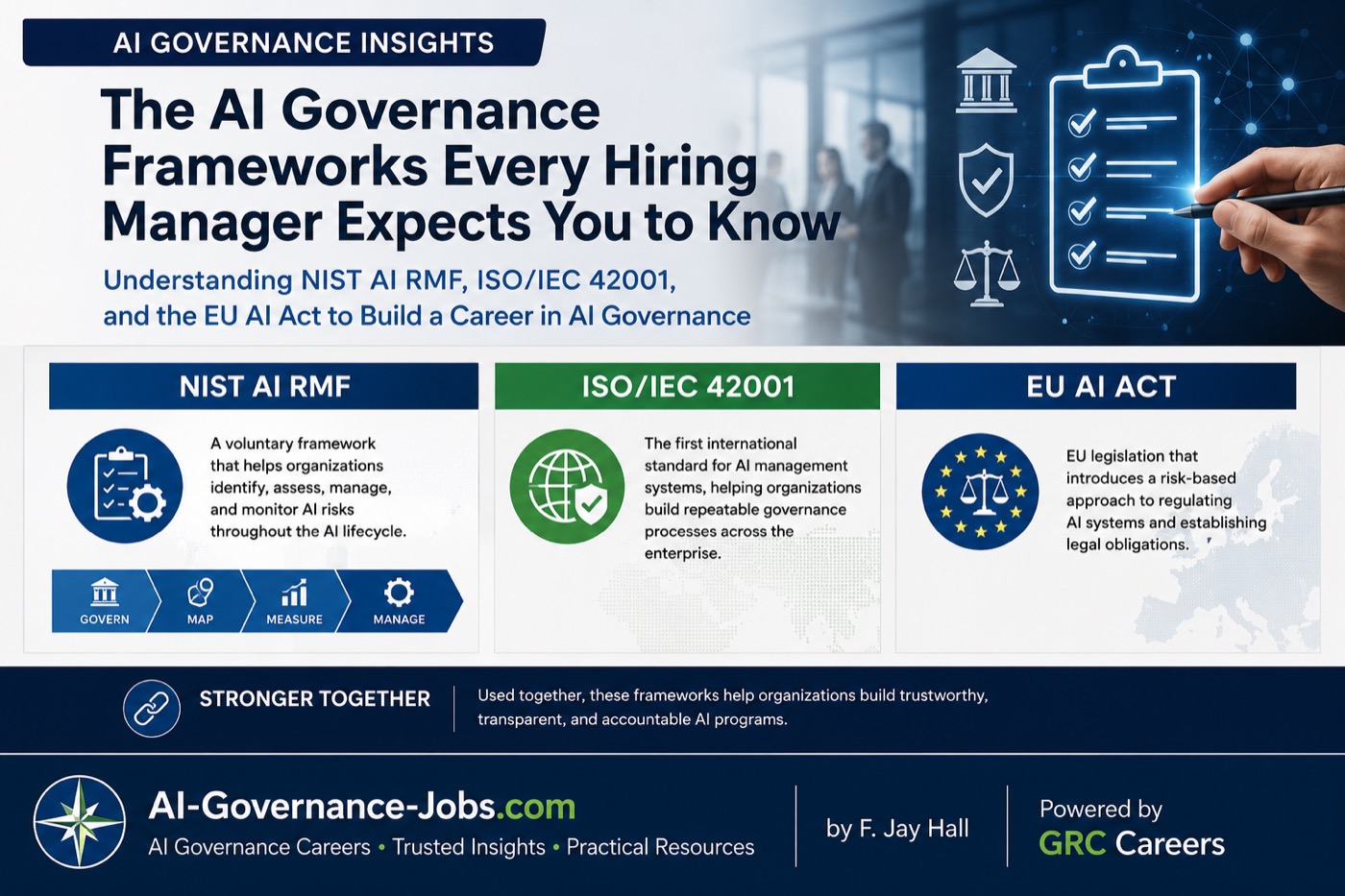
- NIST AI RMF is voluntary guidance for managing AI risk, built around Govern, Map, Measure, and Manage.
- ISO/IEC 42001 is the first international management-system standard for AI, the ISO 27001 of AI governance.
- The EU AI Act is law: a risk-based approach that classifies AI systems by their potential impact.
- Most organizations use all three together. Knowing how they fit beats quoting any one of them.
Why hiring managers care about frameworks
Organizations are pouring money into AI. They are also fielding new questions from regulators, customers, boards, and their own legal teams. Questions like: How do we identify AI risk? Which controls do we put in place? How do we prove we are doing this responsibly? Which laws actually apply to us?
Frameworks are how an organization answers those questions the same way twice. That is why the person who understands them gets hired. Not for the trivia. For the structure.
NIST AI Risk Management Framework
Built by the National Institute of Standards and Technology, the NIST AI RMF is practical guidance for finding, assessing, managing, and monitoring AI risk across the whole AI lifecycle. It is not a law, and it is not a test you pass. It is a flexible playbook organizations adapt to their own environment.
Learn its four core functions, because they show up constantly in interviews and on the job:
- Govern: build the culture, roles, and accountability for managing AI risk.
- Map: understand the context and surface the risks.
- Measure: analyze, assess, and track those risks.
- Manage: prioritize, act, and respond.
Talk through Govern, Map, Measure, and Manage in plain language and you are already ahead of most candidates.
ISO/IEC 42001
ISO/IEC 42001 is the first international management-system standard made specifically for artificial intelligence. It does not zoom in on one model. It helps an organization build repeatable governance processes across the entire enterprise.
Think of it as the AI version of what ISO 27001 became for information security. As more organizations pursue formal, certifiable AI governance programs, the people who understand 42001 become the people they need.
The European Union AI Act
Here is what sets the EU AI Act apart from the other two. It is not guidance. It is law.
It takes a risk-based approach, sorting AI systems by how much harm they could cause and attaching obligations to each tier. Build or deploy AI in the European market and those obligations may apply to you, with real legal weight behind them. And it is phasing in on a staggered timeline rather than all at once, so which obligations apply, and when, depends on the system and the date.
It is not only a European concern, either. Plenty of organizations headquartered far from Brussels are watching closely, because they operate internationally or simply want one consistent governance standard everywhere they work.
How the three fit together
The biggest myth in this field is that you have to pick one. You do not. Most mature programs run all three at once, each doing a different job:
- NIST AI RMF gives you the practical method for managing AI risk.
- ISO/IEC 42001 gives you the management system and the repeatable processes.
- The EU AI Act gives you the legal obligations, where they apply.
Together they are how an organization builds AI that is trustworthy, transparent, and accountable. Knowing where they overlap, and where they do not, is the whole skill.
AI Governance Insight
In an interview, the strongest answer is rarely a recited definition. It is showing how the pieces connect: NIST for the how, ISO 42001 for the system, the EU AI Act for the law. Connect them out loud and you sound like someone who has run a program, not someone who studied for the test.
What hiring managers actually want
Almost no one is looking for a candidate who memorized every requirement. They want someone who understands:
- When each framework applies.
- How the three complement one another.
- How governance supports responsible AI in practice, not just on paper.
- How to explain all of it to both engineers and executives.
Discuss these confidently and you will go further than the candidate quoting clause numbers. Fluency beats recall.
Build your career from here
Just starting out? Build a working knowledge of the three frameworks first. Then widen into the disciplines that sit right next to them:
- AI risk management
- AI observability
- Model governance
- Data governance
- AI auditing
- Responsible AI
- AI compliance
These show up together in job descriptions for a reason. Organizations need people who can connect technology, governance, and business strategy, and not many can.
The Bottom Line
AI governance is moving fast, and the frameworks will keep evolving. But the professionals who understand today's leading ones, NIST AI RMF, ISO/IEC 42001, and the EU AI Act, are the ones who get the call tomorrow.
Coming from cybersecurity, compliance, privacy, internal audit, legal, or data governance? You are closer than you think. Learn the three, learn how they fit, and go.
Related Guides
- Top AI Governance Certifications Compared: which credential fits your background.
- What Is AI Observability?: the five pillars and why employers ask for it.
- AI Governance vs. AI Risk vs. AI Compliance: how the three disciplines differ and connect.
- How to Become an AI Governance Analyst: the step-by-step roadmap into the field.
- Five Data Observability Metrics: the data-quality signals every AI governance team should track.
- EU AI Act roles: jobs shaped directly by the new law.
- ISO/IEC 42001 roles: building certifiable AI management systems.
- NIST AI RMF roles: putting the framework to work day to day.
- Responsible AI: turning principles into practice.
- AI Risk Management: spotting and managing model risk.
- AI GRC roles: open governance, risk, and compliance jobs.
Frequently Asked Questions
What are the main AI governance frameworks?
The three that come up most in hiring are the NIST AI Risk Management Framework (voluntary risk guidance), ISO/IEC 42001 (an international AI management-system standard), and the EU AI Act (binding law in the European market). Most organizations use all three together.
Is the NIST AI RMF mandatory?
No. The NIST AI Risk Management Framework is voluntary guidance, not a regulation. Organizations adopt and adapt it because it gives them a practical, flexible method for managing AI risk across the AI lifecycle, organized around four functions: Govern, Map, Measure, and Manage.
What is ISO/IEC 42001?
ISO/IEC 42001 is the first international management-system standard created specifically for artificial intelligence. Rather than focusing on a single model, it helps organizations build repeatable AI governance processes across the enterprise, much as ISO 27001 did for information security.
Does the EU AI Act apply to organizations outside Europe?
It can. The EU AI Act regulates AI systems placed on or used in the European market, so organizations based elsewhere may still have obligations if they operate internationally. Many also adopt it voluntarily to keep one consistent governance standard across regions.
Do I need to memorize these frameworks to get an AI governance job?
No. Hiring managers care far more that you understand when each framework applies, how they complement one another, and how to explain governance to both technical and non-technical audiences than whether you can quote specific clauses.
- Founder of ExecSearches and GRC Careers
- Executive search across corporate, higher education, financial services, and nonprofit sectors
- Focus on AI governance and GRC hiring
- More than a decade in risk advisory and internal audit in financial services
- Led SOX and regulatory audits for Citi, Goldman Sachs, Morgan Stanley, and McKesson
- Public Accounting Certification, Cornell University
Who's Hiring AI Governance Professionals?
Explore current openings in:
AI Governance Jobs · Responsible AI · AI Risk · AI Compliance · AI Audit · AI Policy · Privacy · Cybersecurity · Public Policy
Search the latest opportunities at GRC Careers › · nonprofit GRC jobs ›