
Home › AI Governance Insights › What Is an AI Inventory? The Foundation of Effective AI Governance
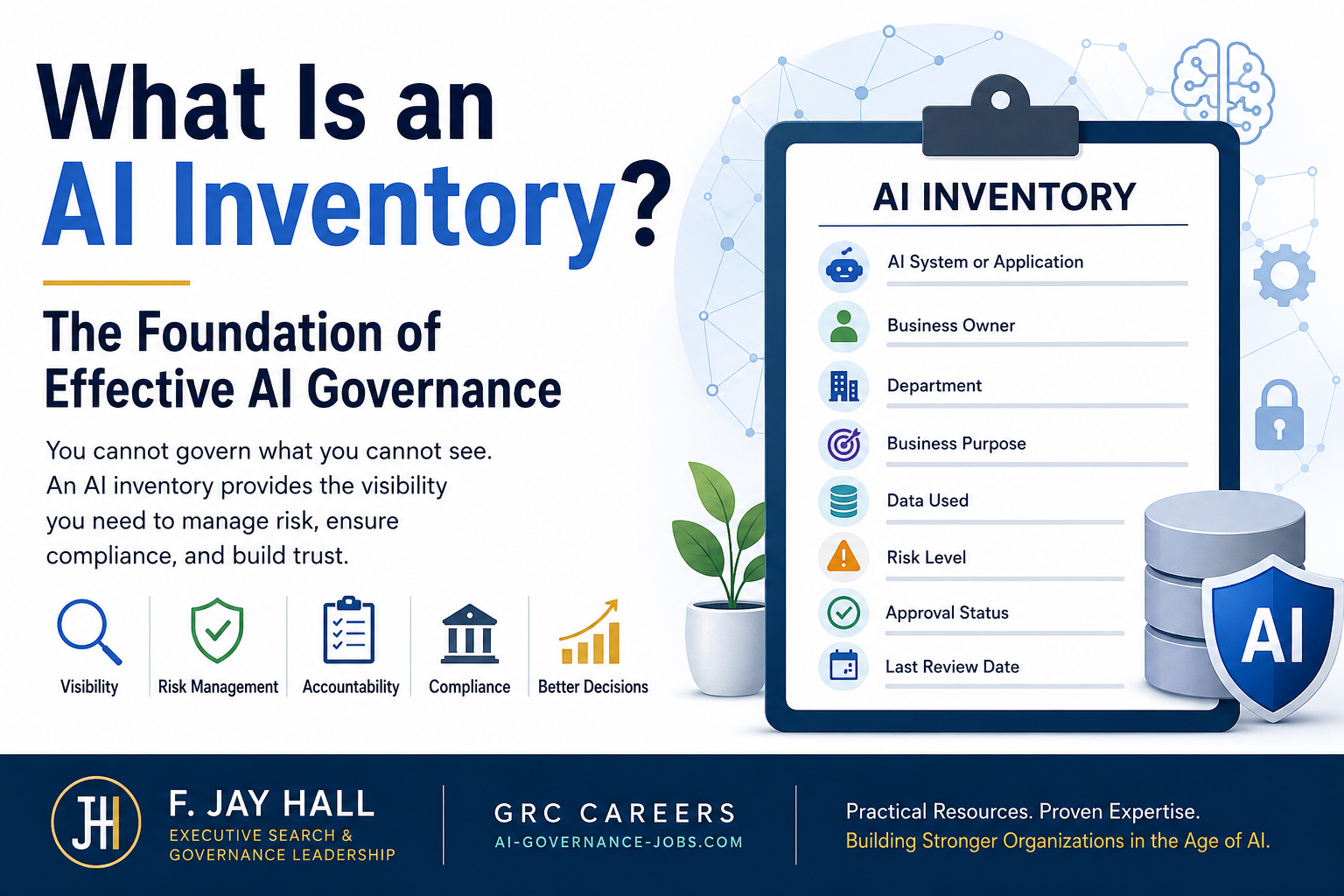
What Is an AI Inventory? The Foundation of Effective AI Governance
By F. Jay Hall and Stephan Pochet, GRC Careers · June 30, 2026 · 6 min read
Artificial intelligence is becoming part of everyday work. Employees use it to draft emails, summarize meetings, analyze spreadsheets, generate code, create marketing content, and support customers. In many organizations, these tools are being adopted faster than the governance practices meant to oversee them.
That creates a simple but important question: do you actually know where AI is being used in your organization? If the answer is "not completely," you are not alone.
An AI inventory is one of the first and most valuable steps an organization can take when building an effective AI governance program.
Key Takeaways
- An AI inventory is a centralized, living record of every AI system, application, model, or service used across an organization.
- You cannot govern what you cannot see. Most organizations already run dozens, or hundreds, of AI tools, many adopted without formal approval.
- A useful inventory captures the owner, purpose, data processed, risk level, and review status of each system.
- It is the foundation that makes every other governance activity easier: risk assessments, policies, audits, and board reporting.
- It is an ongoing process, not a one-time project. Start small and expand as the program matures.
What is an AI inventory?
An AI inventory is a centralized record of every artificial intelligence system, application, model, or service used across an organization. Think of it as a living catalog that helps you answer questions like:
- What AI tools are we using?
- Who owns each system?
- What business purpose does it serve?
- What data does it process?
- Does it interact with confidential or sensitive information?
- Has it been reviewed for security, privacy, and compliance?
- What level of risk does it present?
Without this visibility, organizations are forced to make governance decisions based on assumptions rather than facts.
Why an AI inventory matters
You cannot govern what you cannot see. Many organizations already have dozens, or even hundreds, of AI-enabled tools operating across departments. Some were formally approved. Others were adopted independently by employees looking to work faster.
A good inventory helps an organization:
- Understand where AI is being used.
- Identify duplicate or unnecessary tools.
- Support security and privacy reviews.
- Improve regulatory readiness.
- Prioritize AI risk assessments.
- Establish accountability for each AI system.
- Make more informed technology decisions.
Most importantly, it provides the foundation for responsible AI governance.
What information should it include?
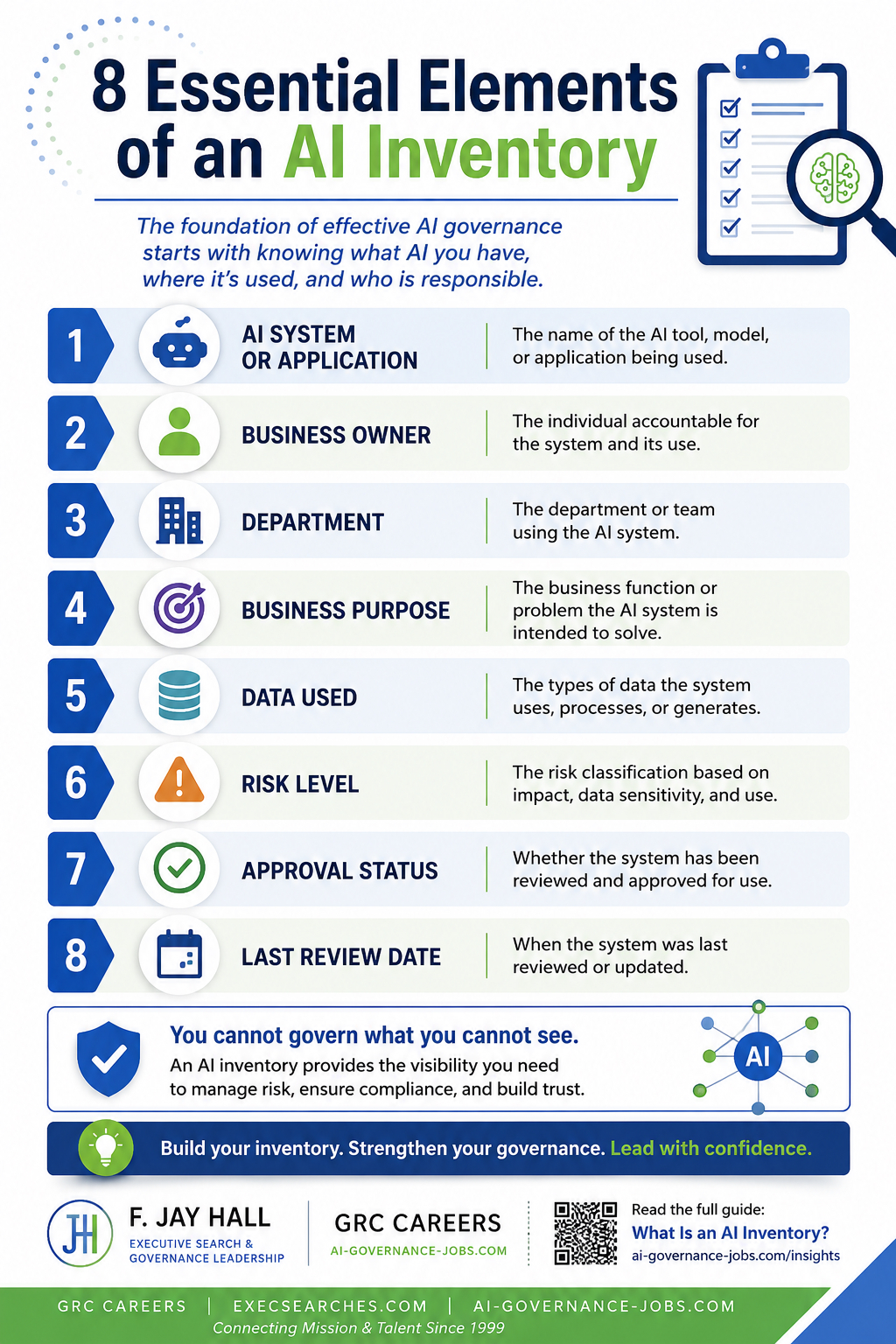
An effective AI inventory does not need to be complicated, but it should capture the information that supports governance and decision-making. Typical fields include:
- AI system or application name
- Vendor or developer
- Business owner
- Department using the tool
- Business purpose
- Data inputs and outputs
- Types of information processed
- Internal or external users
- Risk classification
- Approval status
- Date implemented
- Last review date
You can expand the inventory over time as your governance program matures.
Common mistakes
The biggest mistake is assuming the IT department already knows every AI tool in use. In reality, many AI applications are adopted directly by business units through browser-based services or software subscriptions.
Another common mistake is treating the inventory as a one-time project. AI adoption changes quickly, so the inventory should be an ongoing governance process that is reviewed and updated regularly.
An AI inventory supports every other governance activity
Once you have visibility into your AI landscape, the rest of governance gets easier. An AI inventory supports:
- AI risk assessments
- AI use policies
- Vendor reviews
- Security assessments
- Privacy impact assessments
- Internal audits
- Board reporting
- Regulatory compliance efforts
Rather than treating it as another administrative task, see the inventory as the central reference point for your entire AI governance program.
AI Governance Insight
You cannot govern what you cannot see. Before the policies, the risk assessments, and the board reports comes one unglamorous step: knowing where AI actually lives in your organization. The teams that start there are the ones who stay ahead of the risk.
Getting started
You do not need to inventory every possible AI tool on day one. The important step is getting started. Building an AI inventory creates visibility, encourages accountability, and helps leaders make informed decisions about how AI is used across the organization.
As adoption keeps accelerating, the organizations that understand their AI environment will be in a far stronger position to manage risk, support innovation, and build trust with employees, customers, and stakeholders.
The AI Governance Essentials series
This article is part of our AI Governance Essentials series. Also in the series:
- How to Conduct an AI Risk Assessment
- AI Use Policies: Setting Clear Expectations for Responsible AI (coming soon)
- Building an AI Governance Framework (coming soon)
- Creating an AI Risk Register (coming soon)
- AI Governance Roles and Responsibilities (coming soon)
Related Guides
- How to Conduct an AI Risk Assessment: the next step once you know where your AI lives.
- The AI Governance Frameworks Every Hiring Manager Expects You to Know.
- AI Governance vs. AI Risk vs. AI Compliance.
- AI GRC roles: open governance, risk, and compliance jobs.
- Responsible AI: turning principles into practice.
Frequently Asked Questions
What is an AI inventory?
An AI inventory is a centralized, living record of every artificial intelligence system, application, model, or service used across an organization. It catalogs what is in use, who owns each system, its business purpose, the data it processes, and the level of risk it presents.
Why does an AI inventory matter?
You cannot govern what you cannot see. Most organizations already run dozens or hundreds of AI tools, many adopted without formal approval. An AI inventory provides the visibility that every other governance activity, from risk assessments to board reporting, depends on.
What information should an AI inventory include?
Typical fields include the system or application name, vendor or developer, business owner, department, business purpose, data inputs and outputs, types of information processed, internal or external users, risk classification, approval status, date implemented, and last review date. You can expand it as your program matures.
Is an AI inventory a one-time project?
No. AI adoption changes quickly, so the inventory should be an ongoing governance process that is reviewed and updated regularly, not a one-time exercise.
How do we get started with an AI inventory?
Start small. You do not need to capture every tool on day one. Begin by cataloging the AI systems you already know about with a few core fields, owner, purpose, data, and risk, and expand from there as your governance program grows.
- Founder of ExecSearches and GRC Careers
- Executive search across corporate, higher education, financial services, and nonprofit sectors
- Focus on AI governance and GRC hiring
- More than a decade in risk advisory and internal audit in financial services
- Led SOX and regulatory audits for Citi, Goldman Sachs, Morgan Stanley, and McKesson
- Public Accounting Certification, Cornell University
Who's Hiring AI Governance Professionals?
Explore current openings in:
AI Governance Jobs · Responsible AI · AI Risk · AI Compliance · AI Audit · AI Policy · Privacy · Cybersecurity · Public Policy
Search the latest opportunities at GRC Careers › · nonprofit GRC jobs ›