
Home › AI Governance Insights › What Is an AI Risk Assessment? A Practical Guide to Identifying and Managing AI Risk
What Is an AI Risk Assessment? A Practical Guide to Identifying and Managing AI Risk
By F. Jay Hall, Founder, GRC Careers LLC · July 2, 2026 · 9 min read
Artificial intelligence can help organizations work faster, see patterns sooner, and make better use of information they already have. It can also introduce risk.
Not the vague kind of risk that lives in a board presentation and disappears after the meeting. Real risk: risk to customers, employees, patients, students, donors, applicants, vendors, operations, reputation, and trust. That is why an AI risk assessment matters.
Before an organization deploys or expands the use of an AI system, leaders need to understand what the system does, what data it uses, who it affects, how decisions are reviewed, and what could happen if the system performs poorly. AI governance is not just about having a policy. It is about asking better questions before the consequences become expensive.
Key Takeaways
- An AI risk assessment is a structured review of an AI system or use case to identify risks and decide how to manage them, before deployment.
- Risk depends on context: the same capability can be low risk in one use and high risk in another.
- Review nine areas: purpose, data, impact on people, accuracy, bias and fairness, security and privacy, human oversight, vendor risk, and legal alignment.
- Score risk by likelihood and impact, and match the depth of review to the risk level.
- It is not a one-time stamp: reassess when the system, vendor, data, or use case changes.
- The assessment identifies risk; the AI risk register tracks and manages it over time.
What is an AI risk assessment?
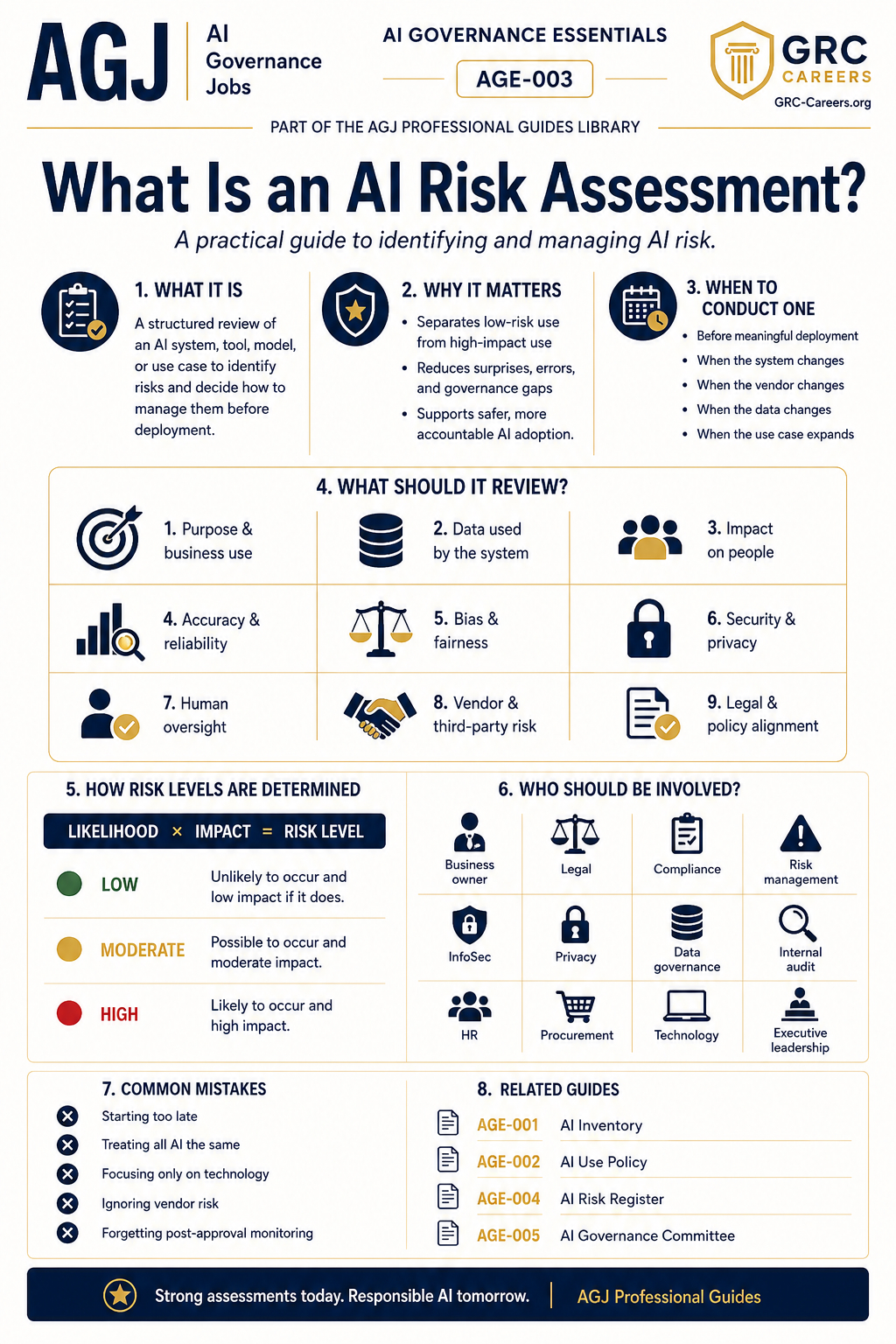
An AI risk assessment is a structured review of an AI system, tool, model, or use case to identify potential risks and determine how those risks should be managed. It helps an organization answer questions such as:
- What is this AI system being used for?
- What data does it rely on?
- Who could be affected by its outputs?
- What decisions does it influence?
- Could the system create bias, errors, privacy concerns, security issues, or compliance problems?
- Who is responsible for reviewing and approving its use?
- What safeguards should be in place before it is deployed?
A good assessment does not exist to stop innovation. It exists to make innovation safer, clearer, and more accountable. The goal is not to create paperwork. The goal is to make better decisions.
Why AI risk assessments matter
Many organizations are already using AI in ways leadership may not fully see. Employees may be using public AI tools to draft documents, summarize sensitive information, evaluate data, assist customers, screen applicants, or generate recommendations. Some of those uses may be low risk. Others may carry serious consequences.
An AI risk assessment helps organizations separate casual productivity tools from systems that require closer review. A tool used to summarize public meeting notes may present limited risk. A tool used to screen job candidates, evaluate loan applications, recommend medical treatment, or prioritize public services requires a much higher level of oversight.
Risk depends on context. The same AI capability can be low risk in one setting and high risk in another.
When should an AI risk assessment be conducted?
An AI risk assessment should happen before an AI system is approved for meaningful use. It should also be repeated when the system changes, when the vendor changes, when the data changes, or when the use case expands. Common trigger points include:
- A new AI tool is being considered.
- An existing tool adds AI features.
- Employees begin using AI in a new workflow.
- AI is used to support decisions affecting people.
- Sensitive, confidential, or regulated data may be involved.
- A vendor offers an AI-enabled product or service.
- The organization receives complaints, errors, or unexpected results.
- Regulations, internal policies, or business priorities change.
The assessment should not be treated as a one-time approval stamp. AI systems can change over time, and so can the risks around them.
What should an AI risk assessment review?
Every organization will design its own process, but most AI risk assessments should examine several core areas.
1. Purpose and business use
Start with the basic question: what problem is this AI system supposed to solve? If the purpose is unclear, the risk will be hard to evaluate. Document the intended use, business owner, expected benefits, and boundaries, and identify what the system should not be used for. Clarity at the beginning prevents confusion later.
2. Data used by the system
AI systems depend on data, which makes it one of the most important parts of any assessment. Identify what data is used, where it comes from, whether it is sensitive, confidential, personal, or regulated, whether it is accurate and appropriate, whether the system stores, shares, or learns from it, and whether that use is consistent with privacy and security obligations. If the organization cannot explain what data the system uses, it is not ready to explain the risk.
3. Impact on people
Some AI systems affect people directly: hiring, lending, housing, healthcare, education, benefits, customer service, insurance, discipline, performance reviews, or access to services. Ask who could be helped, who could be harmed, whether the system could treat groups differently, whether an error could affect someone's rights or opportunities, and whether people can challenge or appeal an outcome. AI governance is not just a technology issue. It is a people issue.
4. Accuracy and reliability
AI systems can produce incorrect, incomplete, outdated, or misleading outputs. Review how accuracy will be tested before the system is trusted: testing against known examples, reviewing error rates, comparing results across groups, defining acceptable performance, monitoring over time, and documenting known limitations. A system does not need to be perfect to be useful, but leaders need to know where it can fail.
5. Bias and fairness
Bias can enter through data, design choices, assumptions, vendor models, prompts, workflows, or human interpretation. Ask whether the system was tested for biased outcomes, whether some groups are more likely to be affected by errors, whether the data is representative, whether the output could reinforce past inequities, who reviews fairness concerns, and what happens if a bias issue is found. Fairness cannot be assumed. It has to be tested, reviewed, and monitored.
6. Security and privacy
AI systems can create new security and privacy risks: unauthorized data exposure, prompt injection, model manipulation, vendor access, weak access controls, or improper use of confidential information. Involve information security and privacy leaders when sensitive data, external vendors, or critical processes are involved. At minimum, understand who can access the system, what data can be entered, where it is stored, whether the vendor can use it for training, how it is protected, how incidents are reported, and what contractual protections exist. Security and privacy belong at the beginning, not after the system is already in use.
7. Human oversight
Define the role of human judgment. Be clear about whether the system is providing suggestions, supporting analysis, drafting content, ranking options, making recommendations, triggering decisions, or automating decisions. The higher the impact, the more important human oversight becomes. Human review should be meaningful, not a rubber stamp. Identify who reviews AI outputs, what they check, and when they can override the system.
8. Vendor and third-party risk
Many organizations use AI through vendors, which means they may not control the model, training data, security environment, or updates. Ask who developed the system, what documentation the vendor provides, how they handle customer data, whether they test for bias, accuracy, and security, what happens when the model changes, whether service levels and responsibilities are clearly defined, and whether the organization can audit vendor performance. A vendor's promise is not a governance program.
9. Legal, regulatory, and policy alignment
Review whether the use case aligns with applicable laws, regulations, contracts, internal policies, and industry expectations, especially in employment, finance, healthcare, education, insurance, housing, public services, and regulated data. Involve legal and compliance early when AI may affect rights, eligibility, access, safety, or regulated decisions. The better question is not "Can we use this?" but "Can we use this responsibly, explain it clearly, and defend our decision if challenged?"
How risk levels are determined
Most organizations classify AI risk by considering two things: likelihood (how likely is it that something could go wrong?) and impact (how serious would the consequences be?). A low-risk tool may need basic documentation and approval. A moderate-risk system may need additional testing, security review, and owner accountability. A high-risk system may need executive approval, legal review, human oversight, monitoring, board visibility, and formal documentation. Keep scoring practical: too complex and people avoid it, too vague and it will not guide decisions.
Who should be involved?
AI risk assessment should not belong to one department alone. Depending on the system, the review may involve the business owner, legal, compliance, risk management, information security, privacy, data governance, internal audit, human resources, procurement, technology, and executive leadership. The goal is not a committee for every small use case, but bringing the right people in before risk decisions are made in isolation.
Common mistakes
- Starting too late. If the assessment begins after deployment, the organization may already be exposed.
- Treating all AI the same. Risk depends on purpose, data, impact, and context.
- Focusing only on technology. AI risk is also legal, operational, reputational, ethical, and human.
- Ignoring vendor risk. A third-party AI system still creates risk for the organization that uses it.
- Forgetting to monitor after approval. Approval is not the end of governance. It is the beginning of oversight.
AI Governance Insight
An AI risk assessment evaluates a specific system or use case: what risks exist, and how serious are they? An AI risk register tracks those risks over time: who owns each one, what is being done about it, and what is the current status? The assessment helps you identify risk. The register helps you manage it. You need both.
Final thoughts
An AI risk assessment gives organizations a practical way to slow down just enough to make better decisions. It does not have to be intimidating, and it does not have to be perfect on day one. But it does need to be real.
As AI becomes part of daily operations, organizations need a repeatable process for identifying risk, assigning accountability, and deciding whether a system is ready to move forward. The strongest AI governance programs will not be built by organizations that avoid AI. They will be built by organizations that ask disciplined questions, document their decisions, and create safeguards that let responsible innovation continue. An AI risk assessment is one of the clearest places to begin.
The AI Governance Essentials series
This is AGE-003 in our AI Governance Essentials series. Also in the series:
- AGE-001: What Is an AI Inventory?
- AGE-002: What Is an AI Use Policy?
- AGE-004: What Is an AI Risk Register? (coming soon)
- AGE-005: What Is an AI Governance Committee? (coming soon)
- Browse the full series →
Related Guides
- What Is an AI Inventory?: the foundation the assessment builds on.
- The AI Governance Frameworks Every Hiring Manager Expects You to Know.
- Chief Risk Officer (CRO): AI Risk Edition: the executive who owns this work.
- AI GRC roles: open governance, risk, and compliance jobs.
Frequently Asked Questions
What is an AI risk assessment?
An AI risk assessment is a structured review of an AI system, tool, model, or use case to identify potential risks and decide how they should be managed. It documents what the system does, what data it uses, who it affects, what decisions it influences, and what safeguards are needed before deployment.
When should an AI risk assessment be conducted?
Before an AI system is approved for meaningful use, and again whenever the system, vendor, data, or use case changes. Common triggers include adopting a new tool, an existing tool adding AI features, using AI in decisions that affect people, or involving sensitive or regulated data. It is not a one-time stamp.
What should an AI risk assessment review?
Nine core areas: purpose and business use, the data the system uses, impact on people, accuracy and reliability, bias and fairness, security and privacy, human oversight, vendor and third-party risk, and legal, regulatory, and policy alignment.
How are AI risk levels determined?
By weighing likelihood (how likely something could go wrong) against impact (how serious the consequences would be). Low-risk tools need basic documentation; moderate-risk systems need testing and owner accountability; high-risk systems need executive approval, legal review, human oversight, monitoring, and board visibility.
What is the difference between an AI risk assessment and an AI risk register?
An assessment evaluates a specific system or use case, what risks exist and how serious they are. A risk register tracks those risks over time, who owns each one, what is being done, and the current status. The assessment identifies risk; the register manages it.
Who's Hiring AI Governance Professionals?
Explore current openings in:
AI Governance · Responsible AI · AI Risk · AI Compliance · AI Audit · AI Policy