Home › AI Governance Insights › What Is an AI Use Policy? Setting Clear Expectations for Responsible AI
What Is an AI Use Policy? Setting Clear Expectations for Responsible AI
By F. Jay Hall and Stephan Pochet, GRC Careers · June 30, 2026 · 6 min read
Artificial intelligence has found its way into nearly every workplace. Employees use it to summarize meetings, draft emails, analyze spreadsheets, write code, create presentations, and solve everyday business problems. In many organizations, this adoption has happened organically, often without clear guidance from leadership.
That creates an uncomfortable reality. Employees are making decisions about how to use AI every day, whether an organization has established expectations or not.
An AI Use Policy provides those expectations. It gives employees the confidence to use AI appropriately while helping organizations protect sensitive information, maintain compliance, and preserve trust.
Key Takeaways
- An AI use policy defines how AI may and may not be used, giving employees the confidence to use it appropriately.
- AI governance begins with people, not technology. Even a strong framework falls short if employees do not know what is expected.
- The goal is not to control every prompt, but to provide clear guidance so employees make good decisions.
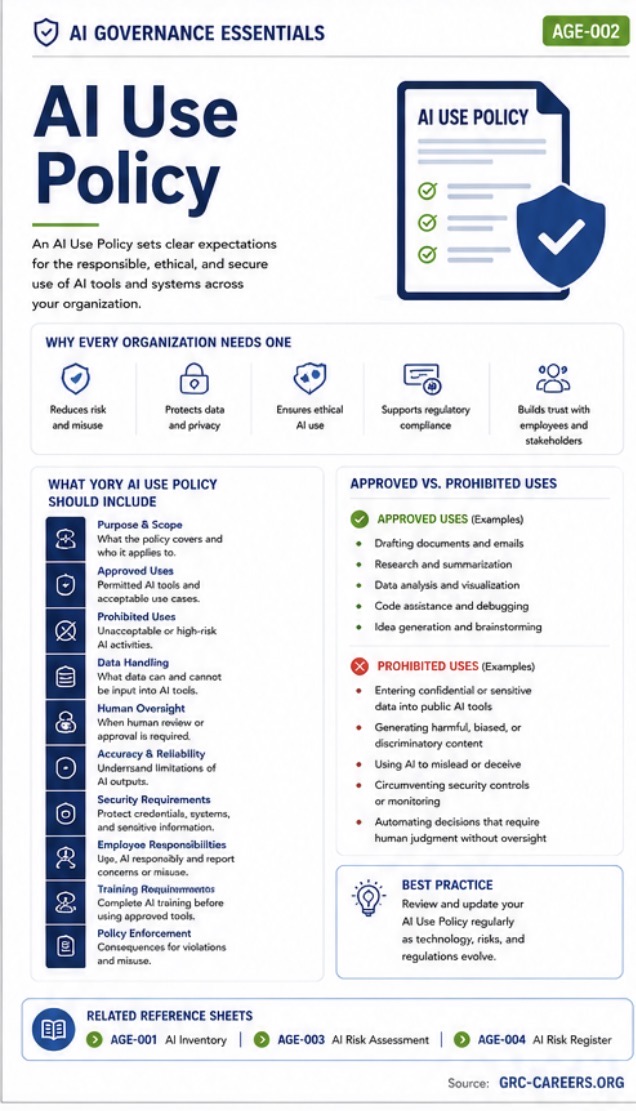
- Cover the essentials: purpose, scope, approved tools, data protection, human oversight, accuracy and verification, security, and reporting.
- Clear rules build confidence and encourage responsible experimentation, they do not slow it down.
- Treat it as a living document, reviewed and updated as the technology and regulations evolve.
What is an AI use policy?
An AI Use Policy is a document that defines how artificial intelligence may and may not be used within an organization.
Rather than discouraging innovation, a good policy encourages responsible experimentation. It creates a shared understanding of acceptable practices while reducing unnecessary risk.
The goal is not to control every click or prompt. The goal is to provide clear guidance so employees can make good decisions.
Why every organization needs one
Many organizations assume AI governance begins with technology. In reality, it begins with people. Even the most sophisticated governance framework will fall short if employees do not understand what is expected of them.
An AI Use Policy helps organizations answer practical questions such as:
- Can employees use public AI tools?
- Can confidential information be entered into AI systems?
- Which AI applications have been approved?
- Is human review required before AI-generated work is shared externally?
- Who approves new AI tools?
- What happens if an employee identifies a problem?
These are not hypothetical questions anymore. They are everyday business decisions.
What should an AI use policy include?
Every organization will tailor its policy to its own culture, industry, and regulatory obligations. Most policies, however, address several common topics.
- Purpose. Explain why the organization is establishing the policy and how AI supports business objectives.
- Scope. Identify who the policy applies to, including employees, contractors, consultants, and third-party service providers when appropriate.
- Approved AI tools. List approved applications, or explain the process for requesting approval before adopting new tools.
- Data protection. Clearly identify what information may never be entered into public AI platforms, including confidential, proprietary, customer, or regulated data.
- Human oversight. Employees should understand that AI supports decision-making. It does not replace professional judgment or organizational accountability.
- Accuracy and verification. AI-generated content should be reviewed for accuracy before it is shared, published, or used to support business decisions.
- Security. Explain expectations for passwords, account security, access controls, and reporting suspicious activity.
- Reporting concerns. Create a simple process for reporting security concerns, unexpected AI behavior, or potential policy violations.
AI Governance Insight
The goal is not to control every click or prompt. It is to give employees clear enough guidance that they can make good decisions on their own. Governance that builds confidence gets used. Governance that only restricts gets ignored.
The best AI policies build confidence
Some organizations worry that introducing an AI Use Policy will slow innovation. The opposite is often true.
Employees are more likely to explore new technologies when they understand the rules. Clear expectations reduce uncertainty. They also reduce inconsistent decision-making across departments.
Good governance creates confidence, and confident employees are more likely to use AI responsibly.
An AI use policy is not a one-time exercise
Technology changes quickly. So do regulations, business priorities, and employee expectations.
An effective AI Use Policy should be reviewed regularly and updated as new tools, risks, and opportunities emerge. Organizations that treat the policy as a living document are better positioned to adapt as AI continues to evolve.
Final thoughts
Artificial intelligence is becoming part of everyday work. Organizations do not need to choose between innovation and governance. They need a framework that allows both to succeed.
An AI Use Policy provides that foundation. It gives employees practical guidance, protects organizational interests, and helps preserve the trust that responsible AI depends on.
The AI Governance Essentials series
This is AGE-002 in our AI Governance Essentials series. Also in the series:
- AGE-001: What Is an AI Inventory? The foundation, knowing where AI lives in your organization.
- AGE-003: How to Conduct an AI Risk Assessment.
- AGE-004: Creating an AI Risk Register (coming soon).
- Browse the full series →
Related Guides
- What Is an AI Inventory?: the step that comes before the policy.
- The AI Governance Frameworks Every Hiring Manager Expects You to Know.
- AI GRC roles: open governance, risk, and compliance jobs.
- Responsible AI: turning principles into practice.
For practical examples to build from, the Nonprofit Learning Lab has compiled a set of sample AI policies and resources for organizations, a useful companion to the principles above.
Frequently Asked Questions
What is an AI use policy?
An AI Use Policy is a document that defines how artificial intelligence may and may not be used within an organization. It gives employees clear guidance so they can use AI appropriately, while helping the organization protect sensitive information, maintain compliance, and preserve trust.
Why does an organization need an AI use policy?
Because employees are already making decisions about how to use AI every day, whether or not expectations exist. AI governance begins with people, not technology, and even a strong framework falls short if employees do not understand what is expected. A policy answers the practical questions: which tools are approved, what data is off limits, when human review is required, and what to do when a problem is found.
What should an AI use policy include?
Most policies cover purpose, scope, approved AI tools, data protection, human oversight, accuracy and verification, security, and a simple process for reporting concerns. Each organization tailors the policy to its own culture, industry, and regulatory obligations.
Will an AI use policy slow down innovation?
Usually the opposite. Employees are more likely to explore new tools when they understand the rules. Clear expectations reduce uncertainty and inconsistent decisions across departments, and confident employees tend to use AI more responsibly.
How often should an AI use policy be updated?
Regularly. Technology, regulations, and business priorities change quickly, so an AI Use Policy should be treated as a living document that is reviewed and updated as new tools, risks, and opportunities emerge.
- Founder of ExecSearches and GRC Careers
- Executive search across corporate, higher education, financial services, and nonprofit sectors
- Focus on AI governance and GRC hiring
- More than a decade in risk advisory and internal audit in financial services
- Led SOX and regulatory audits for Citi, Goldman Sachs, Morgan Stanley, and McKesson
- Public Accounting Certification, Cornell University
Who's Hiring AI Governance Professionals?
Explore current openings in:
AI Governance Jobs · Responsible AI · AI Risk · AI Compliance · AI Audit · AI Policy · Privacy · Cybersecurity · Public Policy
Search the latest opportunities at GRC Careers › · nonprofit GRC jobs ›