
Home › AI Governance Insights › What Are DMCA Policies, Do You Need One, and What Should You Do Next?
What Are DMCA Policies, Do You Need One, and What Should You Do Next?
By F. Jay Hall, Founder, GRC Careers · October 11, 2026 · 9 min read
A recruiter uploads a company logo with a job posting. A guest contributor submits an article with a photograph. A reader posts a comment containing someone else's work. Each creates a copyright question: who has permission to use the material, and what happens if its owner objects?
A DMCA policy gives people a clear way to report claimed infringement and explains how your organization responds. Its value depends on the process behind it: a monitored contact, trained staff, accurate records, and people who can act promptly. Publishing a page is only one part of that work.
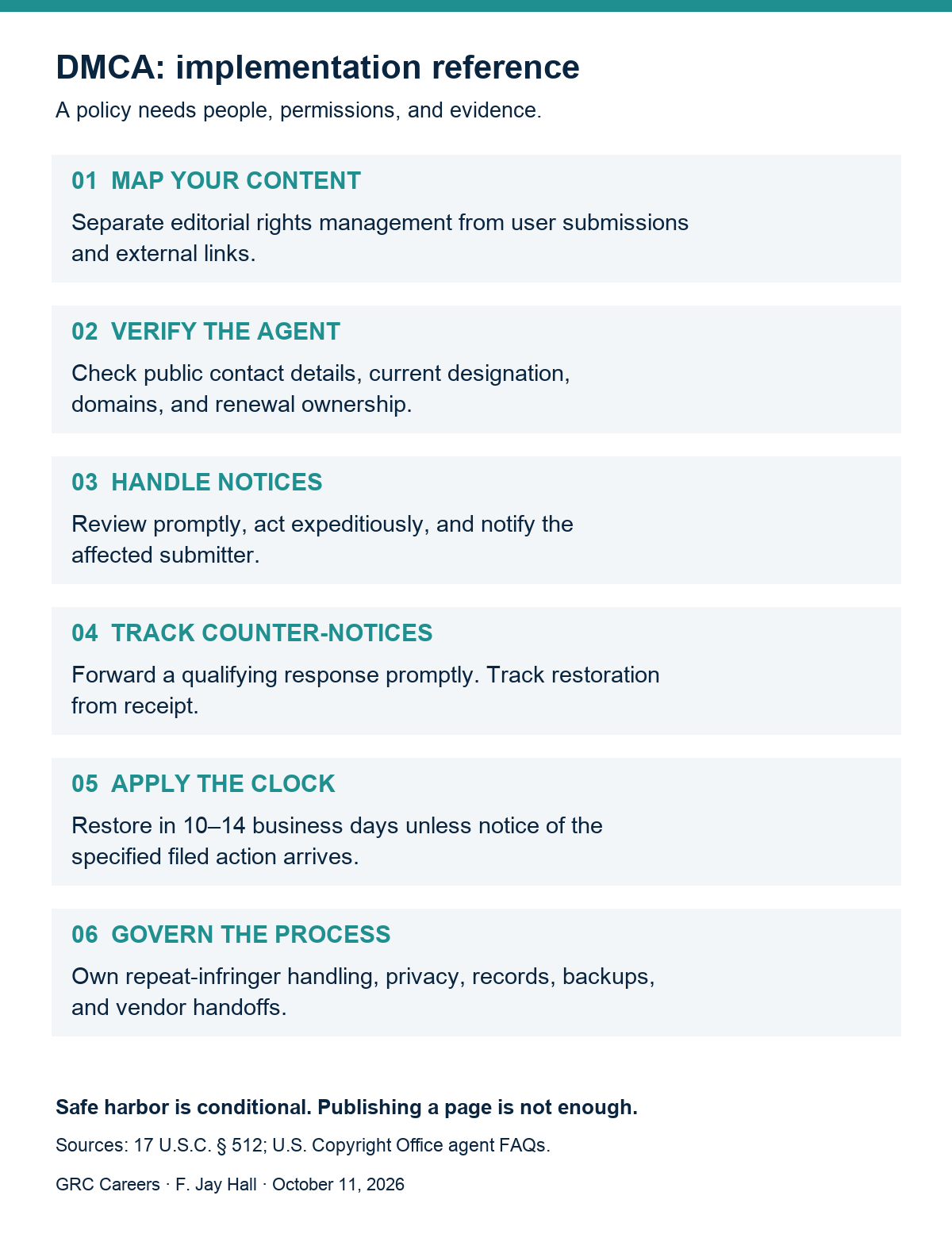
Download the reference sheet (PDF) · Download the editorial summary (PDF)
What a DMCA policy does
DMCA stands for the Digital Millennium Copyright Act. Section 512 establishes conditional limitations on copyright liability, often called safe harbors, for certain online service-provider activities. A policy explains your copyright complaint process; it does not create those protections by itself. Eligibility depends on the applicable activity, the facts, and whether the organization meets and implements the relevant conditions. The U.S. Copyright Office's Section 512 overview explains the framework.
DMCA and DMARC address different problems. DMARC is an email authentication and reporting mechanism used to help domain owners address unauthorized use of their domain in email. It does not handle copyright complaints. This article concerns DMCA copyright policies. See the DMARC specification for the email mechanism.
A useful copyright policy identifies the service and operator, provides the copyright contact, explains notices and counter-notices, describes removal and restoration, and addresses repeat infringers. It should also explain what information will be shared with the parties.
Does your organization need one?
Start with how your website accepts and publishes material. A job board that lets employers submit descriptions and logos has a different exposure from a recruitment firm publishing only articles written by its staff. Guest blogs, uploaded images, profiles, comments, and community forums warrant attention. External links can also raise questions under Section 512's separate provisions for information-location tools.
If you host material at users' direction and seek the relevant safe-harbor protection, a working notice process, designated agent, and other applicable conditions matter. Ask counsel which provisions fit your activities. There is no universal rule that every business website must publish a page called “DMCA Policy.”
For your own editorial content, maintain evidence of ownership, licenses, permissions, and any applicable legal basis for use. A takedown policy does not turn unauthorized copying into authorized use or automatically protect content your organization creates or selects itself. Mixed sites need both rights management for editorial material and an appropriate process for user submissions. 17 U.S.C. § 512 distinguishes the covered activities and conditions.
For employers and recruiters submitting to AGJ, the immediate responsibility is straightforward: check that you can submit the job description, logo, photograph, and any attached material. Authority to recruit for an employer does not necessarily grant permission to use every image or third-party document. Keep permission records and identify who can respond if a complaint arrives.
Put an accountable person and a working process behind the policy
Establish the designated agent and public contact
For the applicable safe-harbor process, publish the designated agent's name, mailing address, telephone number, and email address, and make the required designation with the Copyright Office. Verify the service provider's legal name, address, and alternate names, including relevant domains. An ordinary contact email on a website does not establish a registered designation.
The agent may be an individual, a specified position or department, or a third-party entity. Keep the website and directory information accurate. A designation expires after three years unless renewed through amendment or resubmission. Assign responsibility for that renewal and for changes when staff, vendors, addresses, or domains change. Separate legal entities need separate designations. The Copyright Office's agent-directory FAQs explain the details, including the distinction between the provider's street address and the agent's mailing address.
Receive and assess notices promptly
A notice must substantially identify the copyrighted work, the material to remove and where to find it, the complainant's contact information, an authorized signature, a good-faith statement about unauthorized use, and an accuracy and authority statement with the required penalty-of-perjury declaration.
Do not demand a copyright registration certificate or court judgment as a routine prerequisite to processing a notice. Where a notice sufficiently identifies the work, material, and contact information but is otherwise incomplete, promptly seek clarification or otherwise assist in obtaining a substantially complete notice. Escalate uncertainty about fair use, ownership, or legal sufficiency to the person qualified to assess it.
For a notice meeting the applicable requirements, act expeditiously to remove or disable access to the identified material. For affected user submissions, take reasonable steps to notify the submitter promptly and explain how to respond. Removal is a procedural action; it does not decide who ultimately owns the rights or whether infringement occurred.
Handle counter-notices and the restoration clock
A counter-notice lets an affected submitter respond when removal resulted from mistake or misidentification. It substantially requires a signature, identification of the removed material and its previous location, the required good-faith statement under penalty of perjury, and the submitter's name, address, and phone number. It also requires consent to the specified federal court jurisdiction and acceptance of service from the complainant or the complainant's agent.
After receiving a qualifying counter-notice, promptly send a copy to the original complainant and explain that the material will be restored in 10 business days. Restoration occurs no earlier than 10 and no later than 14 business days after receipt of the qualifying counter-notice, unless the designated agent first receives notice that the complainant filed the specified action seeking a court order restraining the submitter's infringing activity relating to that material. Record receipt accurately. Forwarding the counter-notice later does not restart the statutory clock. See Section 512(c)(3) and (g).
Implement the repeat-infringer policy
Explain that subscriber and account-holder access will be terminated in appropriate circumstances for repeat copyright infringement, and implement that policy reasonably. Track related incidents and consider retractions, counter-notices, and relevant decisions. A court judgment is not necessarily a prerequisite to acting, and a complaint is not automatically proof of infringement. Avoid treating a fixed number of unexamined allegations as a legal requirement. Section 512 also requires accommodation of, and noninterference with, qualifying standard technical measures. See Section 512(i).
Align privacy, staff responsibilities, and vendors
A counter-notice includes personal contact information and must be forwarded as part of the statutory process. Your Privacy Policy should explain that disclosure and the handling of copyright submissions. Tell submitters what will be shared before they send it. A confidential job listing does not make a counter-notice anonymous.
Assign a process owner, a backup, and an escalation contact. Give the responsible staff authority and access to disable material, notify users, and restore it. Use a case record containing the notice, receipt date, affected URLs, actions taken, communications, counter-notice, deadlines, and any notice of filed court action. Restrict access to those records and establish a retention schedule with legal and privacy input, including how litigation holds affect deletion.
Your hosting provider, job-board platform, or outsourced agent may have its own procedures. Specify who receives notices, who can act, how notices reach your team, and how deadlines are handed over. A provider's published policy does not establish your organization's agent designation or prove that your own workflow meets every relevant condition.
Review the copyright policy alongside your Terms, Privacy Policy, complaint routes, and removal rules. General account-removal language should not quietly contradict the promised DMCA process. Route non-copyright issues, such as misleading job claims, trademarks, or privacy requests, to the appropriate process.
Assess the policy you already have
If your organization already has a DMCA policy, test it against the work your website actually performs. Is the named operator still correct? Do the agent's public details match the current directory entry? Can staff find a complaint, act on it, and track a counter-notice deadline without relying on one person's memory?
Check new features too. A site that once published only staff articles may now accept guest posts, employer logos, or comments. Review old promises about confidentiality and account removal alongside the copyright workflow. Update the policy and the operational instructions together, and communicate material changes through your established change process.
A governance checklist before launch or review
- Map user submissions, editorial content, external links, and the legal entity responsible for each service.
- Confirm which Section 512 provisions apply with qualified counsel.
- Verify public agent details, directory designation, alternate names, and renewal ownership.
- Approve one consistent set of copyright, Terms, and privacy statements.
- Test the mailbox, backup coverage, removal permissions, and restoration permissions.
- Give staff a documented notice and counter-notice workflow with deadline tracking.
- Establish repeat-infringer handling, access controls, retention, and escalation rules.
- Agree on responsibilities with hosting and platform vendors.
- Run a practice case, including a counter-notice, before relying on the process.
- Recheck the workflow when domains, staff, submission features, or vendors change.
For governance professionals, the next step is to walk one hypothetical complaint through the organization. Follow it from receipt to review, removal, notification, counter-notice, and restoration. Identify who makes each decision and what evidence they retain. That exercise will reveal whether the public policy describes a process your team can actually deliver.
This article provides general operational information, not legal advice for a particular organization. Have qualified counsel assess your activities and review the policy before implementation.
Key Takeaways
- Match the policy to your activities and legal entity.
- Verify the designated agent and implement the notice workflow.
- Track restoration from receipt of a qualifying counter-notice.
- Align privacy, repeat-infringer handling, staff ownership, and vendors.
Related AI Governance Essentials
Explore the AI Governance Essentials library for practical guidance on governance, accountability, and risk.
F. Jay Hall · Founder, GRC Careers. Author profile and professional background.Who's Hiring AI Governance Professionals?
Explore current openings in:
AI Governance Jobs · Responsible AI · AI Risk · AI Compliance · AI Audit · AI Policy · Privacy · Cybersecurity · Public Policy
Search the latest opportunities at GRC Careers › · nonprofit GRC jobs ›