Home › AI Governance Insights › How the EU AI Act Maps to NIST AI RMF: A Practical Guide for AI Governance Teams
How the EU AI Act Maps to NIST AI RMF: A Practical Guide for AI Governance Teams
By F. Jay Hall and Stephan Pochet · July 7, 2026
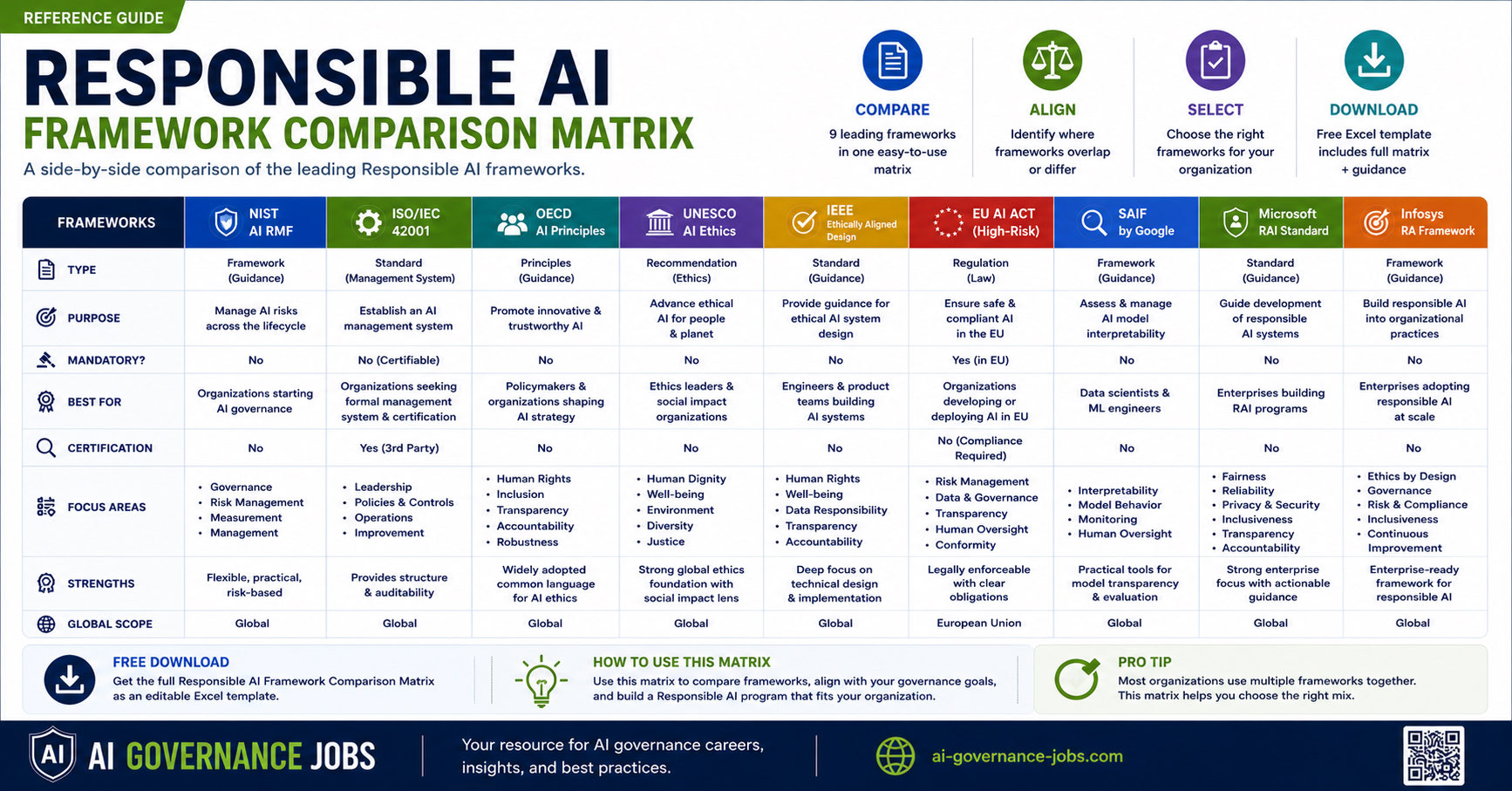
Artificial intelligence governance is becoming increasingly complex as organizations navigate both voluntary frameworks and legally binding regulations. Two names dominate nearly every discussion: the EU AI Act, the world's first comprehensive AI regulation, and the NIST AI Risk Management Framework (AI RMF 1.0), the most widely adopted voluntary AI governance framework in the United States.
At first glance, these appear to serve different purposes. One is legislation. The other is guidance. In reality, they complement one another remarkably well. Organizations using the NIST AI RMF are already building many of the governance practices needed to comply with the EU AI Act. Likewise, organizations implementing the EU AI Act often discover that NIST AI RMF provides an excellent operational roadmap for meeting many of the regulation's expectations.
This article explains how the two frameworks align and how governance, risk, compliance, audit, cybersecurity, and legal teams can use them together. (For a related comparison, see our companion piece on NIST AI RMF vs. ISO/IEC 42001.)
Understanding the Difference
The easiest way to think about these frameworks is this: the EU AI Act tells organizations what they must comply with. NIST AI RMF helps organizations build the governance processes needed to achieve that compliance. One establishes legal obligations. The other provides operational guidance.
What Is the EU AI Act?
The EU AI Act establishes a risk-based regulatory framework for artificial intelligence systems used within the European Union. Rather than regulating all AI equally, it classifies AI systems into different levels of risk: unacceptable risk, high risk, limited risk, and minimal risk.
Higher-risk AI systems face stricter requirements for risk management, data governance, technical documentation, human oversight, transparency, accuracy, robustness, cybersecurity, and post-market monitoring. Organizations deploying or providing high-risk AI systems must demonstrate ongoing compliance throughout the AI lifecycle.
What Is NIST AI RMF?
The NIST AI Risk Management Framework is a voluntary governance framework developed to help organizations manage AI risks across the entire lifecycle. Rather than prescribing specific legal requirements, it organizes AI governance around four core functions: Govern, Map, Measure, and Manage.
These functions encourage organizations to establish governance structures, evaluate AI use cases, assess risks, monitor controls, and continuously improve AI oversight. Because it is technology-neutral and industry-neutral, organizations across finance, healthcare, government, manufacturing, higher education, and nonprofit sectors have adopted the framework.
Where the Frameworks Align
The two frameworks share many common objectives. Although the terminology differs, many organizations discover they are performing similar governance activities.
| EU AI Act Requirement | NIST AI RMF Function |
|---|---|
| AI governance | Govern |
| Risk management | Map + Measure + Manage |
| Human oversight | Govern |
| Technical documentation | Govern |
| Transparency | Govern + Manage |
| Data governance | Map |
| Continuous monitoring | Manage |
| Incident management | Manage |
| Accountability | Govern |
| Lifecycle management | All four functions |
Mapping the Four NIST Functions
1. Govern
The Govern function establishes leadership accountability, policies, governance structures, and organizational oversight. This aligns closely with EU AI Act requirements covering governance responsibilities, quality management systems, accountability, human oversight, internal policies, and documentation. Organizations that already have mature governance structures typically find compliance significantly easier.
2. Map
Mapping focuses on understanding AI systems, intended uses, stakeholders, and potential impacts. This supports several EU AI Act expectations, including risk classification, intended purpose, data governance, use-case documentation, and stakeholder analysis. The more clearly organizations understand their AI systems, the easier regulatory compliance becomes.
3. Measure
The Measure function evaluates AI risks using testing, validation, monitoring, and performance assessment. This supports EU AI Act expectations involving accuracy, bias evaluation, robustness, security testing, validation, and performance monitoring. This is often where internal audit and model validation teams contribute significant value.
4. Manage
Manage focuses on responding to identified risks, implementing controls, monitoring performance, and improving governance over time. It aligns closely with EU AI Act requirements covering risk mitigation, corrective actions, incident reporting, continuous improvement, and lifecycle monitoring. Organizations that treat AI governance as an ongoing process, not a one-time compliance exercise, will be better positioned for long-term success.
Why Many Organizations Start with NIST
Many organizations outside Europe are not immediately subject to every provision of the EU AI Act. However, many still begin with NIST AI RMF because it provides flexible governance, practical implementation guidance, risk-based decision making, strong executive communication, and better audit readiness. Once governance processes mature, mapping them to the EU AI Act is often much easier than building compliance from scratch.
Practical Implementation Roadmap
- Inventory AI systems.
- Identify applicable EU AI Act obligations.
- Build governance using NIST AI RMF.
- Document policies and procedures.
- Perform AI risk assessments.
- Establish human oversight.
- Monitor AI performance continuously.
- Conduct internal audits.
- Update governance as regulations evolve.
What This Means for AI Governance Professionals
The intersection of AI governance and regulatory compliance is creating entirely new career opportunities. Organizations increasingly seek professionals who understand both governance frameworks and regulatory requirements, including AI Governance Managers, Responsible AI Specialists, AI Compliance Managers, AI Risk Managers, Internal Auditors, AI Security Architects, AI Governance Consultants, and Chief AI Governance Officers.
Professionals who can translate regulatory requirements into practical governance programs are becoming some of the most valuable members of AI leadership teams.
Final Thoughts
The future of AI governance is unlikely to revolve around a single framework or regulation. Successful organizations will combine internationally recognized standards, practical risk management frameworks, and applicable legal requirements into a cohesive governance program. The EU AI Act and NIST AI RMF are excellent examples of this complementary approach. One establishes the destination. The other provides much of the roadmap.
Organizations that understand how these frameworks work together will be better prepared to build trustworthy AI systems, demonstrate regulatory compliance, and create governance programs that can evolve alongside rapidly changing technology.
Sources: EU Artificial Intelligence Act; NIST AI Risk Management Framework (AI RMF 1.0).
Put these frameworks to work: browse EU AI Act jobs and NIST AI RMF jobs, or explore our AI career guides.
Frequently Asked Questions
Does following NIST AI RMF automatically make an organization compliant with the EU AI Act?
No. The NIST AI RMF is voluntary guidance, while the EU AI Act establishes legal requirements. However, many governance activities recommended by NIST support compliance efforts.
Can organizations outside Europe benefit from understanding the EU AI Act?
Yes. Many multinational organizations operate across jurisdictions, and the Act is influencing AI governance expectations well beyond Europe.
Which should organizations implement first?
For many organizations, NIST AI RMF provides a practical starting point. As governance programs mature, organizations can map those practices to the specific obligations of the EU AI Act.
Do the two frameworks compete?
No. They address different needs. The EU AI Act defines regulatory obligations, while NIST AI RMF provides operational guidance for managing AI risks.
- Founder of ExecSearches and GRC Careers
- Executive search across corporate, higher education, financial services, and nonprofit sectors
- Focus on AI governance and GRC hiring
- More than a decade in risk advisory and internal audit in financial services
- Led SOX and regulatory audits for Citi, Goldman Sachs, Morgan Stanley, and McKesson
- Public Accounting Certification, Cornell University
Who's Hiring AI Governance Professionals?
Explore current openings in:
AI Governance · Responsible AI · AI Risk · AI Compliance · AI Audit · AI Policy · Privacy · Cybersecurity · Public Policy
Search the latest opportunities at GRC Careers › · nonprofit GRC jobs ›