Home › AI Governance Insights › NIST AI RMF vs. ISO/IEC 42001: Which Should You Adopt First?
NIST AI RMF vs. ISO/IEC 42001: Which Should You Adopt First?
By F. Jay Hall and Stephan Pochet · July 7, 2026
Organizations everywhere are racing to implement artificial intelligence, but many quickly discover that choosing an AI governance framework is just as challenging as selecting the technology itself. Two names consistently rise to the top: the NIST AI Risk Management Framework (AI RMF 1.0) and ISO/IEC 42001, the world's first international AI management system standard.
While they are often presented as competing approaches, they are actually designed to solve different problems. Understanding those differences can save organizations months of work and help AI governance teams build a stronger foundation.
If you are wondering which framework to adopt first, the short answer is: start with NIST AI RMF if you are beginning your AI governance journey. Add ISO/IEC 42001 when you are ready to formalize, scale, and potentially certify your AI management system. Here is why.
What is the NIST AI Risk Management Framework?
Developed by the National Institute of Standards and Technology, the AI RMF is a voluntary framework that helps organizations identify, assess, manage, and monitor AI risks throughout the AI lifecycle. Unlike a compliance standard, NIST focuses on practical risk management.
The framework is built around four core functions: Govern, Map, Measure, and Manage. These encourage organizations to establish governance structures, understand AI use cases, evaluate risks, and continuously improve controls.
One of NIST's greatest strengths is flexibility. Organizations of every size can adapt the framework without needing formal certification. It is especially popular among government agencies, financial institutions, healthcare organizations, critical infrastructure providers, internal audit departments, and enterprise risk management teams.
What is ISO/IEC 42001?
ISO/IEC 42001 takes a different approach. Rather than focusing primarily on risk assessment, it defines the requirements for an Artificial Intelligence Management System (AIMS). If you have worked with ISO 9001, ISO 27001, or ISO 37301, the structure will feel familiar.
ISO 42001 establishes requirements for leadership responsibilities, AI governance policies, documented procedures, operational controls, risk assessments, internal audits, continuous improvement, and management reviews. Organizations can also pursue third-party certification, providing external assurance that their AI governance program meets an internationally recognized standard.
Side-by-Side Comparison
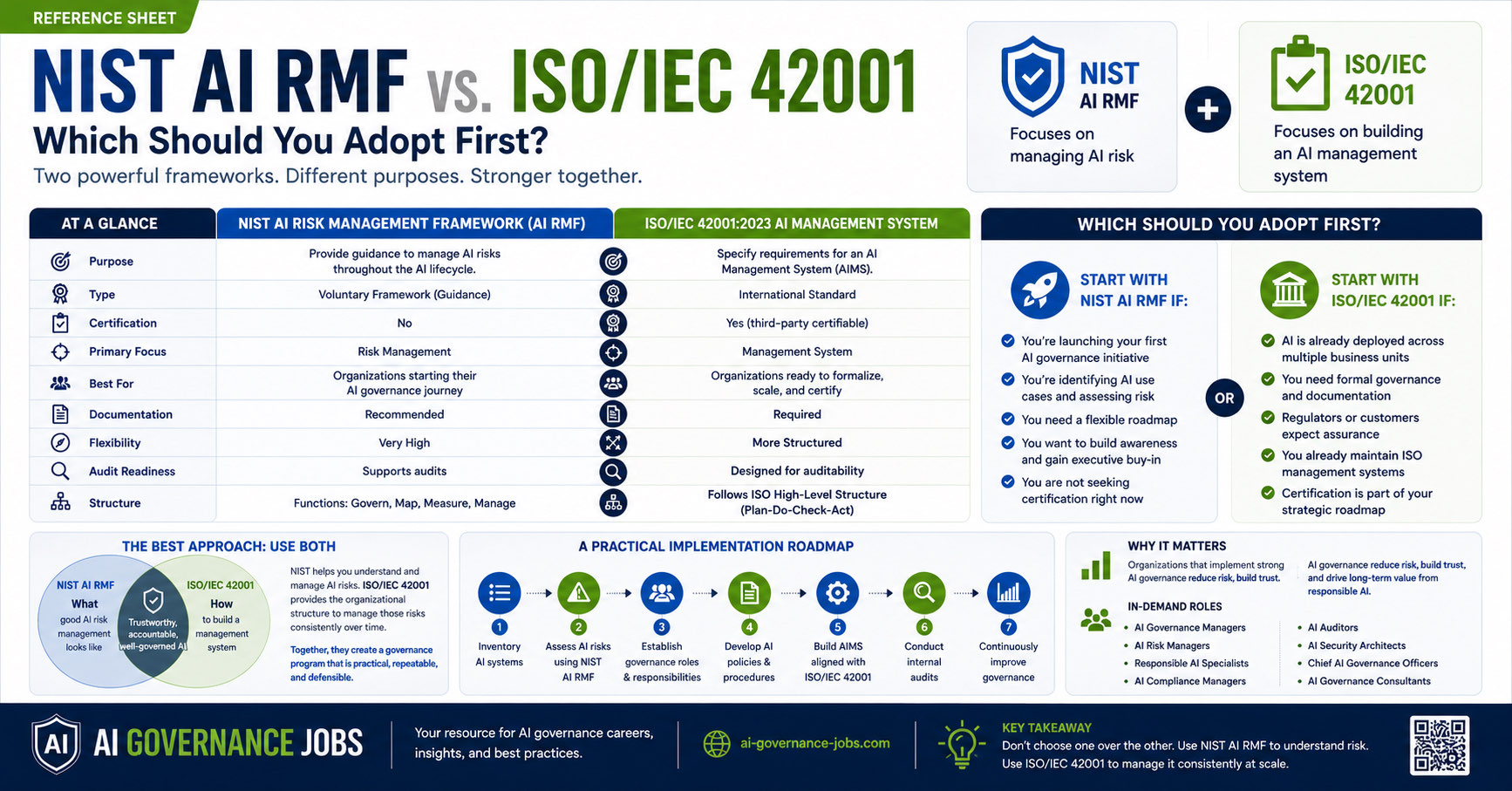
| Category | NIST AI RMF | ISO/IEC 42001 |
|---|---|---|
| Purpose | AI risk management guidance | AI management system standard |
| Mandatory? | Voluntary | Voluntary (certifiable) |
| Certification | No | Yes |
| Focus | Managing AI risk | Building an organizational management system |
| Best For | Starting AI governance | Scaling enterprise AI governance |
| Audit Ready | Supports audits | Designed for auditability |
| Flexibility | Very high | More structured |
| Documentation | Recommended | Required |
Which Should You Adopt First?
The answer depends on your organization's maturity.
Choose NIST AI RMF first if:
- You are launching your first AI governance initiative.
- You are still identifying AI use cases.
- Your internal audit team is evaluating AI risk.
- You need executive buy-in.
- You want a flexible roadmap.
- You are not seeking certification.
NIST gives organizations a practical way to start asking the right questions without overwhelming teams with documentation requirements.
Choose ISO/IEC 42001 first if:
- AI is already deployed across multiple business units.
- Regulators or customers expect formal governance.
- You already maintain ISO management systems.
- You need documented policies and procedures.
- Executive leadership wants measurable governance maturity.
- Certification is part of your strategic roadmap.
The Best Approach: Use Both
The strongest AI governance programs do not choose between the two frameworks. They combine them. NIST AI RMF helps you understand and manage AI risks. ISO/IEC 42001 provides the organizational structure needed to manage those risks consistently over time. Together they create an AI governance program that is practical, repeatable, and defensible.
A common implementation roadmap looks like this:
- Inventory AI systems.
- Assess AI risks using NIST AI RMF.
- Establish governance roles and responsibilities.
- Develop AI policies and procedures.
- Build an AI Management System aligned with ISO/IEC 42001.
- Conduct internal audits.
- Continuously improve governance based on findings.
What This Means for AI Governance Professionals
Demand for professionals who understand these frameworks continues to grow. Organizations are hiring AI Governance Managers, AI Risk Managers, Responsible AI Specialists, AI Compliance Managers, AI Auditors, AI Security Architects, AI Governance Consultants, and Chief AI Governance Officers.
Professionals who understand both NIST AI RMF and ISO/IEC 42001 will be especially valuable because they can bridge strategic governance with operational implementation. Whether you work in governance, risk, compliance, internal audit, cybersecurity, legal, or enterprise architecture, familiarity with these frameworks is rapidly becoming a core competency.
Final Thoughts
As AI adoption accelerates, organizations need governance programs that are both practical and sustainable. NIST AI RMF and ISO/IEC 42001 each address a different part of that challenge. If your organization is just beginning its AI governance journey, start with NIST AI RMF to understand and manage AI risks. As your program matures, use ISO/IEC 42001 to establish a structured, auditable AI management system that can scale with your organization.
The organizations best positioned for the future will not ask which framework is better. They will understand how each contributes to building trustworthy, accountable, and well-governed AI.
Sources: NIST AI Risk Management Framework (AI RMF 1.0); ISO/IEC 42001:2023 Artificial Intelligence Management System; OECD AI Principles; International Association of Privacy Professionals (IAPP) guidance on AI governance standards.
Ready to put these frameworks to work? Browse NIST AI RMF jobs and ISO 42001 jobs, or explore our AI career guides.
Frequently Asked Questions
Is NIST AI RMF required?
No. It is a voluntary framework intended to improve AI risk management.
Can organizations become certified to NIST AI RMF?
No. NIST AI RMF is guidance, not a certifiable standard.
Can organizations become certified to ISO/IEC 42001?
Yes. Accredited certification bodies can audit organizations against ISO/IEC 42001 requirements.
Should small organizations use ISO 42001?
Not necessarily. Many begin with NIST AI RMF and adopt ISO 42001 as their AI governance program matures.
Can both frameworks be used together?
Absolutely. Many practitioners view them as complementary: NIST provides the risk management methodology, while ISO/IEC 42001 provides the management system needed to operationalize and sustain those practices.
- Founder of ExecSearches and GRC Careers
- Executive search across corporate, higher education, financial services, and nonprofit sectors
- Focus on AI governance and GRC hiring
- More than a decade in risk advisory and internal audit in financial services
- Led SOX and regulatory audits for Citi, Goldman Sachs, Morgan Stanley, and McKesson
- Public Accounting Certification, Cornell University
Who's Hiring AI Governance Professionals?
Explore current openings in:
AI Governance · Responsible AI · AI Risk · AI Compliance · AI Audit · AI Policy · Privacy · Cybersecurity · Public Policy
Search the latest opportunities at GRC Careers › · nonprofit GRC jobs ›