Home › AI Governance Insights › The Responsible AI Framework Map: How the Leading AI Governance Frameworks Fit Together
The Responsible AI Framework Map: How the Leading AI Governance Frameworks Fit Together
By F. Jay Hall and Stephan Pochet · July 7, 2026
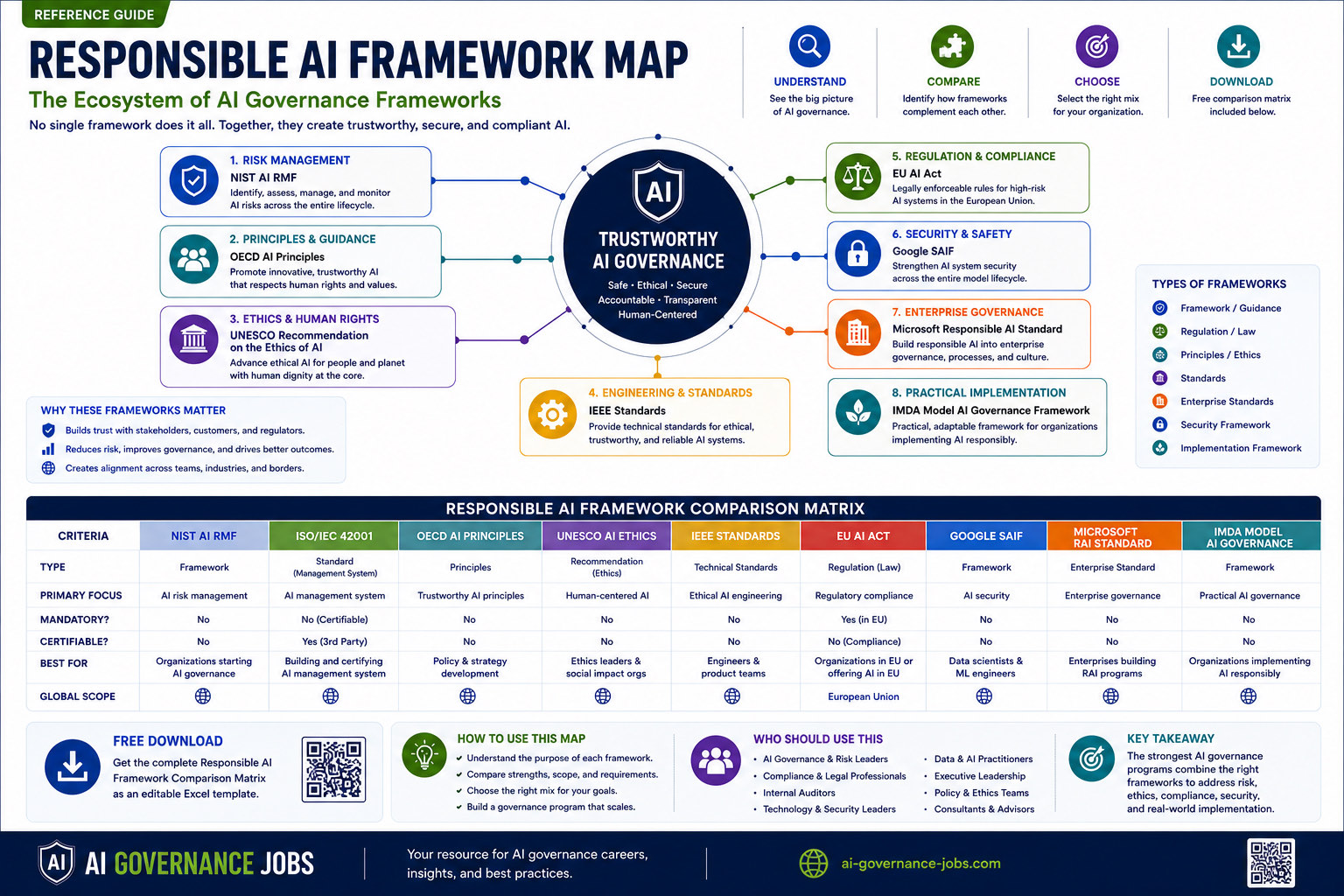
No single framework does it all. The strongest AI governance programs do not pick one standard and stop. They combine the leading frameworks, each of which brings the most value at a different part of the AI lifecycle. This map shows how the top Responsible AI frameworks work together, and where each one is strongest.
The Frameworks by Purpose
- Risk Management, NIST AI RMF. Identify, assess, manage, and monitor AI risks across the lifecycle. The risk foundation.
- Management Systems, ISO/IEC 42001. Build an AI Management System (AIMS) with policies, processes, and controls. Turns governance into an auditable system.
- Principles and Guidance, OECD AI Principles. Promote innovative, trustworthy AI that respects human rights and values.
- Ethics and Human Rights, UNESCO AI Ethics. Advance ethical AI for people and planet, with human dignity at the core.
- Engineering and Standards, IEEE Standards. Provide technical standards for ethical, trustworthy, and reliable AI systems.
- Regulatory Compliance, EU AI Act (High-Risk). Legally enforceable rules for high-risk AI systems in the European Union.
- Security and Safety, Google SAIF. Strengthen AI system security across the entire model lifecycle.
- Enterprise Governance, Microsoft Responsible AI Standard. Operationalize responsible AI at enterprise scale with governance practices.
- Practical Implementation, IMDA Model AI Governance Framework. A practical framework to implement AI governance that is scalable and adaptable.
Framework Comparison Matrix
| Framework | Type | Primary Focus | Best For | Mandatory? | Certifiable? | Global Scope |
|---|---|---|---|---|---|---|
| NIST AI RMF | Framework | AI risk management | Organizations starting AI governance | No | No | Global |
| ISO/IEC 42001 | Standard | AI management system | Organizations building an AIMS | No | Yes (3rd party) | Global |
| OECD AI Principles | Principles | Trustworthy AI principles | Policymakers and organizations | No | No | Global |
| UNESCO AI Ethics | Recommendation | Human-centered AI | Ethics leaders and social impact orgs | No | No | Global |
| IEEE Standards | Standards | Ethical AI engineering | Engineers and product teams | No | No | Global |
| EU AI Act (High-Risk) | Regulation | Regulatory compliance | Organizations in or offering AI in the EU | Yes (in EU) | No (compliance) | European Union |
| Google SAIF | Framework | AI security | Data scientists and ML engineers | No | No | Global |
| Microsoft Responsible AI Standard | Standard | Enterprise governance | Enterprises building RAI programs | No | No | Global |
| IMDA Model AI Governance Framework | Framework | Practical AI governance | Organizations implementing AI responsibly | No | No | Global |
How the Frameworks Work Together
Read across the lifecycle, each framework hands off to the next:
- Understand and assess risks with NIST AI RMF, the risk foundation.
- Build governance and controls with ISO/IEC 42001, turning governance into a system.
- Apply principles and ethics with OECD and UNESCO, ensuring AI is ethical, human-centered, and trustworthy.
- Design and build responsibly with IEEE Standards guiding ethical engineering and trustworthy design.
- Secure and protect with Google SAIF strengthening AI security throughout the lifecycle.
- Comply with regulations with the EU AI Act ensuring legal compliance for high-risk AI systems.
- Operate and improve continuously with Microsoft Responsible AI and IMDA providing practical ways to operationalize and improve over time.
Running underneath all of it: continuous monitoring, improvement, and accountability.
What This Means for Your Career
The strongest AI governance programs combine the right mix of frameworks, and organizations are hiring professionals who understand the whole ecosystem: AI Governance Managers, AI Risk Managers, Responsible AI Specialists, AI Compliance Managers, AI Auditors, AI Security Architects, AI Governance Consultants, Chief AI Governance Officers, and Data Governance Leaders.
Go deeper with our crosswalk guides: NIST AI RMF vs. ISO/IEC 42001 and How the EU AI Act Maps to NIST AI RMF.
Frequently Asked Questions
Do organizations need to choose one AI governance framework?
No. The strongest programs combine several. Each leading framework is strongest at a different part of the AI lifecycle, from risk management to management systems, ethics, engineering, security, regulation, and continuous improvement.
Which framework should you start with?
Many organizations start with NIST AI RMF for risk management, then add ISO/IEC 42001 to build an auditable management system, and layer in the EU AI Act, Google SAIF, and others as their needs and jurisdictions require.
How do these frameworks work together?
They hand off across the lifecycle: NIST assesses risk, ISO 42001 builds the system, OECD and UNESCO supply the principles and ethics, IEEE guides engineering, SAIF secures it, the EU AI Act enforces compliance, and Microsoft RAI and IMDA operationalize and improve it, with continuous monitoring and accountability throughout.
- Founder of ExecSearches and GRC Careers
- Executive search across corporate, higher education, financial services, and nonprofit sectors
- Focus on AI governance and GRC hiring
- More than a decade in risk advisory and internal audit in financial services
- Led SOX and regulatory audits for Citi, Goldman Sachs, Morgan Stanley, and McKesson
- Public Accounting Certification, Cornell University
Who's Hiring AI Governance Professionals?
Explore current openings in:
AI Governance · Responsible AI · AI Risk · AI Compliance · AI Audit · AI Policy · Privacy · Cybersecurity · Public Policy
Search the latest opportunities at GRC Careers › · nonprofit GRC jobs ›