
Home › Cybersecurity & GRC Career Guides › Writing a Resume for AI Cybersecurity Jobs
Writing a Resume for AI Cybersecurity Jobs
Putting “AI” next to “cybersecurity” on a resume does not tell an employer very much. It might mean you secured an application that uses a language model. It might mean you introduced an AI tool into a security operations workflow. Or it might mean you completed a course and are looking for your first opportunity to work in the field.
All three are reasonable starting points. They lead to different conversations with a hiring manager.
Your resume needs to make clear which conversation you are prepared to have. That starts with understanding the position, then choosing the parts of your experience that deserve the reader’s attention.
Read past the job title
An AI Security Engineer posting may describe application security work with additional responsibilities for AI integrations. Another employer may use the same title for someone who tests models, examines training data, or investigates adversarial attacks.
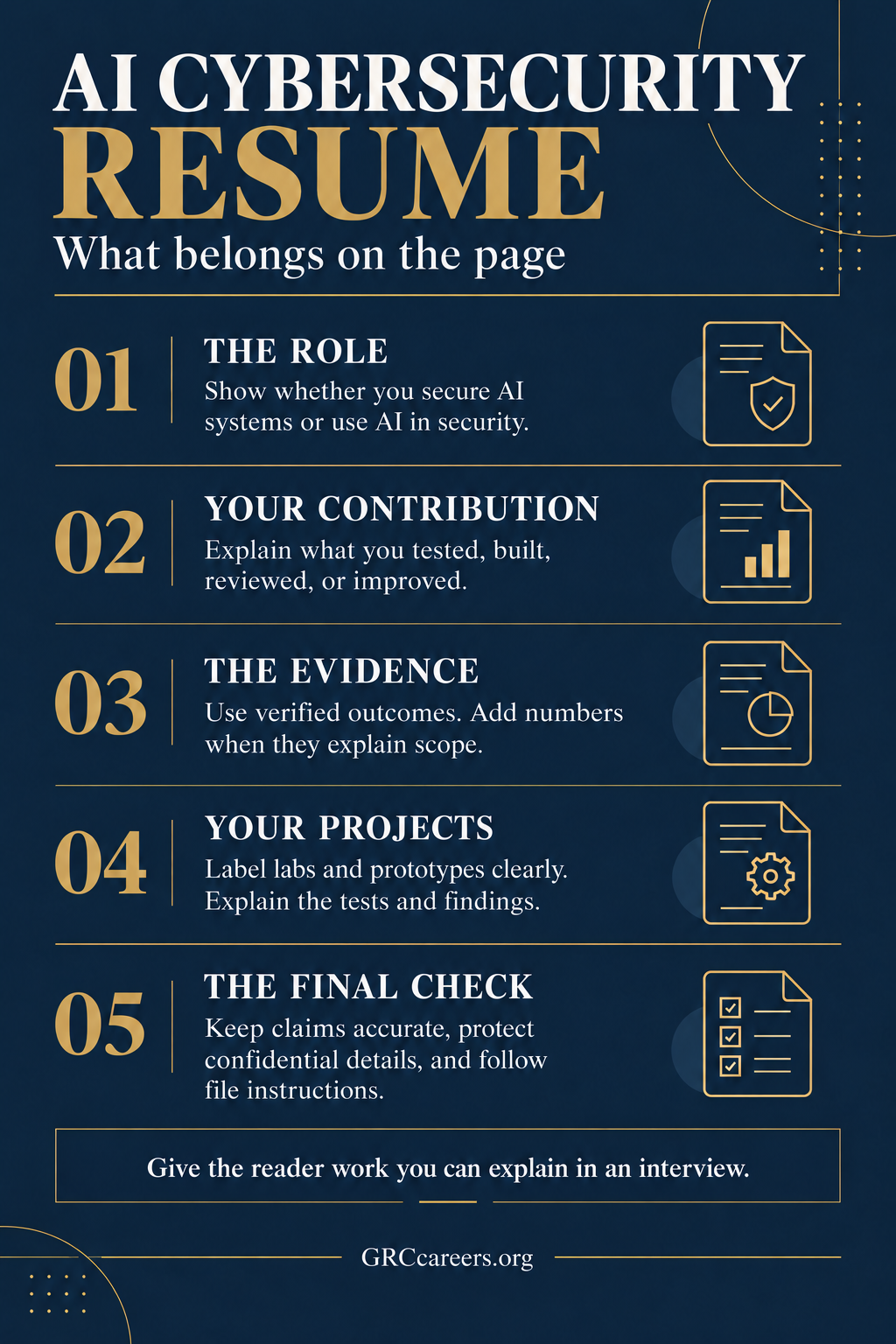
Before revising your resume, look at what the person will actually do, which is also what hiring managers screen for. Will you review architecture? Test applications? Investigate alerts? Assess vendors? Work with developers to correct weaknesses?
Then look for evidence in your own background.
Someone who has spent several years securing APIs may have relevant experience for an AI application security position, even without an AI job title. The connection becomes clearer when the resume explains the authentication, authorization, data handling, and integration work involved.
The same is true for a security analyst who has evaluated an AI-assisted investigation tool. The useful story concerns how the analyst checked its findings, handled errors, and decided when an investigation needed further review.
Keep that distinction in mind throughout the application. Securing AI and using AI in security can overlap, but an employer may be hiring primarily for one of them.
Give the reader something concrete
A resume can be full of the right terminology and still leave a recruiter unsure what the candidate has done.
Consider this statement:
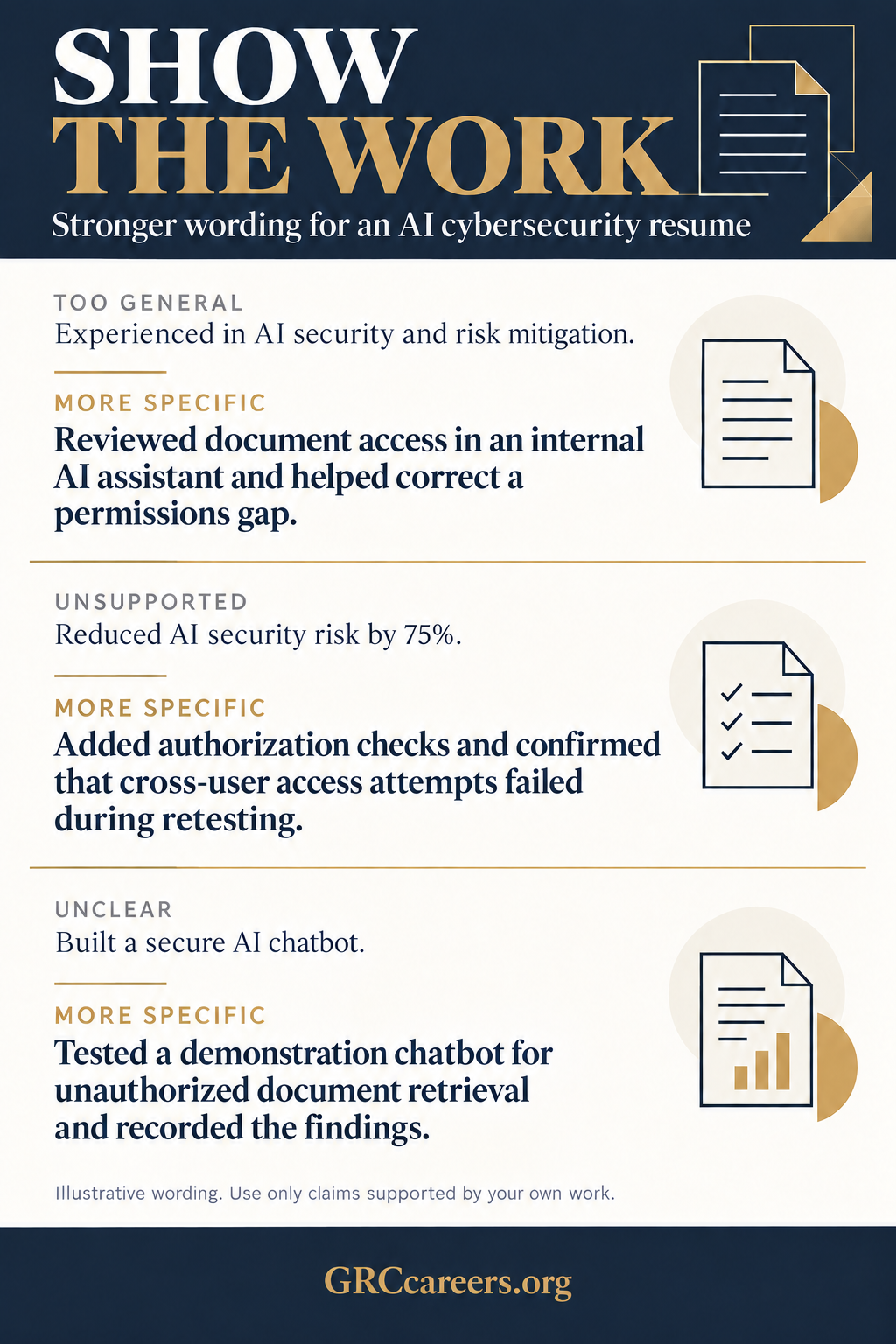
“Experienced in AI security, responsible AI, threat modeling, cloud security, and risk mitigation.”
There may be substantial experience behind it. The sentence does little to reveal that experience.
A more useful description would be:
“Reviewed access controls for an internal AI assistant that retrieved company documents. Identified a gap in how user permissions were applied and worked with developers to correct the retrieval process.”
Now the reader can understand the system, the security concern, and the candidate’s contribution. There is also something worth discussing in an interview.
That is the standard to aim for in your experience section. Describe the work closely enough that another person can follow it without needing your entire technical background.
You can usually shorten the wording afterward. First, make sure there is an actual accomplishment underneath it.
Your existing security experience belongs in the story
Candidates moving toward AI cybersecurity sometimes give their newest course or personal project more space than years of relevant professional work.
Be careful with that choice.
Experience investigating incidents, testing applications, managing cloud permissions, or reviewing data access may be central to the position. A recent AI project can help explain where you are heading, but it should not obscure what you already know how to do.
For example, an application security professional might write:
“Tested APIs for authorization weaknesses and supported remediation across customer-facing applications. Applied that experience in a subsequent assessment of a generative AI prototype with access to internal documents.”
That is a credible account of a transition. It does not require changing a previous job title or implying that every earlier assignment involved AI.
Use your actual titles. Explain relevant responsibilities beneath them. If your role expanded to include AI security work, say when and how.
Write the summary after the experience section
The opening summary is easier to write once you have decided which accomplishments belong on the page.
Keep it brief. Give the reader your professional background and the connection to the work you are seeking. There is no need to announce that you are passionate, innovative, or uniquely positioned. That habit is the subject of the resume mistake that costs good candidates interviews.
For an experienced candidate, something like this may be enough:
“Cybersecurity engineer with a background in application security and cloud access controls. Recent work includes security reviews of an internal generative AI application, with responsibility for threat modeling, authorization testing, and remediation support.”
A candidate building AI experience independently might use:
“Application security analyst with experience testing APIs and investigating access-control weaknesses. Completed an independent assessment of a demonstration AI application, examining document access and adversarial prompts.”
Both examples depend on the facts being true. Adjust the wording to your background rather than adopting a stronger claim because it sounds more impressive.
Use numbers where they explain the work
Numbers can help a reader understand scale. Reviewing two applications is different from coordinating reviews across thirty. Resolving a finding before deployment is different from leaving it in a backlog.
But not every accomplishment has a meaningful percentage attached to it.
“Reduced AI security risk by 75 percent” raises an immediate question: How was that measured?
If you cannot answer, use a more precise account of what changed:
“Implemented retrieval-layer authorization checks and confirmed that the previously successful cross-user access attempts failed during retesting.”
That statement has limits, as any test result does. It also describes a result you could explain.
Use verified counts, time savings, or other measures when available. Where they are unavailable, describe the completed work and its outcome. Do not manufacture a number to satisfy a resume formula.
A project should survive a conversation
A personal project can strengthen an application, particularly when you are entering the field. Its value depends on what you did and what you learned.
Give it a clear name. Identify it as an independent lab, course assignment, or prototype. Explain the question you investigated and how you approached it.
For example:
Document access testing in an AI assistant
Independent lab“Built a demonstration assistant using synthetic documents and separate user permissions. Tested whether requests could retrieve information outside a user’s assigned access. Added authorization checks to the retrieval process and repeated the test cases.”
You should be able to discuss why you chose those tests, what failed initially, and what remained unresolved. A project with a modest scope and a thoughtful explanation can be more persuasive than an ambitious description that falls apart under questioning.
Keep confidential material out of public portfolios. You can describe your contribution without sharing employer code, customer records, incident details, or internal architecture.
Match the emphasis to the assignment
You do not need a completely new resume for every application. You do need to decide what deserves prominence.
An engineering position may call for implementation and remediation examples. An architecture role may require more attention to system design, permissions, and data flows. A red team position will need evidence of authorized testing and reproducible findings.
For security operations work, the employer may care more about investigation quality, detection performance, and how you evaluated an AI tool’s recommendations.
Move the most relevant evidence higher on the page. Trim material that crowds it out. Use terminology from the posting when it accurately describes your experience.
A skills section can help with scanning, but it should support the experience section. Listing a framework is not the same as applying it. If your familiarity comes from study, be prepared to say so, and the certification academy is the honest way to build it.
Let the layout do its job quietly
Use familiar section headings and a reading order that makes sense. Keep your contact information easy to find. A single-column format is a sensible starting point.
Give relevant work enough space to be understood. One page may suit an early-career candidate; two may be appropriate for someone with a longer record. Cutting useful evidence simply to reach one page can weaken the application.
Follow the employer’s instructions for file format. Check the final document yourself, including whether its text copies in the intended order.
The resume’s design should make your experience easier to read. It does not need to become another thing the reader has to interpret.
Be responsible for every sentence
If you use a writing tool to help revise your resume, review the result closely. Smooth wording can conceal a change in meaning.
“Supported a security review” can quietly become “led the security program.” A suggested outcome can become a claimed accomplishment. A laboratory exercise can begin to sound like a production deployment.
Those changes matter.
Keep the language within the facts, and retain wording you would comfortably use in an interview. You should not have to explain that a tool exaggerated your experience.
Before submitting, read the resume as someone meeting you for the first time. Can that person tell what you have done, what you contributed, and why it matters for this position?
An AI cybersecurity resume earns attention through evidence. Give the reader a clear account of your work, including the experience you are still developing. That creates a much better starting point for a hiring conversation.
Check it before you send it
Our resume checker runs a resume against a posting and against the hiring conventions of the market it is going to, which differ more than most people expect. It flags filler phrases, bullets with no result in them, and vocabulary written for the wrong country. Nothing is uploaded.
If you would rather a person read it, the resume review comes back with tracked changes rather than a score. Related reading: AI security skills, AI incident response skills, AI auditing skills and shadow AI. Open roles: cybersecurity compliance jobs, AI risk jobs, CISO jobs and cleared GRC jobs. Writing the bullets themselves: the bullet builder. Preparing for the conversation after: interview questions.
Where to go next
- Browse the jobs that use these skills
- Follow a career roadmap into the role you want
- Hiring for this? Start from a job description template
- Free certification study games, 652 practice questions
Frequently Asked Questions
What should an AI cybersecurity resume include?
Evidence rather than terminology. Name the system you worked on, the security concern you found or prevented, and what you specifically contributed. A line like “reviewed access controls for an internal AI assistant that retrieved company documents, identified a gap in how user permissions were applied, and worked with developers to correct the retrieval process” tells a reader far more than a list of topics you are familiar with.
Do I need AI experience to apply for AI security jobs?
Often not as much as candidates assume. Many AI security postings are application security, cloud permissions, or vendor assessment work with AI systems as the subject. Years spent securing APIs, investigating incidents, or reviewing data access can be directly relevant. Explain the authentication, authorization, data handling, and integration work involved and the connection becomes clear without an AI job title.
How do I show AI security work without a matching job title?
Use your actual title and describe the relevant responsibilities beneath it. If the role expanded to include AI security work, say when and how. Changing a past job title to look more relevant is both unnecessary and easy to catch in an interview.
Should I put numbers on an AI security resume?
Where they genuinely explain the work. Counts, scale and time saved all help a reader understand the size of what you did. Avoid invented percentages: “reduced AI security risk by 75 percent” invites the question of how it was measured. If you cannot answer that, describe precisely what changed instead.
Do personal AI security projects count?
Yes, particularly when you are entering the field, provided the project survives a conversation. Label it as an independent lab or course assignment, explain the question you investigated, and be ready to say what failed first and what you left unresolved. A modest project explained well is more persuasive than an ambitious one that falls apart under questioning. Keep employer code, customer records and internal architecture out of any public portfolio.
Should an AI cybersecurity resume be one page or two?
It depends on the market as much as on your experience. One page suits an early-career candidate in the United States. Two pages is standard and expected in the United Kingdom, and two to four is normal in Australia. Cutting useful evidence purely to reach one page can weaken the application.
More in this series
- 9 Essential Data Governance Skills for the AI Era
- 10 Internal Audit Skills for Modern Assurance Careers
- 12 Transferable GRC Skills You May Already Have
- Technical vs. Nontechnical GRC Skills: What Employers Actually Need
- AI Governance Skills Employers Actually Hire For
- GRC Analyst Skills: What the Job Actually Requires
- Compliance Analyst Skills
- Risk Assessment Skills
- Controls Testing Skills
- Policy Writing Skills
- Regulatory Change Management Skills
- Third-Party Risk Skills
- Model Risk Management Skills
- AI Impact Assessment Skills
- AI Auditing Skills
- AI Evaluation and Testing Skills for Governance Careers
- Data Lineage Skills
- Data Quality Skills
- Privacy Engineering Skills
- AI Security Skills
- AI Incident Response Skills
- Governance Program Management Skills
- Stakeholder Communication Skills
- Executive Risk Reporting Skills
- Evidence Documentation Skills
- Control Mapping Skills
- Framework Crosswalking Skills
- Vendor Due Diligence Skills
- Responsible AI Skills
- GRC Tools and Automation Skills
- How to Build the 9 Data Governance Skills: A 12-Month Career Plan
- 10 In-Demand Compliance Skills for Today’s GRC Careers
- 10 Essential Risk Management Skills Employers Value
- 10 In-Demand Data Privacy Skills for Privacy Professionals
- 10 Cybersecurity Skills for GRC and Security Careers
- 9 AI Assurance Skills for Audit, Risk, and Governance Professionals
- Founder of ExecSearches and GRC Careers
- Executive search across corporate, higher education, financial services, and nonprofit sectors
- Focus on AI governance and GRC hiring
- More than a decade in risk advisory and internal audit in financial services
- Led SOX and regulatory audits for Citi, Goldman Sachs, Morgan Stanley, and McKesson
- Public Accounting Certification, Cornell University