
Home › Cybersecurity & GRC Career Guides › Control Mapping Skills
Control Mapping Skills
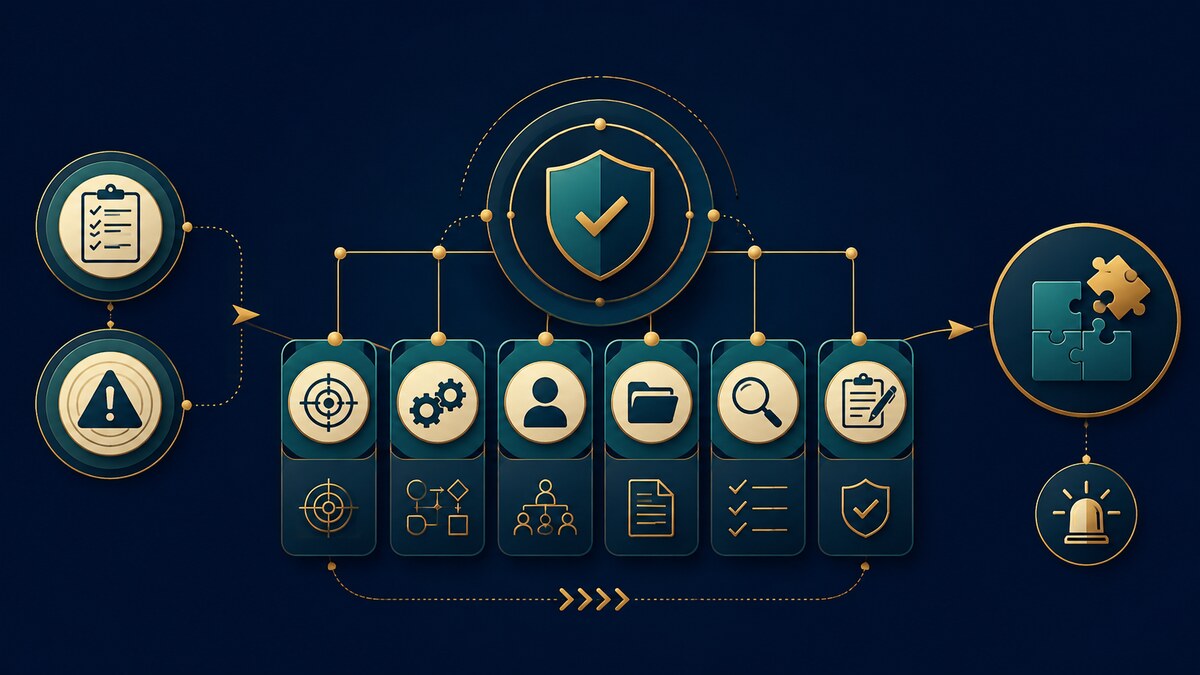
Control mapping is the highest-leverage skill in GRC and the one most job descriptions bury in a bullet. Done well, it means your company runs one test and satisfies four frameworks. Done badly, it means four teams collect four sets of screenshots for the same access review and nobody can explain why.
The work itself is unglamorous. You take an obligation, break it into what somebody actually has to do, find the mechanism that already does it, and write down honestly how well it fits.
Start with the clause, not the framework
People new to mapping try to map ISO 27001 to SOC 2 as whole documents. That never works, because the documents are organized around different ideas. Map at the level of the requirement.
Take access reviews. ISO/IEC 27001 Annex A control 5.18 covers access rights and their periodic review. SOC 2 asks for the same evidence under CC6.2 and CC6.3. Your internal access policy almost certainly says something similar in plainer English. That is three sources and one control activity: somebody reviews who has access to a system on a defined cycle, and keeps the record.
One quarterly review, evidenced once, answers all three. That is the entire economic argument for mapping, and it is the sentence to say in an interview.
Where mapping goes wrong
The mistake that costs the most is false equivalence: recording a partial fit as a full one because the words looked similar. Two clauses that both mention encryption are not the same requirement if one specifies data at rest and the other covers data in transit. When the auditor pulls the thread, the gap surfaces in fieldwork instead of in your register, which is the expensive place to find it.
The relationship is rarely one to one. A single change management control can support half a dozen requirements. A single requirement, like NIST SP 800-53 AC-2 on account management, needs provisioning, review, and deprovisioning, which are usually three separate activities owned by different people.
Write the partial fits down as partial. A map that admits "covers provisioning only, deprovisioning gap open" is worth more than one that claims full coverage and is wrong.
What the artifact looks like
A working map is a table, and the columns are the skill. Source requirement. The risk it addresses. The control objective in your own words. The activity that actually happens. Who owns it. How often. What evidence it leaves. How it gets tested. What is still missing.
Most people can produce the first four columns. Owner, frequency and evidence are where maps die, because those columns require you to go and ask someone, and the answer is often that nobody owns it.
Tools, and why they are not the skill
Archer, ServiceNow IRM, LogicGate, Hyperproof, Vanta and Drata all ship with pre-built crosswalks between the common frameworks. They are a reasonable starting point and a terrible finishing point, because a vendor crosswalk maps the standard to the standard. It cannot know that your company implements access review through a Jira workflow owned by a team that reorganized in March.
Interviewers know this. The question behind the question is whether you understand that the tool holds the map and you make it.
How to show it
Build one. Take a system you actually understand, pick two frameworks, and map ten requirements end to end with the honest gaps marked. Ten real rows beat a certificate in a conversation, because you can talk about the three that did not fit cleanly and why.
Where to go next
- Browse the jobs that use these skills
- Follow a career roadmap into the role you want
- Hiring for this? Start from a job description template
- Free certification study games, 652 practice questions
Frequently Asked Questions
What are control mapping skills?
Control mapping is the ability to connect an obligation, whether that is a regulation, a framework clause or an internal policy, to the specific control activity that addresses it, along with its owner, frequency, evidence and test. The skill is partly analytical, breaking a requirement into what someone must actually do, and partly investigative, since finding the real owner and the real evidence usually means interviewing people.
Why does control mapping matter so much in GRC?
Because it is where a compliance program either becomes efficient or collapses under its own weight. One well-mapped access review can satisfy ISO 27001, SOC 2 and your internal policy simultaneously. Without mapping, each framework is treated as separate work and the same evidence gets collected several times over.
What is a control crosswalk?
A crosswalk is a mapping between two or more frameworks, showing which clauses address the same underlying requirement. Most GRC tools ship with crosswalks between common frameworks. They are useful as a starting point but cannot reflect how your organization actually implements the control.
Can one control satisfy multiple frameworks?
Frequently, and that is the point. Conversely one requirement often needs several controls. NIST SP 800-53 AC-2 on account management typically requires separate provisioning, review and deprovisioning activities, often owned by different teams.
What is the most common control mapping mistake?
False equivalence. Recording a partial match as full coverage because the wording looked similar. Two clauses that both mention encryption are not the same requirement if one covers data at rest and the other data in transit. Record partial fits as partial, with the gap noted.
What tools are used for control mapping?
Archer, ServiceNow IRM, LogicGate, Hyperproof, Vanta and Drata are common. Plenty of real mapping still happens in Excel. Employers care much more about whether you understand the logic than which platform you have used, because the platform stores the map and you build it.
Do I need a certification to do control mapping?
No. CISA, CRISC and ISO 27001 Lead Implementer all cover the territory and help with screening, but a mapping you built yourself demonstrates more in an interview than a credential does, because you can discuss the requirements that did not fit cleanly.
How do I practice control mapping without a job?
Pick a system you genuinely understand, choose two frameworks, and map ten requirements through to owner, evidence and test, marking the gaps honestly. Ten real rows with three awkward cases you can explain is a portfolio piece.
What jobs require control mapping skills?
GRC analyst, compliance analyst, IT auditor, controls analyst, security compliance manager and AI governance roles applying ISO/IEC 42001 or the NIST AI RMF alongside existing security frameworks.
More in this series
- 9 Essential Data Governance Skills for the AI Era
- 10 Internal Audit Skills for Modern Assurance Careers
- 12 Transferable GRC Skills You May Already Have
- Technical vs. Nontechnical GRC Skills: What Employers Actually Need
- AI Governance Skills Employers Actually Hire For
- GRC Analyst Skills: What the Job Actually Requires
- Compliance Analyst Skills
- Risk Assessment Skills
- Controls Testing Skills
- Policy Writing Skills
- Regulatory Change Management Skills
- Third-Party Risk Skills
- Model Risk Management Skills
- AI Impact Assessment Skills
- AI Auditing Skills
- AI Evaluation and Testing Skills for Governance Careers
- Data Lineage Skills
- Data Quality Skills
- Privacy Engineering Skills
- AI Security Skills
- AI Incident Response Skills
- Governance Program Management Skills
- Stakeholder Communication Skills
- Executive Risk Reporting Skills
- Evidence Documentation Skills
- Framework Crosswalking Skills
- Vendor Due Diligence Skills
- Responsible AI Skills
- GRC Tools and Automation Skills
- How to Build the 9 Data Governance Skills: A 12-Month Career Plan
- 10 In-Demand Compliance Skills for Today’s GRC Careers
- 10 Essential Risk Management Skills Employers Value
- 10 In-Demand Data Privacy Skills for Privacy Professionals
- 10 Cybersecurity Skills for GRC and Security Careers
- 9 AI Assurance Skills for Audit, Risk, and Governance Professionals
- Writing a Resume for AI Cybersecurity Jobs
- Founder of ExecSearches and GRC Careers
- Executive search across corporate, higher education, financial services, and nonprofit sectors
- Focus on AI governance and GRC hiring
- More than a decade in risk advisory and internal audit in financial services
- Led SOX and regulatory audits for Citi, Goldman Sachs, Morgan Stanley, and McKesson
- Public Accounting Certification, Cornell University