
Home › Cybersecurity & GRC Career Guides › AI Evaluation and Testing Skills for Governance Careers
AI Evaluation and Testing Skills for Governance Careers
Of all the capabilities emerging in AI governance, evaluation may be the one that most cleanly separates candidates. It is also the one most often faked.
Plenty of people can say a system was tested. Far fewer can say what was tested, against what, to what standard, and what the result licenses you to do. That gap is where the career opportunity sits.
Key takeaways
- You do not need to write evaluation code, but you do need the vocabulary to read a result and judge whether it supports a release.
- A demo is not a test. The difference is a dataset, a threshold agreed in advance, and a documented failure mode.
- Evaluation has to be repeated, not performed once, because models, prompts, retrieval sources and providers all change underneath you.
- Organizations that evaluate systematically ship more AI, which is why this skill has commercial leverage rather than only assurance value.
What evaluation actually means here
Conventional software testing asks whether the system did the specified thing. Generative systems are open-ended, so the question becomes whether the behavior is acceptable across a range of inputs nobody enumerated in advance. That is a different exercise, and conventional pass/fail metrics do not fully cover it.
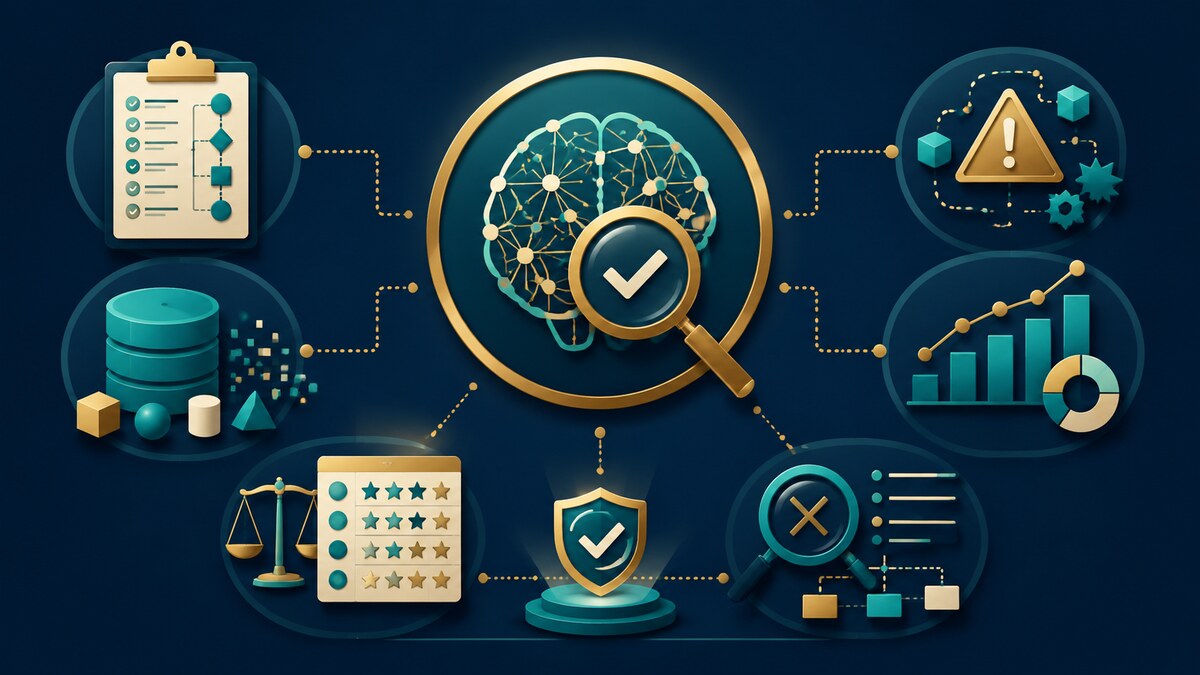
In practice an evaluation has four parts: a dataset of inputs that represents real use including the awkward cases, a definition of what a good output looks like, a threshold agreed before the test rather than after seeing the numbers, and a record of what happened that someone else could reproduce.
The vocabulary governance professionals need
Baselines and acceptance thresholds. What is the system being compared against, and what number was agreed as good enough before anyone ran it? A threshold set after seeing results is not a threshold.
Subgroup performance. Aggregate accuracy hides a great deal. A system at 94% overall can be at 71% for one population, and that is usually the finding that matters.
Groundedness and factuality. Whether outputs are supported by the source material the system was given, as distinct from whether they sound right.
Retrieval quality. For retrieval-augmented systems, most failures are retrieval failures wearing a generation costume. If the wrong document came back, the model was never going to answer well.
Hallucination and harmful-output testing. Deliberate probing for confident fabrication and for outputs that would cause harm if acted on.
Red teaming and prompt injection. Adversarial testing, including whether instructions embedded in retrieved content or user input can redirect the system's behavior.
Robustness, drift and regression. Whether performance holds under paraphrase and noise, whether it degrades over time as the world changes, and whether a change that fixed one thing broke another.
Human and automated evaluation. When a rubric-scored human review is required and when a model-graded automatic evaluation is defensible.
The question that separates real testing from theater
Ask: was the test run against the production configuration?
Systems are frequently evaluated in a notebook with a different prompt, a different model version, different retrieval settings and different tool permissions than what actually ships. The evaluation is real, and it describes a system that does not exist. Knowing to ask this one question puts you ahead of most people in the room.
Why this matters commercially
Databricks reports that organizations actively using AI evaluation tools get nearly six times more AI projects into production, and that organizations using AI governance put more than twelve times as many into production. Those figures are observed associations in their platform telemetry rather than proof of causation, and worth quoting with that caveat.
The direction still makes sense. An organization that cannot evaluate its systems cannot honestly approve them, so it either ships without knowing or does not ship at all. Evaluation is what turns a governance function from a brake into a gate that opens.
Turning evaluation into governance
An evaluation result is only useful if it connects to a decision. That connection is the governance skill: which behaviors must be tested before release, what result blocks a launch, what result requires a mitigation instead, what threshold triggers a rollback in production, and who is notified when monitoring crosses it.
Write those conditions down before the test, not after. An evaluation plan that names its release conditions in advance is the artifact employers are looking for, and it is what our GRC tools and automation skills guide describes wiring into a platform.
How to prove this skill
Pick a use case, such as a support agent answering account questions from a knowledge base. Write the evaluation plan: the behaviors to test, the dataset you would assemble and why, acceptance criteria with numbers, the failure modes you would deliberately probe, the subgroups you would break results out by, the red-team cases, the release conditions, and the monitoring thresholds after launch.
You can write that without touching Python. It demonstrates that you know what a defensible test looks like, which is what the governance role is actually for. See AI audit jobs and AI assurance jobs for where the skill is being hired.
Where to go next
- Browse the jobs that use these skills
- Follow a career roadmap into the role you want
- Hiring for this? Start from a job description template
- Free certification study games, 652 practice questions
Frequently Asked Questions
What is AI evaluation?
Testing whether an AI system's behavior is acceptable across realistic inputs, rather than whether it performed one specified function. It requires a representative dataset, a definition of a good output, an acceptance threshold agreed before the test, and a reproducible record of what happened.
Do I need Python to work in AI evaluation?
To build and run evaluations, usually yes. To govern them, no. Governance professionals need the vocabulary to read a result and judge whether it supports a release decision. Writing an evaluation plan with datasets, thresholds, failure modes and release conditions requires no code at all.
What is the difference between a demo and a test?
A demo shows the system succeeding on inputs someone chose. A test runs it against a dataset that includes the awkward cases, measures against a threshold agreed in advance, breaks results out by subgroup, and records what failed. If the threshold was set after seeing the numbers, it was a demo.
What should I ask when someone says a model was tested?
Ask what was tested, against which dataset, which failure modes were included, what counted as acceptable performance, and whether the test ran against the production configuration. That last one catches the most problems, because systems are often evaluated with a different prompt, model version or tool permissions than what ships.
What is prompt injection and why does it appear in evaluation?
It is when instructions embedded in user input or retrieved content redirect the system's behavior. It matters in evaluation because a system that behaves well on cooperative inputs can behave very differently on adversarial ones, and agents with tool access can be induced to take real actions.
Why does subgroup performance matter more than overall accuracy?
Because aggregate numbers hide the findings that create legal and reputational exposure. A system at 94% overall can sit at 71% for one population. Regulators, auditors and affected users all care about the second number, and it never appears unless someone breaks the results out.
Does evaluation really help organizations ship more AI?
Databricks reports that organizations using AI evaluation tools get nearly six times more projects into production, and those using AI governance more than twelve times as many. Those are observed associations in their platform telemetry, not proof of causation, but the logic holds: teams that cannot measure behavior cannot confidently approve it.
How do I show evaluation skills without a job that involves it?
Write a complete evaluation plan for one realistic use case. Name the behaviors to test, the dataset you would assemble, numeric acceptance criteria, the failure modes you would probe, the subgroups you would report separately, the red-team cases, the conditions that would block release, and the monitoring thresholds after launch.
More in this series
- 9 Essential Data Governance Skills for the AI Era
- 10 Internal Audit Skills for Modern Assurance Careers
- 12 Transferable GRC Skills You May Already Have
- Technical vs. Nontechnical GRC Skills: What Employers Actually Need
- AI Governance Skills Employers Actually Hire For
- GRC Analyst Skills: What the Job Actually Requires
- Compliance Analyst Skills
- Risk Assessment Skills
- Controls Testing Skills
- Policy Writing Skills
- Regulatory Change Management Skills
- Third-Party Risk Skills
- Model Risk Management Skills
- AI Impact Assessment Skills
- AI Auditing Skills
- Data Lineage Skills
- Data Quality Skills
- Privacy Engineering Skills
- AI Security Skills
- AI Incident Response Skills
- Governance Program Management Skills
- Stakeholder Communication Skills
- Executive Risk Reporting Skills
- Evidence Documentation Skills
- Control Mapping Skills
- Framework Crosswalking Skills
- Vendor Due Diligence Skills
- Responsible AI Skills
- GRC Tools and Automation Skills
- How to Build the 9 Data Governance Skills: A 12-Month Career Plan
- 10 In-Demand Compliance Skills for Today’s GRC Careers
- 10 Essential Risk Management Skills Employers Value
- 10 In-Demand Data Privacy Skills for Privacy Professionals
- 10 Cybersecurity Skills for GRC and Security Careers
- 9 AI Assurance Skills for Audit, Risk, and Governance Professionals
- Writing a Resume for AI Cybersecurity Jobs
- Founder of ExecSearches and GRC Careers
- Executive search across corporate, higher education, financial services, and nonprofit sectors
- Focus on AI governance and GRC hiring
- More than a decade in risk advisory and internal audit in financial services
- Led SOX and regulatory audits for Citi, Goldman Sachs, Morgan Stanley, and McKesson
- Public Accounting Certification, Cornell University